TL;DR
Apple has discontinued the $599 Mac Mini with 256GB storage, raising the starting price to $799 with 512GB, as a global DRAM shortage driven by AI data centre demand causes record memory price increases. DRAM prices surged 90 per cent in Q1 2026 as Samsung, SK Hynix, and Micron shifted production toward high-bandwidth memory for AI servers, with IDC projecting 10-20 per cent consumer electronics price increases and an 11.3 per cent PC market contraction by year end.
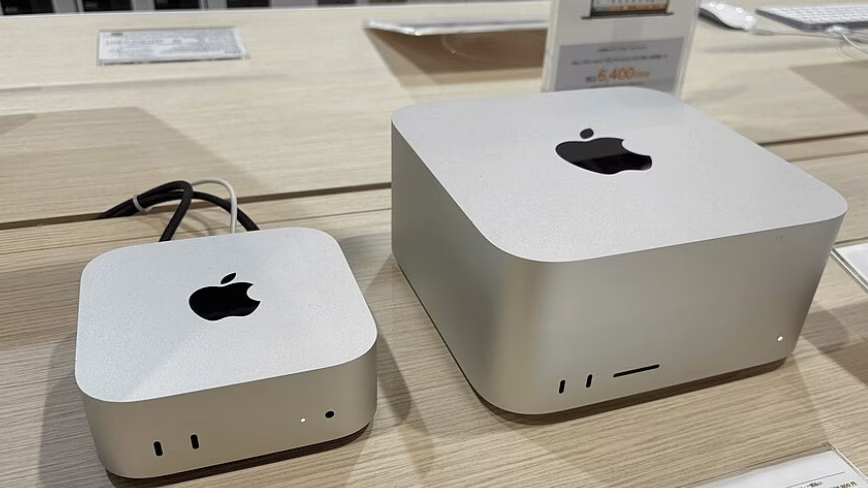
Apple has discontinued the 256 gigabyte Mac Mini worldwide. The company’s cheapest desktop computer, the M4 Mac Mini with 16 gigabytes of RAM and 256 gigabytes of storage, was available for $599 until last week. It is gone. The Mac Mini now starts at $799 with 512 gigabytes of storage. The 256 gigabyte configuration has not been moved to a different price point. It has been removed from Apple’s configurator entirely. The most affordable entry into Apple’s desktop line-up has been eliminated, and the reason has nothing to do with product strategy. It has everything to do with the global memory market and the insatiable demand for DRAM from AI data centres.
The shortage
The Mac Mini and Mac Studio began going out of stock in April, with high-RAM configurations disappearing from Apple’s online store weeks before the discontinuation was made official. Apple CEO Tim Cook said during the company’s most recent earnings call that both products “may take several months to reach supply demand balance.” The Mac Studio’s 512 gigabyte RAM upgrade option has been removed entirely. The price of upgrading from 96 gigabytes to 256 gigabytes of RAM on the Mac Studio has increased from $1,600 to $2,000, a 25 per cent rise. These are not product refreshes. They are supply chain adaptations to a memory market that has moved sharply against consumer electronics.
DRAM contract prices surged approximately 90 per cent in the first quarter of 2026 compared with the fourth quarter of 2025, according to TrendForce, the largest quarterly increase on record. PC DRAM prices rose by more than 100 per cent in the same period. The cause is structural: Samsung, SK Hynix, and Micron, the three companies that manufacture nearly all of the world’s DRAM, have shifted the overwhelming majority of their production capacity toward high-bandwidth memory for AI servers. HBM now consumes 23 per cent of total DRAM wafer output, up from 19 per cent in 2025, and producing a single bit of HBM requires approximately three times the wafer capacity of standard DDR5. Every additional AI server that goes online takes memory away from laptops, desktops, tablets, and smartphones.
The cause
Oracle required PIMCO to anchor a $10 billion tranche of a $16.3 billion data centre financing deal after US banks retreated from the scale of commitment required, and that single transaction illustrates the magnitude of capital flowing into AI infrastructure. Combined capital expenditure across the five largest hyperscalers, Microsoft, Google, Amazon, Meta, and Oracle, is on track to exceed $650 billion in 2026. Nearly all of it goes to data centres, GPUs, custom silicon, and the networking infrastructure that connects them. The AI buildout is the largest corporate investment programme in history outside of wartime mobilisation, and it is consuming physical resources, electricity, land, water, and memory chips, at a rate that the supply chain was not built to sustain.
HBM demand is projected to grow 70 per cent year on year in 2026, driven by Nvidia’s next-generation AI accelerators and the expansion of data centre deployments across North America, Europe, and Asia. Google is assembling a multi-partner chip supply chain with Broadcom, MediaTek, and Marvell to build AI inference chips, and every one of those chips needs HBM. The memory manufacturers have responded rationally to the incentive structure: HBM commands significantly higher margins than consumer DRAM, so production has been reallocated accordingly. The consequence is that every device that uses standard DRAM, from the Mac Mini to the cheapest Android phone, now competes for a shrinking share of global wafer capacity.
The cost
IDC projects that PCs, tablets, and smartphones could see price increases of 10 to 20 per cent by the end of 2026, making this potentially the most expensive year for consumer electronics in recent memory. TrendForce estimates that a mainstream notebook with a $900 retail price could see its cost structure increase by nearly 40 per cent when accounting for both memory and CPU price increases, though the retail price passed to consumers would be somewhat lower due to manufacturer margin compression. The PC market faces an 11.3 per cent contraction in 2026, according to IDC, as rising component costs push average selling prices beyond what many consumers and businesses are willing to pay.
Apple’s response has been to eliminate the configurations that are most sensitive to component cost increases. A 256 gigabyte Mac Mini at $599 was already Apple’s lowest-margin desktop product. With DRAM prices doubling and storage costs rising in parallel, maintaining that price point would have required either selling the product at a loss or reducing the specification below what Apple considers acceptable. Apple chose to remove the product entirely rather than raise its price or degrade its quality. The result is a $200 increase in the minimum cost of buying a Mac desktop, absorbed entirely by the customer.
Mark Zuckerberg told Meta employees that the company’s May layoffs were driven by AI capital spending, not by AI productivity gains, and the dynamic playing out in consumer hardware is the other side of the same equation. The companies building AI infrastructure are spending hundreds of billions of dollars on the chips, memory, and compute that power their models. The companies building consumer products are paying the price in higher component costs, constrained supply, and the disappearance of affordable configurations that were possible when memory was cheap and plentiful.
The trajectory
The DRAM shortage is not expected to ease in 2026. New fabrication capacity takes two to three years to come online, and the memory manufacturers have signalled that their investment priorities will continue to favour HBM and server DRAM over consumer products for the foreseeable future. The US government’s CHIPS Act investments, including a stake in Intel now worth $36 billion, are aimed at expanding domestic semiconductor manufacturing capacity, but the near-term effect on DRAM supply is minimal. The CHIPS Act funds are directed primarily at logic chip fabrication, not memory. The three DRAM manufacturers are all headquartered in South Korea and Japan, and their capacity expansion plans are driven by AI server demand, not by government incentives to produce cheaper laptop memory.
Apple is better positioned than most to absorb the shock. The company designs its own chips, controls its supply chain with unusual precision, and has the negotiating leverage to secure memory allocations that smaller manufacturers cannot. If Apple is discontinuing products and raising prices, the rest of the PC industry is in worse shape. Dell, HP, Lenovo, and every other Windows PC manufacturer faces the same DRAM cost increases without Apple’s margin structure or supply chain control. The $599 Mac Mini was not a product that Apple wanted to kill. It was the most accessible computer the company made, the machine that brought new customers into the Mac ecosystem at the lowest possible price. Its disappearance is not a business decision. It is a consequence of a memory market that has been reshaped by AI infrastructure spending at a scale that the consumer electronics industry cannot absorb without passing the cost to the people who buy its products.
The AI boom has produced extraordinary financial returns for the companies building it: trillion-dollar valuations, record revenues, and capital expenditure programmes that dwarf the GDP of most countries. It has also, quietly and without much public attention, made computers more expensive. The $599 Mac Mini is gone. The memory that would have gone into it is in a data centre somewhere, helping train a model that might one day be useful. Whether that trade-off is worth it depends on which side of the transaction you are on.


 Credit: Kyu3a