TL;DR
Silicon Valley has spent more than 25 million dollars backing San Jose mayor Matt Mahan for California governor, with donors including Sergey Brin, Reed Hastings, and Steve Huffman, but he is polling at four per cent with the June 2 primary less than four weeks away. The campaign is part of the tech industry’s broader push to reshape California politics, including a proposed 500 million dollar endowment and opposition to a billionaire wealth tax ballot measure.
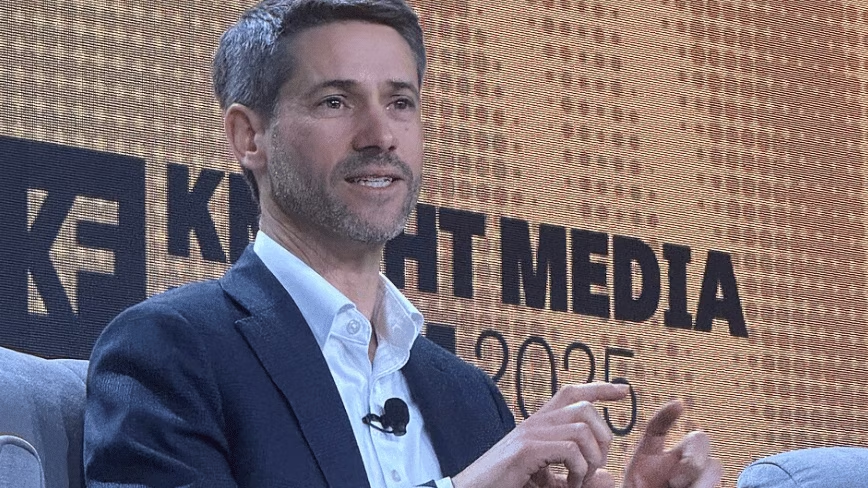
Silicon Valley has spent more than 25 million dollars trying to make one of its own the next governor of California. The candidate is polling at four per cent. The June 2 primary is less than four weeks away. And the most instructive thing about the campaign of Matt Mahan, the 43-year-old mayor of San Jose who entered the race in January backed by Google co-founder Sergey Brin, Netflix co-founder Reed Hastings, Reddit chief executive Steve Huffman, and a constellation of venture capitalists who collectively represent hundreds of billions of dollars in assets, is not that Silicon Valley is trying to buy political power. It is that political power, unlike market share, does not appear to respond to capital injection at the rate the industry is accustomed to.
The candidate
Mahan’s biography reads like an origin story designed in a product management meeting. He graduated from Harvard, where he was a classmate of Mark Zuckerberg, who he has said persuaded him to go into technology instead of law school. He joined Causes, one of the earliest Facebook applications, which allowed users to form groups around nonprofits, and rose from director of nonprofit partnerships to chief executive while the platform attracted more than 186 million users in 157 countries. In 2014, he co-founded Brigade, a nonpartisan civic engagement platform backed by Sean Parker, Ron Conway, and Marc Benioff, which was later acquired by Pinterest. He was elected mayor of San Jose in 2022. He announced his candidacy for governor on 29 January 2026, and within weeks, the money was pouring in.
His campaign has raised 14 million dollars directly, more than any candidate in the race except Tom Steyer, the billionaire climate investor who has self-funded more than 147 million dollars and is on track to run the most expensive gubernatorial campaign in California history. But the independent expenditure committee California Back to Basics, which is legally prohibited from coordinating with Mahan’s campaign, has spent nearly 20 million dollars introducing him to voters outside San Jose, including a 1.5 million dollar Super Bowl advertisement. The committee’s largest donors include Michael Moritz, the venture capitalist, who has given three million dollars, and Michael Seibel, the former Y Combinator chief executive, who has contributed one million. Mahan has received the maximum 39,200 dollar individual donation from Brin, Hastings, Palantir co-founder Joe Lonsdale, and Parker, among others.
The field
The problem is that 25 million dollars does not go as far in a 61-candidate primary as it does in a Series A. A SurveyUSA poll conducted between 28 April and 1 May put Steve Hilton, the former Fox News host endorsed by Donald Trump, at 20 per cent. Steyer was at 18 per cent. Xavier Becerra, the former attorney general who has surged since congressman Eric Swalwell withdrew in mid-April, was at 10 per cent. Mahan and former Los Angeles mayor Antonio Villaraigosa were tied at four per cent. State superintendent Tony Thurmond was at one per cent. California operates a nonpartisan top-two primary in which the two candidates with the most votes, regardless of party, advance to the November general election. The likely outcome is a Hilton-Steyer or Hilton-Becerra runoff, and Mahan’s path to the top two is narrow enough to qualify as a rounding error.
The entanglement of technology wealth and political power has become the defining feature of American governance in 2026, from Elon Musk’s role leading the Department of Government Efficiency to the venture capitalists who maxed out donations to both Mahan and Hilton as a hedge. Lonsdale and Brin have given to both candidates. The bipartisan hedging is standard practice in venture capital, where the objective is not ideological alignment but regulatory optionality. What is unusual about the Mahan campaign is the scale of the bet on a single candidate and the speed with which the thesis appears to be failing. In venture terms, Back to Basics has a burn rate of approximately five million dollars per month and a user acquisition cost, measured in polling points, that would get a startup’s board to convene an emergency meeting.
The strategy
The logic behind the Mahan candidacy extends beyond one election. Silicon Valley has been seething over what it perceives as a hostile regulatory environment in Sacramento, and the 2026 cycle has given the industry an opportunity to push back on multiple fronts simultaneously. Y Combinator, the startup accelerator whose leadership has become increasingly vocal about California policy, represents one node of the network. Its former chief executive, Seibel, is the largest individual donor to Back to Basics. Its current chief executive, Garry Tan, is reportedly among the organisers of California Renewal, a proposed endowment-style fund that aims to raise 500 million dollars, and potentially up to one billion, to finance political activity across election cycles. The fund would give the technology billionaire class a permanent instrument for countering labour unions, progressive advocacy groups, and the ballot initiatives they support.
The most immediate target is a proposed ballot measure for November 2026 that would impose a one-time five per cent tax on billionaires’ accumulated wealth to fund healthcare, food assistance, and public education. The measure’s sponsors announced in April that they had collected 1.6 million signatures, nearly double the 874,641 required to qualify for the ballot. Governor Gavin Newsom has publicly opposed the tax. Tech donors who are backing Mahan are also funding the campaign against the wealth tax. The governor’s race and the ballot measure are two fronts of the same war, and the candidate who wins the governor’s mansion will either sign or veto the legislation that follows. Mahan has positioned himself as a pragmatic moderate who is unafraid to challenge his own party, telling the CNN debate audience on 5 May that he is “the only Democrat in this race who has challenged the establishment within my own party to demand better results.” He has said he supports taxing technology companies to fund workforce retraining but opposes regulating them out of the state.
The pattern
Silicon Valley’s integration into American governance has accelerated since 2025, producing a constellation of technology leaders in government roles and a political class that increasingly speaks the language of product management and disruption. The pattern at the federal level, where Musk’s DOGE operation cancelled more than 10,000 federal contracts and the Trump administration installed technology executives across agencies, is now being replicated at the state level. But California’s political dynamics are different from Washington’s. The state’s Democratic supermajority, its powerful public-sector unions, and its electorate’s demonstrated appetite for progressive ballot measures create a structural environment in which money is a necessary but insufficient condition for political influence. Meg Whitman, the former eBay chief executive, spent 178 million dollars on her 2010 gubernatorial campaign and lost to Jerry Brown by 13 points. Carly Fiorina, the former Hewlett-Packard chief executive, lost her 2010 Senate race to Barbara Boxer. The technology industry’s track record of converting capital into California political power is, historically, poor.
The technology industry’s relationship with the workforce it is displacing has become a central political question, and Mahan’s candidacy sits at its centre. More than 78,000 technology workers were laid off in the first four months of 2026, with nearly half of those cuts attributed to artificial intelligence replacing human roles. Mahan has said he deployed AI in San Jose’s city government and claims to be the only candidate with experience both using and regulating the technology, but his donor base is composed of the same executives whose companies are eliminating the jobs. The tension between Mahan’s message of pragmatic moderation and the interests of his financial backers is the tension at the heart of the technology industry’s political project: it wants a seat at the table in a state where its decisions are putting people out of work, and it wants the people it is putting out of work to vote for its candidate.
The question
Venture capital’s priorities are shifting, from software to deep tech, from consumer applications to industrial infrastructure, from the weightless economy to the physical one. The political priorities are shifting too. Silicon Valley spent two decades treating Sacramento as an irrelevance, a state capital that could be managed through occasional lobbying and the implicit threat of relocation. The proposed wealth tax, the AI regulation debates, and the growing public scepticism about the industry’s social contract have changed that calculation. The 25 million dollars behind Matt Mahan, the 500 million dollar California Renewal endowment, and the tens of millions more flowing into legislative races and ballot measure campaigns represent the industry’s most concerted attempt to reshape the politics of the state where most of its companies are headquartered.
The early returns are not encouraging. Mahan is a credible candidate with a coherent message and a genuine record of municipal governance. He is also polling behind a self-funded billionaire who has spent 132 million dollars, a former Fox News host endorsed by the president, and a former attorney general who entered the race with statewide name recognition. The June 2 primary will determine whether 25 million dollars in technology money can overcome the structural advantages of personal wealth, presidential endorsement, and political incumbency. The polling suggests it cannot. But the technology industry has never evaluated an investment on the basis of a single quarter, and the infrastructure being built around the Mahan campaign, the donor networks, the PAC structures, the endowment, is designed to outlast any individual candidate. Silicon Valley is not trying to win a governor’s race. It is trying to build a political machine. The governor’s race is just the minimum viable product.


 Credit: Jennifer 8. Lee