TL;DR
Peter Arnell, the designer behind the Pepsi logo strategy document and the Tropicana redesign that caused a 20 per cent sales drop, has been appointed America’s first chief brand architect. He will lead the branding of 27,000 government websites under a July 4 deadline, working from the Eisenhower Executive Office Building for a National Design Studio already criticised for accessibility failures and AI-generated code.
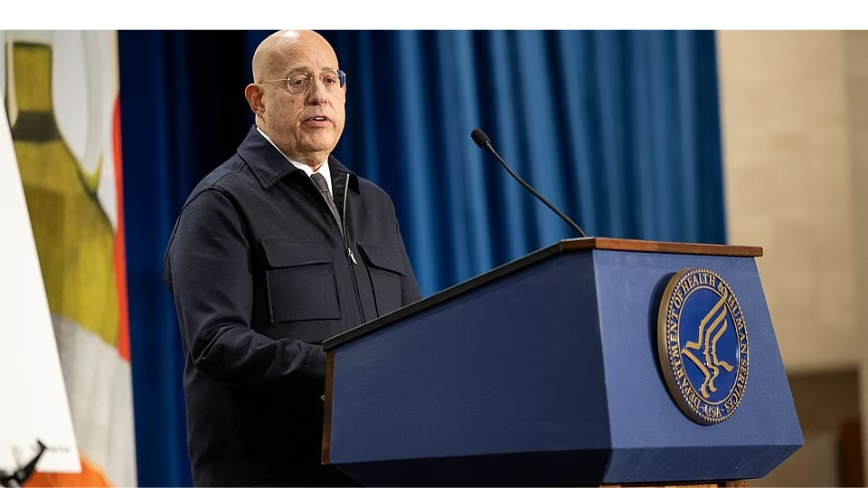
The United States government now has a chief brand architect. Peter Arnell, the designer whose four-decade career includes creating the DKNY brand identity, redesigning the Pepsi logo in a project accompanied by a 27-page strategy document that referenced the Mona Lisa and the Parthenon, and overseeing the Tropicana packaging redesign that caused a 20 per cent sales collapse and was reversed within weeks, has been appointed to lead the strategic and creative development of a unified brand system for the federal government. Joe Gebbia, the Airbnb co-founder who serves as America’s first chief design officer, announced the hire on Monday at the Wall Street Journal’s Future of Everything conference. Arnell will work from the Eisenhower Executive Office Building, joining a National Design Studio tasked with redesigning 27,000 government websites by a July 4 deadline that is now less than two months away.
The studio
The National Design Studio was established by executive order in August 2025 under the “America by Design” initiative, which directed federal agencies to make their public-facing digital and physical services “useable and beautiful.” Gebbia, who left his operating role at Airbnb in 2022 and subsequently joined Tesla’s board, was appointed chief design officer with a mandate to overhaul the government’s online presence. He had initially been expected to join the Department of Government Efficiency but sought his own office. His stated ambition was to make government services feel like the Apple Store: beautifully designed, with a great user experience, running on modern software. The executive order gives agencies until 4 July 2026 to produce initial results in both web and physical space improvements.
The studio has moved quickly. It has recruited Silicon Valley design and software engineering talent, launched redesigned versions of several government websites, and led DOGE’s project to build a fully online retirement application system for federal employees at the Office of Personnel Management. It has also attracted criticism. NOTUS reported that three of the studio’s websites failed accessibility audits conducted by Equalize Digital, with low-contrast text and broken heading structures that could violate Section 508 of the Rehabilitation Act, which mandates that government websites be accessible to people with disabilities. The MAHA nutrition website launched with an acknowledgement that its content was “undergoing a Section 508 review.” Accessibility specialist Anna Cook examined code for the AmericaByDesign.gov site and flagged what she described as a heavy reliance on unedited AI-generated content, warning that AI-written code using outdated techniques could introduce security vulnerabilities.
The architect
Arnell’s appointment as chief brand architect adds a layer of complexity to an already controversial initiative. The history of brand redesign is littered with expensive failures, and Arnell has been at the centre of two of the most prominent. In 2008, PepsiCo hired Arnell Group to redesign the Pepsi logo and Tropicana packaging. The Pepsi project produced a strategy document that became a case study in branding excess, invoking the golden ratio, gravitational fields, and centuries of design history to justify a subtle rotation of the existing logo. The Tropicana redesign replaced the brand’s iconic orange-with-a-straw imagery with a minimalist design that consumers found generic and unrecognisable. Sales dropped 20 per cent. PepsiCo reversed the packaging within two months. Arnell later told CBS News that the Pepsi logo he designed was “bullshit” and that the Tropicana debacle was “not my brand.”
Arnell left Omnicom in 2011 after disputes with the company and founded Intellectual Capital Investments. His career since has been quieter. The government appointment represents a return to prominence and, for the first time, a client whose brand identity is not a commercial proposition but a civic one. The distinction matters. The challenges of design in the AI era are substantial even for private companies, where the consequences of a failed rebrand are measured in quarterly earnings. For a government, the consequences are measured in whether citizens can access the services they need.
The context
The National Design Studio exists within a broader pattern of Silicon Valley’s integration into the Trump administration’s governing apparatus. The relationship between Silicon Valley and the Trump White House has produced a constellation of tech leaders in government roles: Elon Musk led DOGE before stepping down in May 2025, David Sacks serves as special adviser for AI and cryptocurrency, and a September 2025 White House dinner gathered 33 Silicon Valley leaders including Sam Altman, Mark Zuckerberg, Tim Cook, and Bill Gates. Gebbia, a former Democratic donor who has said he voted for Trump and supports the Make America Healthy Again movement, represents the design wing of this convergence.
The studio’s approach raises questions that extend beyond aesthetics. The previous government technology organisations, the United States Digital Service and 18F, were built on a philosophy of civic technology: bringing Silicon Valley methods to government with an emphasis on user research, accessibility, iterative testing, and inclusive design. USDS was reorganised into the U.S. DOGE Service and lost the majority of its experienced staff. 18F was eliminated entirely in March 2025, its 450 projects and 11 years of institutional knowledge dispersed. The National Design Studio has filled part of the gap left by their removal, but with a different ethos. Where USDS and 18F prioritised function, accessibility, and the needs of underserved populations, the studio’s mandate emphasises beauty, delight, and the visual language of consumer technology. The distinction is not trivial when the users include veterans navigating disability claims, elderly citizens applying for Social Security, and non-English speakers seeking immigration information.
The question
The challenge of making complex technology usable for ordinary people is well understood in the design industry, where the consensus is that if an interface requires users to learn how the system thinks, the architecture has failed. Government websites have historically failed this test by a wide margin. The federal web estate is a patchwork of decades-old systems, inconsistent design languages, and navigation structures that reflect the organisational chart of agencies rather than the needs of the people trying to use them. The ambition to fix that is not controversial. The question is whether the fix being implemented prioritises the people who most need government services or the people who are least likely to struggle with a well-designed consumer interface.
AI-assisted development has accelerated the speed at which websites can be built, but it has also introduced quality and security concerns that the National Design Studio’s own launches have illustrated. The studio’s federal chief information officer has acknowledged using AI to perform “complete website redesigns,” and the accessibility failures flagged by independent auditors suggest that the speed of deployment is outpacing the rigour of testing. Arnell’s role as chief brand architect adds a strategic branding layer to an initiative that is already struggling with the fundamentals of code quality, accessibility compliance, and inclusive design. Unifying the visual identity of 27,000 government websites is a monumental task. Doing it in less than two months, with AI-generated code, under the creative direction of a designer whose most famous projects include one of the most expensive branding failures in consumer goods history, while the government’s most experienced civic technologists have been fired, is either an act of extraordinary ambition or an exercise in the kind of branding spectacle that Arnell has spent a career producing. The July 4 deadline will determine which.


 Credit: USDAgov