TL;DR
Tesla is selling Shanghai-made Model 3 sedans in Canada at C$39,490, nearly half the C$79,990 price of the Fremont-sourced model, after Prime Minister Carney’s January 2026 trade deal with Beijing cut Chinese EV tariffs from 100 per cent to 6.1 per cent under a quota of 49,000 vehicles. Tesla is the first company to exploit the deal, which also opens the Canadian market to BYD and other Chinese EV manufacturers.
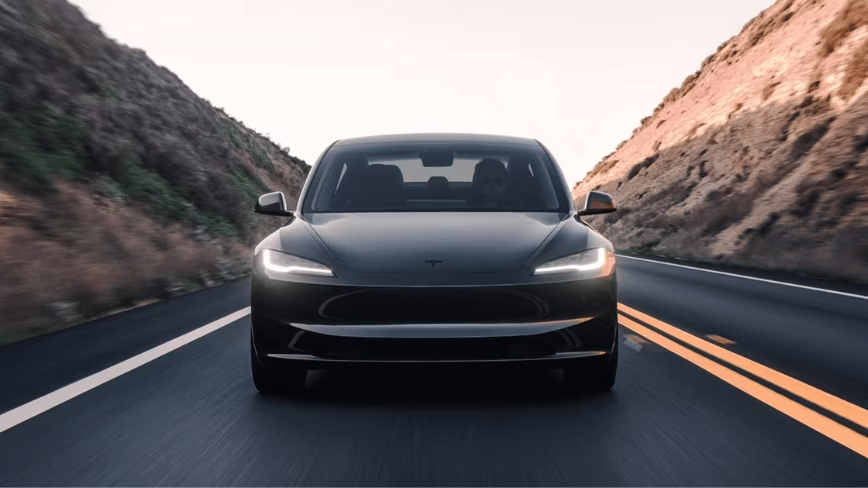
Tesla is now selling Chinese-made Model 3 sedans in Canada at the lowest price the car has ever been offered in the country. The Model 3 Premium RWD, manufactured at Giga Shanghai, starts at C$39,490, roughly US$29,000. Two months ago, the cheapest Model 3 available in Canada was the Long Range AWD built at Tesla’s Fremont factory in California, priced at C$79,990. The price has been cut nearly in half, and the car is now made on a different continent. The reason is not a product redesign or a manufacturing breakthrough. It is a tariff deal that Prime Minister Mark Carney struck with Beijing in January 2026, and the first company to exploit it is the one run by the man closest to the US president who started the trade war that made the deal necessary.
The deal
Canada imposed a 100 per cent surtax on Chinese-made electric vehicles in October 2024, matching the tariff the United States had applied earlier that year. The broader US-China technology competition has produced tariff walls across semiconductors, AI, and electric vehicles, and the EV surtax was part of that pattern: a policy designed to protect domestic and North American automakers from the cost advantage that Chinese EV manufacturers, powered by vertically integrated battery supply chains and lower labour costs, had built over the previous decade. Tesla, which had been shipping Shanghai-made Model 3s to Canada, switched its Canadian supply to the Fremont factory.
Then the trade environment shifted. In early 2025, Canada imposed 25 per cent counter-tariffs on US-made vehicles in response to American tariffs on Canadian goods. The Fremont-sourced Model 3 Long Range AWD, already expensive at Canadian exchange rates, became untenable at C$79,990. Tesla was caught between a 100 per cent tariff on its Chinese-made cars and a 25 per cent tariff on its American-made ones. Neither supply route was economically viable at a price that Canadian consumers would accept.
In January 2026, Carney visited Beijing and signed what he called a “preliminary but landmark” trade agreement. Canada reduced the tariff on Chinese-made EVs from 100 per cent to 6.1 per cent, the standard most-favoured-nation rate, under a quota of 49,000 vehicles for the first half of 2026. A second allocation of 24,500 vehicles covers September through February 2027. The quota will expand to 70,000 vehicles annually by 2030. In exchange, China lowered tariffs on Canadian canola seed from approximately 85 per cent to 15 per cent and removed anti-discrimination tariffs on Canadian lobster, crab, and peas. It was a trade deal in the oldest sense: agricultural commodities for manufactured goods, negotiated bilaterally while the country that used to broker such agreements was busy imposing tariffs on both parties.
The arbitrage
Tesla moved immediately. The Shanghai-built Model 3 Premium RWD, with 463 kilometres of range and a 4.2-second sprint to 100 km/h, entered the Canadian market on 1 May at C$39,490 with a 6.1 per cent import duty. The Model 3 Performance, also sourced from Shanghai, was repriced at C$74,990, a 17 per cent reduction. First deliveries are expected in May or June. The Shanghai-built cars do not qualify for Canada’s C$5,000 Electric Vehicle Affordability Program rebate, which requires manufacture in a free-trade partner country. China is not one. The price is low enough that the absence of the rebate is unlikely to deter buyers.
Giga Shanghai delivered 851,000 electric vehicles in 2025, more than half of Tesla’s total global production, and has now built more than four million cars since it opened. The factory’s cost advantage over Fremont is structural: lower labour costs, a more efficient supply chain, and proximity to the battery materials and component manufacturers that dominate global EV production. When the tariff differential between Chinese-made and American-made vehicles narrows enough, as it has in Canada, Shanghai becomes the obvious source. Tesla is not choosing China over America for ideological reasons. It is choosing the factory that makes the car cheaper.
The competition
The 49,000-vehicle quota is not reserved for Tesla. BYD, Geely, SAIC, and every other Chinese EV manufacturer can apply for import permits under the same terms. BYD’s Atto 3, Dolphin, and Seal models, which compete directly with the Model 3 on price and specification, could enter Canada at prices significantly below their current availability through grey-market imports. The quota is small, roughly 3 per cent of the Canadian auto market, but it opens a channel that did not exist six months ago.
Tesla’s advantage is speed. It has the factory capacity, the logistics infrastructure, and the regulatory certifications to begin shipping immediately. Chinese automakers that have not previously sold in Canada will need to establish service networks, obtain Canadian safety certifications, and build dealer or direct-sales channels before they can compete for quota allocations. Tesla will likely capture a disproportionate share of the initial quota simply because it is the only manufacturer ready to ship on day one.
Tesla recently became the first company to receive approval for Full Self-Driving Supervised in Europe, starting with the Netherlands, and the company’s strategy of seeking regulatory approvals in individual markets while its competitors navigate slower bureaucratic processes is being replicated in Canada. Tesla is not waiting for the competitive landscape to develop. It is taking the quota before anyone else can.
The irony
The geopolitical context is difficult to ignore. Elon Musk spent much of 2025 embedded in the Trump administration’s Department of Government Efficiency, an association that triggered boycotts across Europe and contributed to a 28 per cent decline in Tesla’s European sales. The US EV market itself shrank 28 per cent in the first quarter of 2026 after federal tax credits expired, pushing Tesla’s average selling price up to $45,343 as the company prioritised margins over volume. The American market that Musk helped shape through his political proximity is now one of Tesla’s most challenging.
Canada, meanwhile, is offering Tesla a lifeline through a trade deal with the country that the Trump administration has spent two years trying to economically isolate. The C$39,490 Model 3 exists because Canada broke with American trade policy and negotiated directly with Beijing. Tesla, the company most closely associated with the current US administration, is the first and most aggressive beneficiary of that decision. The car arrives in Canadian driveways carrying a “Made in China” label, a 6.1 per cent Canadian tariff, and the implicit acknowledgment that the global EV supply chain runs through Shanghai whether Washington wants it to or not.
The signal
Europe is dismantling its own regulatory framework to compete with America, and Canada’s deal with Beijing follows the same logic from a different direction: countries that feel squeezed by American trade policy are building alternative relationships that bypass Washington entirely. The Carney-Beijing agreement is small in absolute terms, covering fewer than 50,000 vehicles in its first year, but it establishes a precedent. If Chinese EVs can enter Canada at 6.1 per cent, other countries will negotiate similar terms. The 100 per cent tariff wall that the United States and its allies built in 2024 is developing cracks, and the first company through the gap is Tesla.
The Model 3 at C$39,490 is now one of the cheapest electric vehicles available in Canada. It offers more range, faster acceleration, and a more established charging network than any comparably priced competitor. It is also a Chinese-manufactured product entering a North American market through a tariff loophole that exists because Canada decided that its economic relationship with China was more valuable than its alignment with American trade policy. Tesla did not create that loophole. But it is exploiting it faster than anyone else, and the 49,000-vehicle quota will not last long once BYD, Geely, and the rest of China’s EV industry realise that the Canadian market is open for business at a price they can profitably serve.


 Credit: Tesla