The company that outsells Tesla on humanoid robots just unveiled a pilotable mecha. Unitree is filing for a $7 billion IPO.
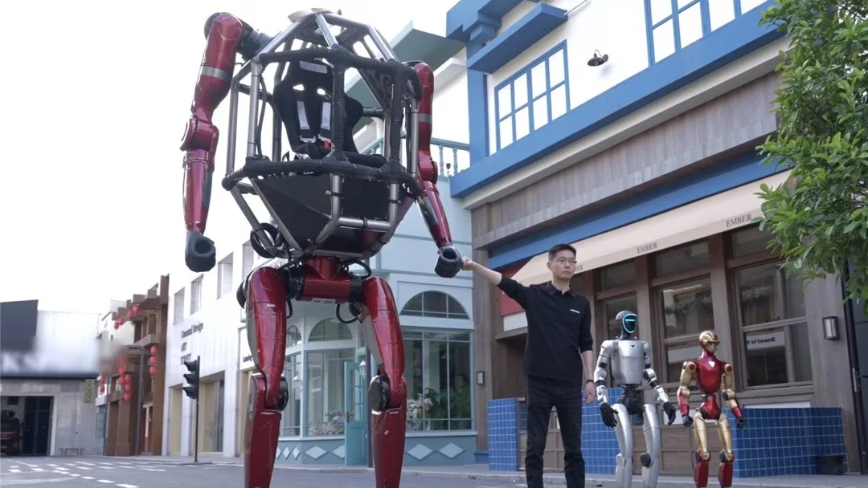
GD01 with Unitree’s CEO and existing humanoid robots.
Credit: Unitree
TL;DR
Unitree Robotics unveiled the GD01, a 2.8-metre transformable mecha priced from $650,000, but the real story is the company behind it: Unitree shipped more humanoid robots than Tesla in 2025, holds 70% of the quadruped market, grew revenue 335% to $235 million, has been profitable since 2020, and is filing for a $7 billion IPO on the Shanghai Stock Exchange.
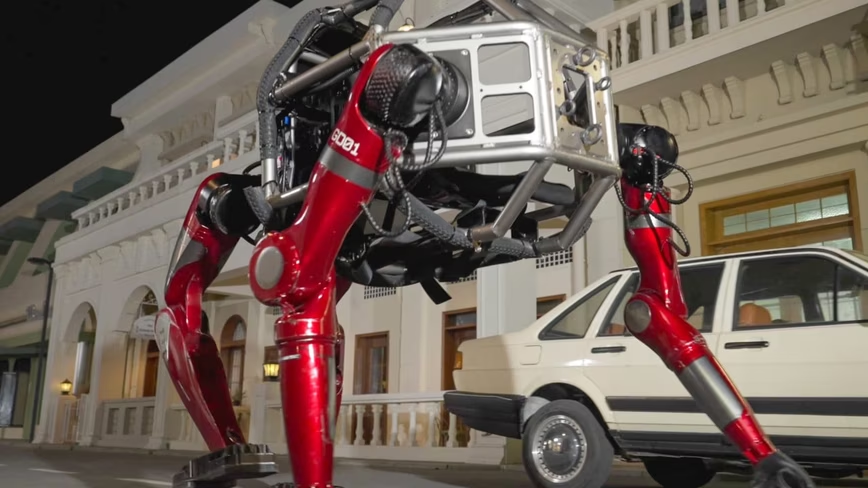
Unitree Robotics has unveiled a 2.8-metre transformable mecha that a human pilot climbs inside and operates from an open cockpit in the torso. The GD01 walks on two legs, folds into a quadruped configuration in seconds, weighs roughly 500 kilograms with a passenger, and is priced from 3.9 million yuan, approximately 650,000 dollars. It can also operate unmanned. Unitree calls it the world’s first production-ready manned mecha. It is a civilian vehicle, the company says, built for transport across rough terrain, exploration, and rescue operations where a tall vantage point helps.
The GD01 is a spectacle. It is also a brand statement from a company that has earned the right to make one.
The company
Unitree was founded in 2016 by Wang Xingxing, who built his first quadruped robot as a master’s thesis project at Shanghai University and left a job at DJI to start the company in a 50-square-metre office in Hangzhou. A decade later, Unitree holds roughly 70 per cent of the global quadruped robot market, having shipped more than 23,700 units in 2024 across its Go, A, and B series. In 2025, it shipped more than 5,500 humanoid robots, more units than any other manufacturer including Tesla.
Revenue reached 1.71 billion yuan, approximately 235 million dollars, in 2025, representing 335 per cent year-on-year growth. The company has been profitable every year since 2020. Humanoid robots overtook quadrupeds as the primary revenue driver in 2025, contributing roughly 52 per cent of total revenue in the first three quarters. Unitree filed for an initial public offering on the Shanghai Stock Exchange in March 2026, seeking to raise 4.2 billion yuan, approximately 610 million dollars, at a target valuation of seven billion dollars.
The investor list reads like a directory of Chinese technology capital: Alibaba, Tencent, China Mobile, Geely Capital, Ant Group, Jinqiu Capital (ByteDance’s investment arm), and HongShan Capital, formerly Sequoia China. Every major Chinese technology conglomerate has money in the company that dominates the market for robots that walk.
The product line
Unitree’s commercial significance has nothing to do with the GD01. It rests on a product line that spans the market from consumer to industrial at prices that undercut every Western competitor by an order of magnitude. The Go2 consumer quadruped starts at 1,600 dollars. The G1 humanoid, a research and light industrial platform, sells for 13,500 to 27,000 dollars. The H2, a full-size industrial-grade humanoid, is priced at 29,900 dollars. The B2-W, a wheeled quadruped variant, handles inspection, patrol, and fire rescue.
Unitree Robotics unveiled the GD01, source: Unitree — Credit: Unitree
For context, Figure AI’s Figure 02 industrial humanoid is being piloted at BMW at costs that have not been publicly disclosed but are estimated to be multiples of Unitree’s pricing. Boston Dynamics has begun commercial production of its electric Atlas, with every 2026 unit already committed to Hyundai. Tesla’s Optimus remains in research and development with no productive factory deployments as of the first quarter of 2026. Unitree is the only company simultaneously shipping consumer, research, and industrial humanoid robots at scale.
China’s humanoid robot boom faces a commercialisation reality check, with more than 150 companies chasing a market where only 23 per cent of buyers report satisfaction with the robots they have purchased. Unitree’s answer to the satisfaction problem is iteration speed and price. If the first robot disappoints, the replacement costs less than a competitor’s pilot programme. The company treats humanoid robots the way Chinese smartphone manufacturers treated handsets a decade ago: ship fast, price aggressively, iterate on customer feedback, and let volume drive down cost.
The mecha
The GD01 transforms between bipedal and quadrupedal modes by folding its legs and shifting its centre of gravity, a process that takes a few seconds. In bipedal mode, it walks upright at nearly three metres tall. In quadruped mode, it lowers its profile for stability on rough terrain. The machine uses LiDAR, depth cameras, an inertial measurement unit, and pressure sensors for stability and navigation. It runs on Unitree’s self-developed high-torque motors. Demonstration videos show it walking through urban environments, smashing through brick walls, and carrying a pilot across uneven ground.
Unitree has been explicit about safety. The company has asked users to refrain from dangerous modifications and noted that humanoid robotics remains in an early experimental stage with functional limitations. The 650,000 dollar price is described as a preliminary reference; the final production version may be adjusted depending on performance optimisation. The machine is not a toy. It is also, unmistakably, not yet a product with a clear commercial market beyond high-net-worth buyers and demonstration events.
What it is, precisely, is a capability demonstration. The GD01 proves that Unitree can build large-scale bipedal systems with transformation mechanics, high-torque actuation, and manned operation. Those capabilities feed back into the company’s commercial product line. The motors, sensors, control algorithms, and structural engineering developed for a 500-kilogram mecha are directly applicable to the next generation of industrial humanoids that will carry loads, navigate construction sites, and operate in environments too dangerous for human workers.
The market
Tesla has explored using its Shanghai Gigafactory for Optimus humanoid robot mass production, a decision that would place the world’s most valuable car company’s robotics programme inside China’s manufacturing ecosystem. The irony is instructive. Tesla, the American company, would build its humanoid robot in China because Chinese manufacturing infrastructure, supply chains, and cost structures are the most efficient in the world for producing complex electromechanical systems at scale.
Unitree already has that infrastructure. The components that go into a humanoid robot, precision motors, sensors, thermal management systems, lightweight structural materials, and battery cells, are the same components that Chinese factories produce at scale for smartphones, electric vehicles, and drones. Morgan Stanley forecasts China’s humanoid robot sales will reach 28,000 units in 2026, a 133 per cent year-on-year increase, with material costs falling 16 per cent as supply chain efficiencies from consumer electronics manufacturing carry over into robotics production.
Chinese electric vehicles are flooding American social media despite 100 per cent tariffs, driven by consumer demand that trade barriers cannot fully suppress. The pattern for robotics is likely to follow the same trajectory. Unitree’s quadrupeds already sell globally. Its humanoids are priced at a fraction of Western alternatives. The GD01, whatever its practical utility, ensures that the Unitree brand is visible in every robotics conversation on the planet.
The IPO
Unitree’s Shanghai Stock Exchange filing is the first major humanoid robotics IPO. Boston Dynamics, owned by Hyundai, has been valued between 21 and 28 billion dollars by Korean securities firms, with bullish IPO projections reaching 100 billion dollars. Figure AI raised one billion dollars at a 39 billion dollar valuation in September 2025. But neither has gone public. Unitree, the company from the 50-square-metre Hangzhou office, would be the first pure-play robotics company to list.
Cerebras, the AI chipmaker, is targeting a 40 billion dollar IPO valuation in what would be the first major AI hardware listing of 2026. Unitree’s seven billion dollar target is more modest, but the company has something Cerebras does not: profitability. Unitree has been profitable every year since 2020. In a market where AI and robotics companies routinely burn capital at extraordinary rates, a profitable robotics manufacturer filing for a public listing is an anomaly.
UBTech, one of Unitree’s Chinese competitors, has offered 18 million dollars to hire a chief AI scientist, a figure that illustrates the talent arms race in Chinese robotics. Unitree’s advantage is not a single hire. It is a decade of iteration from Wang Xingxing’s thesis project to a product line that covers the market from 1,600-dollar consumer quadrupeds to 650,000-dollar pilotable mechs, all manufactured in China at costs that Western competitors cannot match.
The statement
The GD01 will not sell in volume. A 650,000 dollar mecha does not have a mass market. What it has is attention. Every technology publication in the world covered the announcement. The videos went viral. The brand registered. And behind the spectacle, Unitree’s actual business, the one generating 335 per cent revenue growth and filing for a seven billion dollar IPO, continued shipping robots that walk, run, and work at prices that make every competitor recalculate their cost structure.
Wang Xingxing built his first walking robot in a university lab in 2013. Thirteen years later, the company he founded from that project sells more humanoid robots than Tesla, holds 70 per cent of the quadruped market, counts every major Chinese technology company as an investor, and just unveiled a vehicle that transforms from a walking machine into a crawling one with a human inside. The GD01 is not the product. The product is the company that could build it.
Get the TNW newsletter
Get the most important tech news in your inbox each week.


 Credit: Unitree