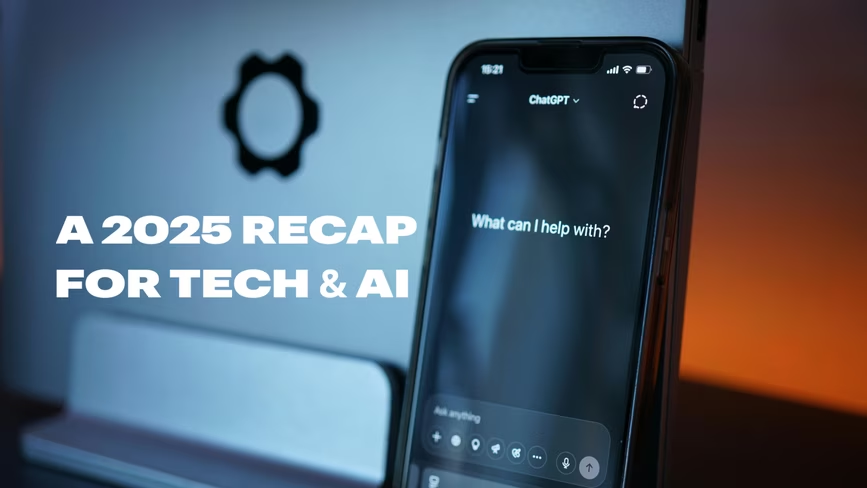
2025 was the year technology stopped being tomorrow’s promise and became today’s anchor. What began as a surge in generative AI and platform innovation two years prior crystallized this year into concrete shifts in how people work, governing bodies legislate, and markets invest. Across continents and industries, the arc of technology bent toward practical impact, regulatory reality, and economic weight!
At the heart of the year’s story was artificial intelligence’s jump from novelty to infrastructure. LLMs and multimodal models moved beyond demos into everyday workflows, influencing how documents are written, campaigns are conceived, products designed, and code generated.
Enterprises that once hesitated began deploying AI tools at scale, with early adopters reporting measurable productivity gains by integrating copilots into core processes, a trend visible in surveys showing widespread adoption among software professionals.
This editorial isn’t a chronicle of every press release.
It’s a reflection on how 2025, at the crossroads of technology, governance, and economic strategy, brought about a series of inflection points that will shape the next era of creation, competition, and control.
When imagination became infrastructure
OpenAI’s release of GPT-5 in August pushed the boundaries of what AI could do, delivering notable gains in coding, math, and multimodal understanding. But unlike the jaw-dropping debut of ChatGPT a couple years prior, this new generation of foundation models arrived to a more measured reception.
Tech leaders and investors had begun asking harder questions: beyond impressive demos, could these models drive real products and revenue?
Google’s answer was Gemini 3, launched in November as its “most intelligent model” and immediately woven into Google’s flagship product, Search. For the first time, an AI model upgrade wasn’t just about boastful leaderboard scores, it was about transforming user experience.
Typing a query into Google now often meant receiving an AI-generated synthesis instead of the familiar list of links, a sea change in how information is delivered. Google even unveiled a Gemini “agent” that could execute multi-step tasks like booking travel or organizing email, hinting at a future where AI acts more like a digital butler than a chatbox.
Anthropic’s Claude 4 model, for instance, gained a strong following among developers by expanding how much it could handle at once, processing entire codebases with tens of thousands of lines, rather than by producing viral one-liners.
AI grew up in 2025: it was still improving at breakneck speed, but it also had to earn its keep in real products and justify the billion-dollar bets fueling its rise.
Chips and Gadgets
Driving this AI explosion was a parallel leap in hardware. The hunger for AI computers in 2025 was insatiable, and chipmakers raced to deliver.
NVIDIA, whose GPUs had become the era’s essential infrastructure, rolled out its new Blackwell architecture with chips like the B200 that boasted up to 3× the training speed of its predecessor. Cloud data centers around the world scrambled to deploy these to keep up with demand from model training and inference.
Rival chipmakers weren’t idle either: AMD and a cadre of startups pushed innovative AI accelerators, while even Intel signaled ambitions to catch up, reportedly exploring an acquisition of AI chip designer SambaNova.
Perhaps most tellingly, tech giants themselves started designing silicon tailored for AI workloads, recognizing that owning the chip means owning the future of computing.
Beyond AI chips, consumer hardware saw its own milestones. After years of anticipation, augmented reality glasses and mixed-reality headsets finally had their moment, sort of.
Apple’s Vision Pro headset, unveiled in late 2023, reached select markets in 2024; by 2025 developers were crafting the first wave of immersive apps. However, mass adoption lagged due to the device’s sky-high price and bulky format.
Competitors like Meta’s Quest line offered cheaper VR headsets and modest improvements, but the “metaverse” hype of yesteryear largely fizzled out, users and investors had shifted their excitement to generative AI and tangible productivity tools.
Smartphones and laptops in 2025 continued incremental improvements (faster Apple M3/M4 chips, foldable screens becoming more common), yet it was clear the next paradigm shift in personal tech was still on the horizon.
Even so, one hardware frontier made concrete progress: quantum computing. Industry leaders like IBM and Google demonstrated prototype systems with ever-larger qubit counts and made strides in error correction, inching closer to viable quantum machines.
These advances, while esoteric to the public, underscored a broader theme, from AI accelerators to quantum chips, the machinery under the hood of tech was evolving rapidly to enable the software of tomorrow.
Regulators strike back
If 2025 proved anything, it’s that technology no longer operates above the law. This was the year regulators moved from intent to enforcement, with Europe leading the charge.
After years of debate, the EU’s Artificial Intelligence Act came into force, becoming the world’s first complex AI law. From February, certain “unacceptable risk” uses, such as social scoring and real-time biometric surveillance, were banned outright.
By August, transparency rules followed, forcing companies to label AI-generated content and comply with new obligations for general-purpose models. The signal was unmistakable: in Europe, the era of unchecked AI was over.
Companies now face audits, penalties, and real consequences if their systems cross legal or ethical lines, a regulatory moment European officials openly compared to GDPR’s impact on data privacy.
The pressure didn’t stop with AI. In 2025, regulators also went after the gatekeepers. The EU’s Digital Markets Act forced long-resistant changes from Big Tech, most notably when Apple opened the iPhone to third-party app stores and sideloading in Europe, dismantling a 15-year walled garden.
At the same time, enforcement of the Digital Services Act intensified. Platforms were scrutinized for how they handle disinformation, with companies like X warned or penalized during periods of geopolitical tension. In response, social networks expanded moderation teams, adjusted algorithms, and exposed more of their inner workings to researchers.
Elsewhere, governments followed suit.
The US issued an AI executive order and signaled tougher enforcement through agencies like the FTC, while states stepped in, including New York’s law requiring mental-health warnings on addictive social features.
In China, new draft rules targeted AI systems designed for human-like interaction, tightening licensing and ideological oversight. By the end of the year, the freewheeling phase of tech disruption had given way to something more restrained. The question was no longer whether regulation would catch up, but how deeply it would reshape innovation itself.
Platforms pivot & users change course
The platform shake-up that began in 2023 gathered real momentum in 2025, as both companies and users adjusted to a post-pandemic, AI-saturated reality.
Nowhere was this clearer than in social media. Elon Musk’s X, which entered the decade with noise and bravado, found itself on the defensive. Meta’s Threads, initially dismissed after an early spike, steadily closed the gap, nearing parity with X in daily mobile users by mid-year.
X’s audience shrank as policy whiplash and leadership churn eroded confidence, and while its remaining users were still deeply engaged, the era of unquestioned Twitter dominance was over. Disenchanted users scattered across a fragmented landscape, from Meta’s polished Threads to decentralized alternatives like Bluesky and Mastodon, breaking the old Facebook–Instagram–Twitter equilibrium.
The recalibration extended well beyond social feeds.
Major platforms retooled around changing habits: Google reshaped Search around generative answers to fend off AI assistants and algorithmic discovery, while Microsoft pushed its Copilot deeper into Windows, Office, and Bing, betting on “AI inside” as a platform reset.
Everyday behavior shifted too. Smarter voice and chat assistants returned to daily use, handling emails, refunds, and scheduling with little friction. At the same time, screen fatigue set in. Digital-detox travel gained traction, and younger users gravitated toward apps that promised less algorithmic pressure and more human curation. Even streaming came full circle.
After years of fragmentation, providers began rebundling services, offering combined video, music, and gaming packages that looked suspiciously like cable TV reborn, a reminder that while technology moves forward, user preferences often move in cycles.
Society grapples with tech’s consequences
Amid the gains and momentum, 2025 also became a year of reckoning. As AI systems spread, society began grappling with their cultural and ethical cost. Creators who once marveled at generative tools started pushing back, arguing that their work had been absorbed without consent or compensation.
A wave of lawsuits moved through US courts, with authors accusing companies like OpenAI, Meta, and Google of scraping books and articles to train models. By year’s end, the message was unmistakable: if AI is built on human creativity, many believe its rewards can no longer flow in one direction alone.
Public trust in technology was also tested by a rise in malicious uses and misuses. In the financial domain, sophisticated deepfake scams caused real damage. The frequency of such incidents spiked sharply; cybersecurity firms reported a 3000% increase in deepfake-related fraud over two years, and authorities scrambled to educate businesses on new verification practices.
Misinformation continued to be a menace: during elections and conflicts, AI-generated fake images and videos spread on social media, forcing newsrooms to set up rapid-response fact-checking teams.
Encouragingly, 2025 also saw growth in countermeasures, from better deepfake detection algorithms to nascent standards for cryptographic content authentication (the Coalition for Content Provenance, including major publishers and tech platforms, expanded efforts to watermark authentic media).
Still, the information ecosystem remained fraught, as even savvy citizens found it ever harder to tell the truth from fabrication online.
And then there’s the human element: how all this tech is affecting everyday lives and livelihoods. Workplace AI adoption soared this year; tools like Microsoft 365 Copilot and a host of AI assistants became common on office desktops. Studies showed productivity boosts but also raised concerns about workers becoming overly reliant on AI suggestions.
Meanwhile, fears of automation resurfaced in certain sectors, for example, as chatbots took over more customer service and code-generation tools improved, professionals in call centers and junior programming positions wondered about long-term job security.
These anxieties fueled calls for new approaches to education and training, so that the workforce of 2030 will be prepared for more creative, complex tasks that AI can’t easily handle.
The editor’s verdict: Lovable wins 2025
Lovable (Stockholm, Sweden) came as one of the most remarkable AI software stories of the year, for me. What began as an open-source project evolved into a commercial platform that lets users build fully functional websites and apps using plain-language prompts, no traditional coding required.
This approach, known in the industry as “vibe coding,” turns ideas into production-ready software simply by describing what you want in natural language.
Lovable’s growth in 2025 was extraordinary by any measure. Eight months after its launch, the company hit over $100 million in annual recurring revenue and raised a $200 million Series A at a roughly $1.8 billion valuation, making it one of Europe’s fastest-growing software startups ever.
By year’s end, Lovable had secured $330 million in Series B funding at about a $6.6 billion valuation, and was rapidly scaling globally.
What makes Lovable meaningful beyond the numbers is what it represents: a shift in how software is built. It demonstrated that AI can democratize development, giving power to non-technical founders, creators, and teams to go from concept to product without traditional engineering barriers.
In an industry long centered on specialized skills and team structures, Lovable’s rise suggested a future where natural language becomes the primary interface to software creation.
On a more hopeful note, 2025 showed signs of a maturing tech culture. Ethical design moved from talking point to practice. Major platforms began experimenting with limits, turning off infinite scroll for teens, adding prompts that nudged users to pause, and treating “time well spent” as a real metric rather than a slogan.
In AI, transparency gained ground. Under pressure from regulators and researchers, companies like OpenAI and Google disclosed more about how their models are trained and where they fall short.
Researchers formed new alliances to share safety techniques, and a second global AI Safety Summit brought dozens of countries together around questions of alignment and control.
None of it amounted to binding rules, but it marked a shift in tone: even the architects of powerful systems openly acknowledged the need for restraint.
Taken together, these moments made 2025 a turning point. For years, technology had surged ahead of the institutions meant to guide it. This year, that gap began to close.
The breakthroughs were real and transformative, but so were the responses to them: laws passed, norms reset, alliances formed. If 2024 was the year the world grasped the power of generative AI, 2025 was the year it began deciding how that power should be used.
The story of technology is no longer just about what can be built, but about how it fits into the lives it shapes, and who gets to decide that fit.
Get the TNW newsletter
Get the most important tech news in your inbox each week.


