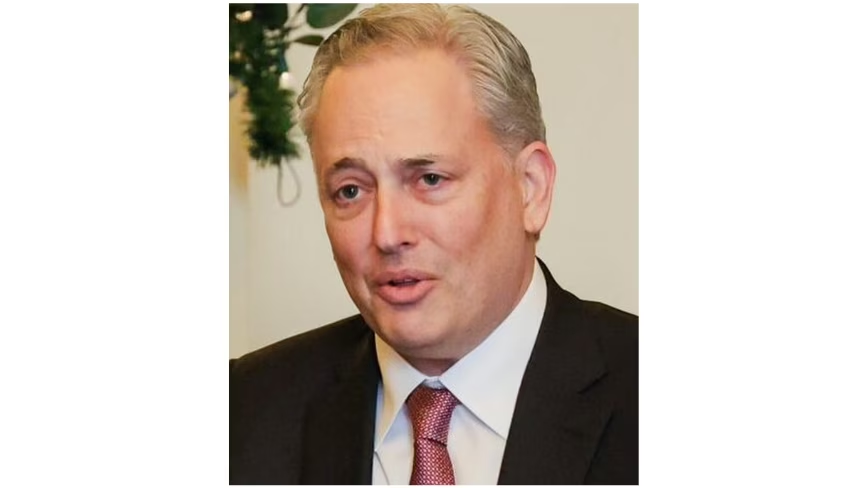
David Sacks at a meeting on Capitol Hill in December 2024, when he was the White House AI and crypto czar.
 Credit: Office of the Speaker of the US House of Representatives / public domain via Wikimedia Commons
David Sacks told Anthropic and OpenAI to go ahead and pace the frontier but to stop seeking an antitrust waiver or an approval regime, arguing that product liability and market pressure already discipline them. Europe reached the same conclusion about liability in February 2025, and from 9 December treats standalone software as a product under strict liability.
David Sacks told Anthropic and OpenAI to go ahead and slow down, and to stop asking for anything in return, ANI reported. He chairs the President’s Council of Advisors on Science and Technology and was the White House AI and crypto czar until March.
His answer to the two chief executives was that they are the frontier. “The easiest way not to build superintelligence is for you to agree not to build it,” he wrote.
What he refused was the list attached to it. Companies asking to pace the frontier should stop pretending antitrust law must be suspended “so you can form a cartel“, he wrote, and stop demanding an approval process that supersedes product liability.
He also questioned the independence of METR, the evaluator Anthropic uses, saying it is intertwined with the company’s investors and staff.
The argument is running against a resignation. A pretraining researcher left Anthropic on 8 September saying the industry was gambling with people’s lives, and the company’s alignment science lead put the odds of AI causing human extinction within a decade above 10%.
Sacks offered a different discipline.
If a model enables a serious cyberattack, he argued, the company faces product liability claims, and markets already punish systems that behave unpredictably. Demanding a regulatory framework as the price of restraint, he wrote, would look like “blackmail“.
Europe reached that conclusion first. The Commission withdrew its proposed AI Liability Directive in February 2025, having decided the revised product liability rules already covered AI software.
From 9 December those rules treat standalone software, operating systems and AI systems as products, under strict liability. A claimant does not have to prove fault.
Defectiveness now takes in cybersecurity vulnerabilities and self-learning behaviour that turns unsafe after release. Courts can order a defendant to disclose evidence, and can presume a defect where the claimant faces excessive difficulty proving one.
What Europe did not do is choose.
The AI Act’s systemic risk duties have bound frontier models since August 2025, and since 2 August the Commission can demand evaluations and fine 3% of global turnover. So the approval-style regime Sacks objects to and the liability regime he prefers will operate on the same models at once.
European lawyers have been working through what that means since the summer, in driver assistance as much as in chatbots. Sacks is proposing an experiment that one jurisdiction is about to run.
Get the TNW newsletter
Get the most important tech news in your inbox each week.


