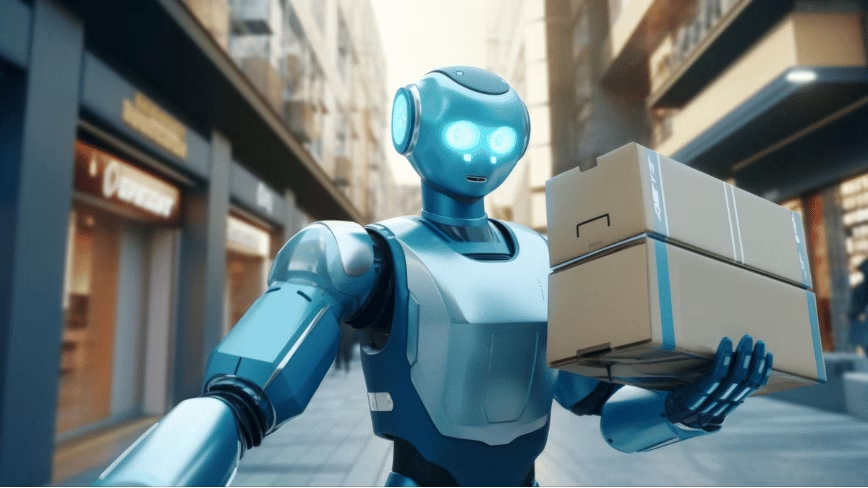

Would you trust an AI agent to run your Amazon store? That future may be near. But true AI transformation requires moving beyond “gap-filling” AI tools. It requires building an infrastructure layer that lets AI agents create and manage their own workflows. We asked 7 e-commerce industry veterans what’s still broken and what needs to change before AI agents can truly operate online stores.
For the past few years, promises of AI transformation have flooded the e-commerce industry. The market for e-commerce SaaS and Amazon listing optimization tools has never been more crowded. So why are e-commerce agencies and large sellers still spending so much time operating their stores manually?
Speak off-the-record to the executives running e-commerce agencies and you start seeing an interesting pattern. One AI tool spots the problem, another recommends a fix, and a human still has to figure out what matters. That human decides whether the recommendation makes sense, makes the change and checks whether it all worked. Despite multiple “copilots” and “AI assistants,” the day-to-day operations of managing multi-million-dollar Amazon portfolios remain manual. They stay fragmented across dozens of tools.
Too Much Software
“E-commerce agencies don’t suffer from a lack of software anymore. In many cases, they suffer from too much of it,” says Cyril Golub, CEO & Founder of Jinnify.ai, an operations layer between AI agents and e-commerce systems.
Cyril Golub is an angel investor and the former CEO and co-founder of Aheadworks. Aheadworks is an e-commerce software company he led to a successful exit in 2019. He has watched the industry’s tech stack evolve for over two decades.
“Every new SaaS dashboard or AI copilot can become another burden: another interface to learn, another stream of recommendations to interpret, another tool a human has to connect to the actual business outcome.”
To map out where the existing AI commerce tools are failing today and where the next generation of AI infrastructure must go, we interviewed e-commerce agency CEOs and industry veterans. The result is an operational “pain map” for 2026. It shows four bottlenecks where legacy tools stall, and the blueprint for the native AI systems replacing them.
1. Catalog Firefighting Is Still a Human Job
When industry outsiders think of Amazon optimization, they picture keyword research or product listing updates. Ask an agency operator what actually consumes their team’s time most. The answer is far less glamorous: relentless catalog firefighting.
“The biggest bottleneck for us is not PPC or research, it’s Seller Central firefighting,” explains Sam Shah, Founder of e-commerce agency Desverto. “Every day something breaks: suppressed ASINs, broken variations, catalog overwrites, 8541 errors, hazmat/document issues, etc. Tools like Data Dive are great at detecting problems, but they stop there. The actual fix often needs Seller Support/Brand Registry cases, multiple follow-ups, and someone who understands the account history.”
Amazon’s backend is a labyrinth of flat files, Brand Registry overrides, and changing category templates. Because of that, today’s SaaS stack only completes half the job. It sounds the alarm, but leaves human operators to put out the fire.
“The biggest unsolved bottleneck is turning fragmented catalog data into safe, correct, and scalable execution,” notes Steven Pope, founder of My Amazon Guy, a US-based e-commerce agency managing 450 brands. “Existing tools can identify suppressed listings, missing attributes, keyword gaps, stranded inventory, or variation issues, but they still leave sellers and agencies doing the hard part: determining the true root cause, knowing which edit is safe, navigating conflicting contribution data, and pushing changes without breaking a parent-child relationship, indexing, compliance status, or retail readiness.”
Exception Management
“For a seller managing a large catalog or multiple client accounts, catalog work is not just ‘fill in missing fields.’ It is a constantly changing system involving flat files, Seller Central, brand registry, compliance documentation, category templates, image requirements, inventory feeds, and Amazon’s sometimes inconsistent catalog rules. The actual bottleneck is exception management: thousands of small issues that each require context, judgment, evidence, and follow-through. Most SaaS tools surface the problem; they don’t reliably own the resolution end to end,” says Steven Pope.
2. AI Tools Are Missing a Bigger Business Picture
Another issue agency CEOs point to is that most tools focus on one metric or task without considering the bigger business picture.
“I tried multiple tools, but I think the main bottom line is that across most e-commerce SaaS and AI tools, the control layer is really missing,” says Adnan Aslam, CEO of UK-based Amazon agency Sellonics. “The way you want to optimize your campaigns is something they provide, but eventually, it doesn’t connect with the bigger brand goals.”
Adnan mentions that the next-gen AI commerce tools would have to understand the full spectrum of operational areas simultaneously. That includes PPC budgets, inventory levels, profit margins, competitor rankings and current brand lifecycle stages.
“When there is a new launch and you want to rank for certain keywords, if you just command AI that we want to rank for those keywords, it’s not even possible because you just launched: you don’t have reviews, your conversion will be low, and you’re competing with people who have been selling for decades. An ideal AI would need to understand what’s possible for a certain brand at a certain stage and what the realistic limitations are,” adds Adnan Aslam.
3. More Data Doesn’t Mean Better Decisions
As Large Language Models (LLMs) went mainstream, many e-commerce software developers connected them to Amazon’s Selling Partner API (SP-API). However, giving an LLM access to raw store data hasn’t yielded an ideal autonomous account manager.
In practice, feeding unstructured data into an LLM creates prompt noise and hallucinated AI recommendations that can hurt online store performance. Frontier models lack native operational context. They still can’t distinguish between minor log warnings and serious revenue threats or issues that may even trigger catalog suspension.
“Access is solved; we connect via MCP and can pull whatever we want from wherever we want,” explains Klaidas Siuipys, Founder and CEO of AMZ Bees, a full-service Amazon PPC and account management agency based in Vilnius, Lithuania. “The problem is that everything is not what you need. A system that receives the full dump will use all of it… The real work is judgment: knowing which data matters for this account, this question, this moment, and leaving the rest out. Right now, that filtering is the human part of the job.”
Cyril Golub, CEO & Founder of Jinnify, emphasizes this operational limit of generic AI too: “A powerful LLM is not an e-commerce operator by itself. Using a frontier model to process every raw commerce record is like hiring a PhD to do arithmetic in Excel. You need deterministic software to prepare the data, persistent memory for the merchant’s strategy, permissions around what the agent may change, execution rails, and then a feedback loop to see whether the decision was right.”
4. The Gap Between AI Recommendations and Action
The biggest problem with today’s AI commerce tools is that they can recommend what to do. But they often can’t actually execute these actions. A merchant still has to log into Seller Central, copy and paste recommendations, submit support tickets, and come back later to see if the fix worked.
“The biggest challenge with AI in commerce is integrating the AI-generated recommendation into the operational system around the business,” notes Antons Sapriko, CEO of Scandiweb, one of the largest e-commerce software agencies in Europe. “If people still have to move between tools, validate outputs manually and execute changes themselves, you haven’t fundamentally changed the operating model, but just accelerated one step within it. The real opportunity is to move from AI as a decision-support layer to AI as an execution layer, where agents can access the relevant context, operate within defined permissions, interact with systems of record and ultimately take action on behalf of the business.”
Ruslan Fazlyev, founder of e-commerce store platform Ecwid (which he built to a $500M exit), shares: “We’ve spent two decades making it easier for businesses to sell online. The next phase is about making it easier for businesses to operate online. AI could become a new operational interface for merchants, but the underlying infrastructure will determine whether that shift actually gives merchants more leverage or simply creates another layer of dependency.”
Blueprint of an Ideal AI Commerce Solution for Sellers
E-commerce operators we interviewed described what they believe the ideal AI system should look like to solve these four problems. The next generation of AI tools should not be another dashboard that simply gives recommendations. It should be able to take action directly. It should also give businesses different levels of control depending on the risk involved, while fully understanding the relevant business context.
Steven Pope, founder of My Amazon Guy, notes: “My ideal AI-native catalog system would operate like an experienced Amazon catalog operations team that has complete visibility, persistent memory and the ability to act. It would ingest every ASIN, SKU, parent-child variation, listing contribution, inventory position, case log, brand asset, compliance document, historical change and performance signal, then continuously prioritize work based on revenue risk, conversion upside, inventory exposure, and account-health risk.”
As Steven Pope puts it: “The key feature would be a ‘catalog control center’ that doesn’t merely alert me that an ASIN is suppressed or a variation is broken. It would explain the cause in plain English, show the evidence, recommend the best fix, estimate the expected business impact, and either execute the fix automatically within predefined guardrails or prepare the exact file upload, case, or appeal for approval.”
“The most important design principle would be confidence-based automation. Low-risk, reversible changes could be executed automatically; medium-risk changes could be queued for approval; and high-risk actions, such as variation restructuring, compliance changes, or edits to major ASINs, would require human signoff with a clear explanation of consequences,” says Steven Pope.
Detect, Diagnose, Fix, Verify, Escalate
Sam Shah outlines an ideal AI solution in the following way: “The AI solution I’d want is something that can detect, diagnose, fix, verify, and escalate, with human approval for anything risky. If I could automate one workflow first, it would be suppressed or at-risk listing recovery. It happens daily, directly impacts revenue, and success is easy to measure.”
Adnan Aslam, CEO of Sellonics notes: “An ideal AI would need to understand what’s possible for a certain brand at a certain stage and what the realistic limitations are. And based on that, it can give us, for example, a list of keywords that you can actually rank for.”
“I don’t think AI should be treated as a magician,” Cyril Golub emphasizes. “It should be treated as a very capable assistant with a clear goal, clear boundaries and a measurable expected outcome.”
Cyril recently shared this vision in a conversation with Claus Lauter on The Ecommerce Coffee Break. The podcast reaches millions of e-commerce professionals worldwide. They discussed how AI could reshape e-commerce and the future of online shopping.
The Future of E-Commerce is Agent-Driven
Agency CEOs foresee a shift from AI helping sellers optimize individual tasks to AI agents actively running parts of the commerce business. On the shopper side, AI agents will decide which products to recommend. That makes it more important for brands to structure their product data so machines can understand them. On the seller’s side, AI agents will take over more routine work, following certain guardrails, merchant’s permissions and rules.
Klaidas Siuipys sees a future where AI agents, rather than traditional search, help shoppers find and choose products: “I believe the future lies in conversational commerce, with AI as the layer between product and buyer. Instead of the shopper scanning a results page, an agent picks what fits. For sellers, it changes what optimization means. You stop competing only for a position in search results and start making sure a machine can correctly understand what your product is and who it is for.”
Meanwhile, Steven Pope shares his vision of a future where AI agents can act on sellers’ behalf: “Over the next two to three years, I think AI commerce will shift Amazon sellers from manually operating listings and campaigns to managing intelligent systems that run much of the repetitive work. The winning sellers will not simply be the ones using AI to write better bullet points or generate images, but the ones whose product data, brand assets, operational workflows, and decision rules are structured well enough for AI agents to act on them safely.”
Sam Shah sees the shift this way: “Discovery will move from search results to AI recommendations, making catalog quality the new SEO. Operations will become increasingly agent-driven, while humans focus on strategy, judgment and creativity.”
The Next E-Commerce Era
The winners of the AI commerce era won’t be the tools that simply generate product descriptions or recommend what to improve in your catalog. They will be the infrastructure that gives AI agents what they need to understand the business, make the right decisions, and safely take action.
“Twenty years ago, starting an online store meant renting a server and installing an e-commerce platform,” says Cyril Golub, Founder of Jinnify. “Until now, it meant opening a Shopify account. The next step will be as simple as saying, ‘OK, Claude, start selling online for me.’”
Get the TNW newsletter
Get the most important tech news in your inbox each week.
Contributed article. Not produced by the TNW newsroom and does not reflect the editorial stance of TNW.


