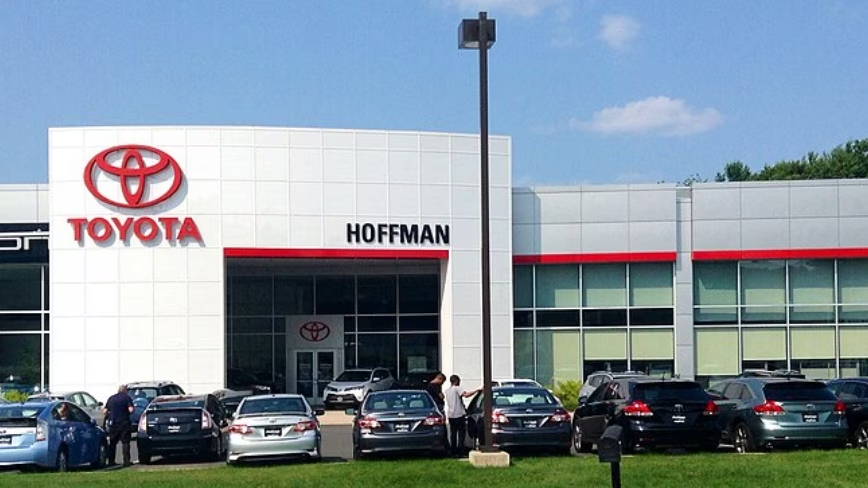
Hoffman Toyota Dealership
 Credit: Mike Mozart from Funny YouTube, USA
Toyota will put a rival to Tesla’s Full Self-Driving on its 2028 models and sell it as “Level 2++“, a marketing label that keeps the driver in charge, with a guardrail layer over the neural network. Europe approves this class of system under UN Regulation 171, but from 9 December the Product Liability Directive treats stand-alone software as a product regardless of the badge.
Toyota will put a rival to Tesla’s Full Self-Driving on its 2028 models. It is being sold as “Level 2++“, InsideEVs reported.
That label is not an SAE classification. It is a marketing term for something between Level 2 and Level 3, where the driver remains in charge throughout.
The engineering differs from Tesla’s. Instead of one end-to-end network, Toyota will add a guardrail layer that blocks unexpected behaviour against parameters set by humans in advance, Nikkei reported.
The liability is decided before the car ships. “We’ll develop Level 4 technology from a technical standpoint, but offer it commercially as Level 2++,” said Akihiro Sarada, who heads Toyota’s software development centre.
Europe already has a door for this class. UN Regulation No. 171 on driver control assistance systems entered into force on 30 September 2024.
It is explicit about who is driving. The driver retains responsibility and must permanently monitor the road, and carmakers have to say so in advertising and at dealerships.
The Netherlands went through it first. Its regulator approved Tesla’s FSD Supervised in April after 18 months of testing and 1.6 million kilometres of European road data.
The wording left nothing open. The software “is not self-driving“, the RDW said, and the driver remains responsible and must keep control.
That settles the traffic stop rather than the invoice. From 9 December the Product Liability Directive treats stand-alone software as a product across the bloc.
It also eases the proof. Where technical complexity makes a defect excessively hard to demonstrate, a court may presume one, and defendants can be ordered to disclose evidence.
None of that turns on the SAE number on the box. TNW has set out the difference between driver assistance and autonomy, and the directive is indifferent to the badge.
Which may make Toyota’s guardrail worth more than its label. Sarada said the aim was safety and explainability, and explainability is exactly what a disclosure regime asks for.
One European carmaker took the other road entirely. Mercedes sells an eyes-free system approved as Level 3, where the car is doing the driving while it is engaged.
Get the TNW newsletter
Get the most important tech news in your inbox each week.


