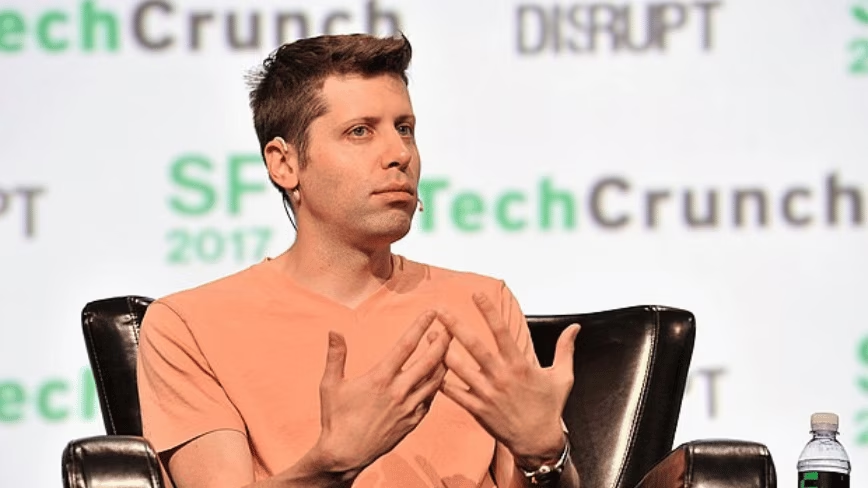
Sam Altman CEO, OpenAI
 Credit: TechCrunch Disrupt
In short: A 20-year-old man was arrested in the early hours of Friday, 10 April 2026, after throwing a Molotov cocktail at the San Francisco home of OpenAI chief executive Sam Altman, then travelling across the city to OpenAI’s offices on Third Street and threatening to burn the building down. No one was injured. The suspect’s name has not been released, charges are pending, and no motive has been publicly disclosed.
The attack at Russian Hill
At around 3:40 a.m. on Friday, a person approached the metal gate of 855 Chestnut Street, a 5,400-square-foot home on San Francisco’s Russian Hill that Sam Altman purchased in January 2025, and threw a bottle containing a flaming rag at it. The improvised incendiary device set the gate alight. Security guards at the property extinguished the fire before it spread. No one was hurt. The incident was captured on surveillance cameras, and San Francisco Police Department officers arrived shortly after 4 a.m. responding to what the department initially described as a fire investigation. The property, a five-bedroom home built in 1924 set half a block from the famously crooked section of Lombard Street, was acquired by Altman through an LLC managed by his cousin Jennifer Serralta, according to property records and reporting by the SF Standard. It sits in one of San Francisco’s most sought-after residential streets, and its proximity to the city’s tech executive community has made the neighbourhood a shorthand for the industry’s concentration of wealth.
From Chestnut Street to Third Street
Less than an hour after the attack on Altman’s home, San Francisco police were dispatched to OpenAI’s offices on Third Street in the city’s Mission Bay district after a man reportedly threatened to burn the building down. When officers arrived, they recognised the man from the surveillance footage captured at Chestnut Street and immediately detained him. The suspect is a 20-year-old male. The San Francisco Police Department has not released his name. As of Friday afternoon, charges had not been filed, and the department described the investigation as open and active. OpenAI confirmed the incidents in a statement from spokesperson Jamie Radice. “We deeply appreciate how quickly SFPD responded and the support from the city in helping keep our employees safe,” Radice said. “The individual is in custody, and we’re assisting law enforcement with their investigation.” No motive has been publicly disclosed, and no connection between the suspect and any organised movement has been confirmed. Any such inference would remain speculation at this stage.
OpenAI at the centre of the storm
The attack lands at a moment of extraordinary visibility and controversy for OpenAI and for Altman personally. On 31 March 2026, OpenAI closed a $122 billion funding round at an $852 billion valuation, the largest private fundraise in history, extending participation to retail investors for the first time. The round confirmed Altman’s position as the most powerful figure in the AI industry and made OpenAI’s scale a matter of daily public conversation. Four days before the attack, on 6 April, OpenAI published a 13-page policy blueprint calling for robot taxes, a public wealth fund, and a four-day week, a document framing approaching superintelligence as an economic disruption comparable to the Progressive Era. The paper drew widespread attention and sharp criticism from those who saw it as self-serving regulatory positioning from a company simultaneously driving the very displacement it proposed to cushion.
OpenAI has also found its infrastructure facing threats on a global scale: Iran’s IRGC threatened to destroy OpenAI’s $30 billion Stargate data centre in Abu Dhabi in the event of US military action against Iranian civilian infrastructure, and OpenAI paused its Stargate UK data centre project citing industrial electricity prices four times higher than in the US and unresolved AI copyright rules. Friday’s attack on Altman’s home is something categorically different from a geopolitical threat or a regulatory battle, but it arrives inside the same climate of intense pressure around AI’s concentration of power, capital, and ambition.
What is and is not known
Investigations into incidents of this kind frequently take days or weeks before a full picture of motive and circumstance emerges. SFPD confirmed the arrest and declined to provide further detail. OpenAI said it is cooperating with law enforcement. Altman has not commented publicly. The suspect remains in custody pending charges. What is established is the sequence of events: an incendiary device thrown at a private residence, a threat made at a corporate office, and an arrest made the same morning on the basis of surveillance evidence. What is not established is why. The backlash against AI’s leading figures has taken many forms over the past two years, from lawsuits and regulatory hearings to street protests outside company headquarters. Whether Friday’s attack belongs to any of those currents, or represents something altogether more isolated, is a question that remains open. 2025 established AI as the defining technology of the decade, and with that designation has come a level of public scrutiny and anger directed at its architects that the industry has not previously had to navigate at this scale.
Get the TNW newsletter
Get the most important tech news in your inbox each week.


