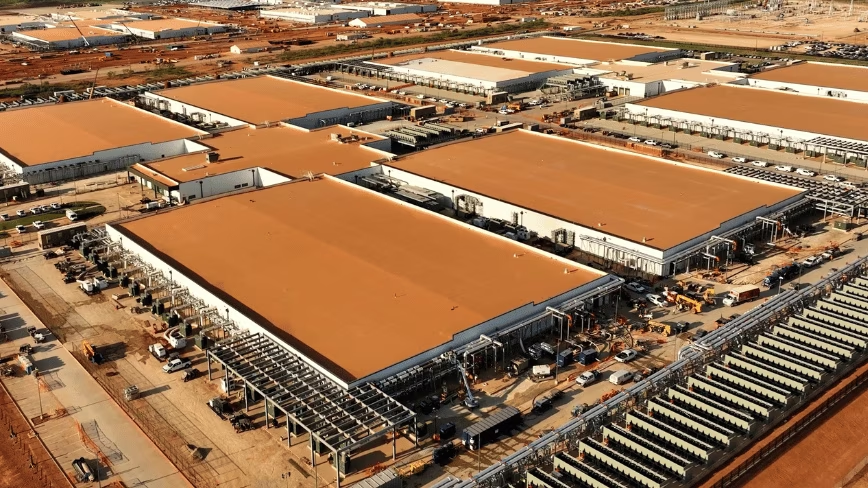
OpenAI, Oracle, and SoftBank expand Stargate

In short: Iran’s Islamic Revolutionary Guard Corps has released a video threatening “complete and utter annihilation” of OpenAI’s $30bn Stargate AI campus in Abu Dhabi, singling out the facility by name for the first time and warning it will strike if the US proceeds with threatened attacks on Iranian civilian infrastructure.
A senior officer in Iran’s Islamic Revolutionary Guard Corps has threatened to destroy OpenAI’s flagship AI data centre in Abu Dhabi, releasing a video that opens on a blurred satellite view of the desert site before switching to sharp night-vision footage of the sprawling Stargate campus. The message overlaid on screen reads: “Nothing stays hidden to our sight, though hidden by Google.”
The video was released on 3 April 2026 by Brigadier General Ebrahim Zolfaghari of the IRGC, and represents a significant hardening of Iran’s position. Just days earlier, the Guard had named 18 US technology companies as legitimate military targets, including Apple, Microsoft, Nvidia, and Tesla, but had not identified any specific facility. The Stargate video is the first time the IRGC has designated a particular installation for threatened destruction.
Zolfaghari said the attack would be carried out if the United States follows through on President Donald Trump’s threat to bomb Iranian power plants and desalination facilities. The threat is conditional rather than imminent, but comes after a month of kinetic escalation: the US-Israel joint campaign that began on 28 February 2026 has already prompted Iranian retaliatory strikes against Gulf energy infrastructure, military installations, and, notably, commercial data centres.
What is Stargate UAE?
Stargate UAE is the international flagship of the $500bn Stargate joint venture between OpenAI, SoftBank, Oracle, and Abu Dhabi sovereign investment vehicle MGX. The campus is being built and financed by UAE artificial intelligence company G42 across approximately 19 square kilometres of desert south of Abu Dhabi, and will be operated jointly by OpenAI and Oracle. SoftBank’s involvement in the project was underwritten in part by SoftBank’s $40bn bridge loan to fund its OpenAI commitment, arranged with JPMorgan Chase, Goldman Sachs, and three Japanese lenders in late 2025.
The facility’s first phase, a 200-megawatt compute cluster powered by Nvidia Grace Blackwell GB300 systems, is scheduled to come online by the end of 2026. At full build-out, the campus is designed to reach 1 gigawatt of total capacity, according to the UAE’s AI minister, who put the projected total construction cost at more than $30bn in January 2026. The facility reportedly houses up to 500,000 Nvidia GPUs, though that figure has not been independently confirmed. If completed as planned, Stargate UAE would be the single largest concentration of AI compute capacity outside the United States.
Cisco is providing zero-trust networking and connectivity infrastructure; Oracle is managing cloud operations; Nvidia is the primary chip supplier. The UAE government, through G42, holds the construction and land interests, while OpenAI oversees model training and inference workloads.
A conflict that has already reached the server room
The threat to Stargate is not hypothetical in the way it might have been six months ago. Before dawn on 1 March 2026, Iranian Shahed drones struck two Amazon Web Services data centres in the UAE and damaged a third in Bahrain, knocking two of the three availability zones in AWS’s ME-CENTRAL-1 region offline for more than 24 hours. The attacks disrupted banking services, ride-hailing platforms, and payment processors across the Gulf, and AWS later waived usage fees for the region for the entire month of March.
Iran also claimed to have struck an Oracle data centre in Dubai on 2 April. Dubai’s media office denied the claim the same day; the true status of that facility remains disputed.
The AWS strikes were the first instance in recorded history of a state deliberately targeting commercial data centres as part of an active military campaign. That precedent makes the current threat to Stargate considerably more credible than a standard piece of geopolitical posturing.
The stakes for global AI infrastructure
The timing is acutely uncomfortable for the industry. Analysts at TD Cowen estimate that hyperscaler capital expenditure will exceed $600bn in 2026, with roughly three-quarters of that tied to AI infrastructure build-out. The Gulf was, until this year, projected to be the fastest-growing data centre market in the world, with annual growth rates above 60 per cent, driven by gigawatt-scale campuses in the UAE and Saudi Arabia.
That pipeline is now exposed. Insurers and institutional lenders are reassessing risk models for Middle Eastern infrastructure at exactly the moment when firms like Meta’s $27bn infrastructure deal with Nebius illustrates how aggressively the industry has been locking in long-term capacity. A successful strike on Stargate, or a prolonged period of credible threat, would force a wholesale recalculation of where the next generation of AI compute gets built, with Northern Europe, India, and Southeast Asia the likeliest beneficiaries.
One analyst cited by Reuters framed the dilemma bluntly: “Before now, the thought was, if America gets constipated in its ability to build data centres, we’ll build them with our allies in the Middle East. But who’s going to insure a $20bn facility in the Middle East that can be taken out by a $5,000 drone?”
The conflict is also sharpening long-running debates about cybersecurity and AI infrastructure as intertwined strategic concerns. Palantir’s chief technology officer has described the Iran conflict as the first major war substantively shaped by AI-assisted targeting, with advanced tools processing battlefield data to accelerate strike decisions. That characterisation cuts both ways: the same AI infrastructure that enables faster military decision-making also becomes a high-value military target.
OpenAI has not commented publicly on the threat. The company has been navigating a complicated period, with questions about its relationship with Microsoft sharpened by Microsoft’s development of Microsoft’s own AI models as a hedge against dependence on any single partner. A forced halt or destruction of the Abu Dhabi facility would remove the most significant planned expansion of OpenAI’s compute base outside US borders.
As of 6 April 2026, Iran has not followed through on the specific threat, and ceasefire negotiations remain deadlocked. Iran has rejected a US proposal for a temporary halt to hostilities, and Trump has continued to threaten Iranian civilian infrastructure. The $30bn campus in the Abu Dhabi desert, not yet online, now sits at the intersection of two conflicts: one kinetic, fought with drones and missiles across the Gulf; the other strategic, fought over who controls the compute that will run the next decade of artificial intelligence. Whether the first conflict destroys a piece of the second may depend on decisions made in the next few weeks.
Get the TNW newsletter
Get the most important tech news in your inbox each week.


