TL;DR
Google announced AI-powered audio glasses at I/O 2026, partnering with Warby Parker, Gentle Monster, and Samsung. Powered by Gemini 2.5 Pro and Android XR, the glasses launch this autumn and take direct aim at Meta’s dominant Ray-Ban smart glasses.
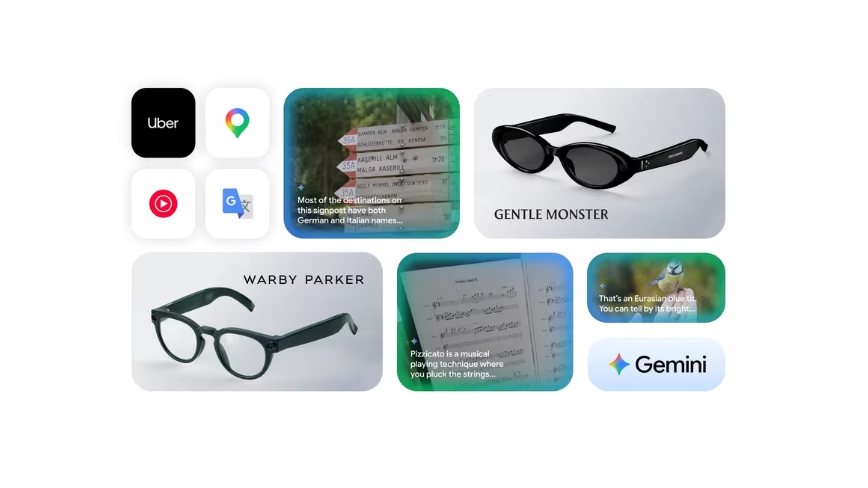
Google is having another go at smart glasses, and this time it is bringing fashionable friends along for the ride. At Google I/O 2026 on Tuesday, the company announced a new partnership with Warby Parker and Gentle Monster to produce AI-powered “audio glasses” designed in collaboration with Samsung. Powered by Gemini 2.5 Pro and running on Android XR, the glasses are expected to ship this autumn and will be compatible with both Android and iOS devices.
What Google actually announced
The pitch is straightforward: wear the glasses, speak a command, and let Google’s ecosystem handle the rest. During a stage demo, a Googler ordered coffee online simply by talking to the frames, a deliberately mundane use case that seemed engineered to signal everyday utility rather than science-fiction ambition. Users can activate the assistant by saying “Hey Google” or tapping the side of the frame.
Google is planning two product tiers. The first, the audio glasses arriving this autumn, will handle voice-driven tasks including call management, text messaging, Gemini-powered message summaries, and real-time translation that matches the speaker’s voice. The second, a Display Edition expected later, will add a monocular microLED heads-up display capable of showing turn-by-turn directions, notifications, and AI-generated responses directly in the wearer’s field of view.
There is also Project Aura, a developer-focused kit built with XREAL that features full binocular displays and a 70-degree field of view, though this is a separate product aimed at encouraging third-party development on the Android XR platform.
Under the hood
Each pair of glasses packs a camera, speaker, and onboard microphone. A Snapdragon processor handles local computation, though Google has not confirmed the specific chip. The feature set leans heavily on Gemini’s multimodal capabilities: users can ask visual questions about what they see, whether that is a restaurant they are passing, a cloud formation overhead, or a parking sign they cannot quite parse. Real-time translation extends beyond audio to text rendered in the wearer’s field of view. No pricing has been announced.
The Meta-shaped elephant in the room
Google is entering a market that Meta has already claimed with startling efficiency. Meta sold roughly seven million pairs of Ray-Ban smart glasses in 2025 and now commands an estimated 82% of the nascent smart glasses market. It is not slowing down either, with prescription models called Scriber and Blazer on the way.
Google’s counter-strategy appears to rest on two pillars: fashion credibility and platform scale. Partnering with Warby Parker gives it access to a brand that resonates with younger, style-conscious consumers in North America, while Gentle Monster, the South Korean luxury eyewear label, opens doors in Asian markets. Samsung’s involvement in the design adds manufacturing heft, and the company’s own Galaxy Glasses, also running Android XR, are expected later this year.
The privacy questions that have dogged every smart glasses maker will inevitably follow Google too. Placing cameras on people’s faces in public spaces remains a contentious proposition, and Google has more reason than most to tread carefully given its history with the category.
The ghost of Google Glass
It is impossible to discuss Google’s smart glasses ambitions without acknowledging the spectacular cultural failure of Google Glass. Launched over a decade ago, the original product became synonymous with tech-industry hubris, spawning the term “glassholes” to describe its early adopters. The device was eventually pulled from the consumer market and redirected toward enterprise applications before being quietly discontinued altogether.
This time, Google appears to have learned at least one lesson: do not try to make people wear something ugly. The Warby Parker and Gentle Monster collaborations suggest the company understands that smart glasses need to be glasses first and smart second. Whether this aesthetic-first approach is enough to overcome the category’s lingering stigma remains to be seen.
The platform play
Perhaps the most significant aspect of the announcement is not the glasses themselves but Android XR, the operating system underneath them. Google’s strategy mirrors what it did with smartphones over a decade ago: build an open platform, recruit hardware partners, and let the ecosystem do the heavy lifting. If Android XR gains traction, Google will not need to win the hardware race outright. It will just need enough manufacturers building on its platform to establish dominance by default.
The growing interest from startups in holographic and advanced display technologies suggests the broader smart glasses category is attracting serious investment. Google is betting that, as with smartphones, the winner will be the company that controls the software layer rather than any single piece of hardware. Given Meta’s commanding market lead and Apple’s rumoured interest in the space, that is a bet with no guaranteed payoff, but it is one Google has won before.


 Credit: Google