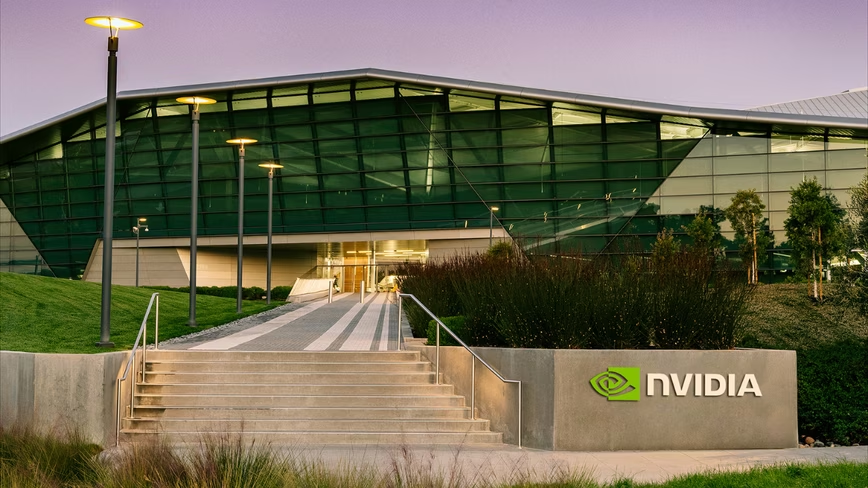
 Credit: NVIDIA
After eight months of export licences that moved almost nothing, Nvidia’s H200 accelerators have started arriving at Chinese technology companies.
ByteDance and Tencent have each received about 10,000 of the processors in recent weeks, according to the Financial Times, with other Chinese groups expected to secure similar volumes shortly.
Even taken at face value, the volumes are small against what was once on the table. When the Commerce Department cleared around ten Chinese firms to buy H200s in May, each licence carried a 75,000-unit cap and not a single chip had shipped; Chinese buyers had reportedly placed orders for roughly two million units back in January.
One figure in the FT report does not reconcile with the record. The paper puts the US ceiling at 100,000 chips per company, whereas the cap reported by Bloomberg in March and echoed in coverage of the May approvals was 75,000. No source has documented a revision, so the higher number belongs to the FT alone until Commerce says otherwise.
Getting to this point took most of a year of stop-start policy on both sides. China blocked H200s at customs in January, then conditionally cleared ByteDance, Alibaba, and Tencent for more than 400,000 units combined a fortnight later, before Washington narrowed the field again in May.
The more interesting complication is geographic. Beijing has instructed companies to keep the hardware outside mainland China in order to protect its domestic chipmakers, and regulators are letting firms route processors to Hong Kong instead, which sits outside the mainland’s customs border.
That workaround is not improvised. Hong Kong already handles more than half of China’s chip imports, some $124bn worth between January and May, which makes it the natural place to warehouse silicon nobody particularly wants to admit through the front door.
Mainland engineering teams can reach compute sited in Hong Kong over cross-border network links, an arrangement that keeps the chips technically offshore while making them functionally available.
Washington has noticed, and the Bureau of Industry and Security is reviewing how Chinese firms rent access to hardware they are not permitted to own outright.
Commerce had already tried to close the geographic gap once. A clarification issued on 31 May extended the licensing requirement to Chinese and Macau-headquartered entities wherever in the world they operate, which is precisely the loophole a Hong Kong data centre would otherwise open.
Nvidia has been tightening its own end of the pipe in response, cutting more than half its Asian customers from an internal approved-buyer list in July, an expensive kind of compliance for a company whose China business was worth billions before the controls landed.
Notably, the drag on this trade is coming from Beijing rather than Washington. Commerce Secretary Howard Lutnick said in May that “the Chinese central government has not let them … buy the chips, because they’re trying to keep their investment focused on their own domestic industry”, a stance consistent with the $295bn domestic AI data centre plan Beijing drafted in June.
The commercial terms remain unusual by any standard. Trump announced in December that the US would allow Nvidia to ship H200s to approved customers in China, with “25% will be paid to the United States of America”, an escalation of the 15% revenue share Nvidia and AMD accepted on H20 and MI308 sales the previous August.
Congress, meanwhile, has been given a considerably smaller picture. Jeffrey Kessler, the under secretary of commerce for industry and security, told the House Foreign Affairs Committee on 14 July that “very few” H200s had reached China or Hong Kong, a volume he separately called trivial.
Twenty thousand units is no longer trivial, but it is not much of a market either. Whether the balance follows now depends far less on American export licences than on how long Beijing thinks its own chipmakers can afford to wait.
Get the TNW newsletter
Get the most important tech news in your inbox each week.


