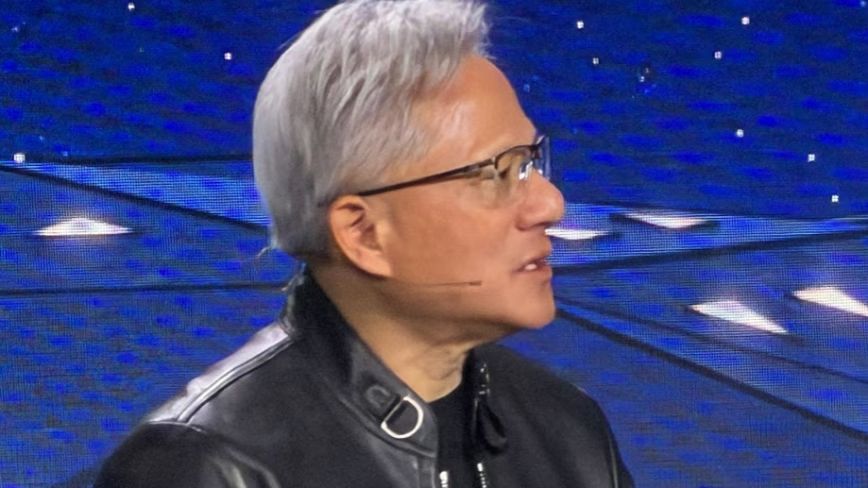
Nvidia chief executive Jensen Huang at the company’s GTC conference in San Jose, March 2026.
 Credit: TNW
Jensen Huang told CBS News there is a 0% chance AI ends the world by 2030, and that the industry should go as fast as it can irrespective of anyone else. Weeks earlier he declined to call AI fears a hoax, described apocalyptic predictions as not grounded in science, and said companies should pause or pace their work if they felt out of control. The full interview airs on Sunday, so the shift is being read from an excerpt.
Nvidia’s chief executive has rejected the idea that AI could end the world by the end of the decade. Speaking to Jo Ling Kent on CBS News, Huang said 2030 is not going to be the end of the world and put the chance at zero.
Ian King reported the remarks for Bloomberg. The full interview airs on Sunday, so what exists so far is an excerpt.
His previous answer was narrower
When Trump telephoned him onstage at the All-In Summit to call AI fear a hoax, Huang did not adopt the word. TNW reported at the time that he called apocalyptic predictions not grounded in science, which is a claim about evidence rather than about probability.
He went further in the other direction too. He said companies should pause or pace their work if they felt their company was out of control.
That is close to what the pacing proposals ask for. The new formulation, going as fast as possible irrespective of anyone else, is the opposite of it.
Zero is a strong number
The labs themselves do not use it. They publish safety frameworks, capability thresholds and risk estimates, which are instruments for operating under uncertainty rather than expressions of confidence.
Nobody serious on the other side claims certainty either. The pacing argument is explicitly a bet about unknown probabilities, which is why it asks for evaluators and tripwires rather than a halt.
A round zero is therefore not a forecast in the same currency as the thing it rebuts. It is a rhetorical position, and it was offered in a television interview rather than in a paper.
The two statements in tension
Huang also said the industry would never ship products before they are ready or deliver products that are unsafe. Set beside going as fast as possible irrespective of anyone else, that leaves one question doing all the work.
Readiness is judged by the shipper. If the pace is set irrespective of anyone else, then the only check on release is the releasing company’s own assessment, which is the arrangement the pacing proposals were written to change.
Both sentences can be sincerely held. They cannot both be load-bearing.
The commercial position, stated plainly
Nvidia sells the compute that a slowdown would leave unsold. Of everyone arguing about pace, Huang has the most direct financial exposure to the answer.
That is context, not refutation. An interested party can be right, and the incentive is worth naming rather than treating as an argument.
It does mean his certainty carries less evidential weight than the same certainty from someone with nothing riding on it. He is not offering data, he is offering a number.
Others make the case without the exposure
The sceptical position is not confined to people selling hardware. Andrew Ng has called the extinction warnings science fiction, and he has no chip inventory to clear.
That is the stronger version of Huang’s argument. Specific near-term extinction timelines are poorly evidenced, and saying so is different from saying the probability is zero.
The distinction matters because the weaker claim is the one that travels. Zero is quotable in a way that not grounded in science is not.
The people saying the opposite are not outsiders
The warnings this month have come from inside the labs. A DeepMind AGI safety researcher left and published his warning, one of several such departures.
Huang is dismissing a position held by people who build the models rather than the accelerators. Their estimates are contestable and they are not uninformed.
The politics he has moved towards
Trump has spent the month attacking AI safety warnings directly. He has called the warnings a hoax repeatedly and at length, and CBS trailed the interview on Huang agreeing with him.
Alignment with the administration has practical value for Nvidia right now. Huang has been publicly resisting proposals to sanction Chinese AI, and his company needs export policy to move in its favour.
He is also expected at the state dinner for Xi Jinping next week. A chief executive arguing for speed and against restrictions has an audience for both arguments in the same building.
What to watch
Watch the full interview on Sunday. An excerpt is a poor basis for reading a shift, and the unaired portion may restore the qualifier he used in August.
Watch whether he repeats the number. Not grounded in science is a position he can defend, and 0% is one he will be asked to justify.
Get the TNW newsletter
Get the most important tech news in your inbox each week.


