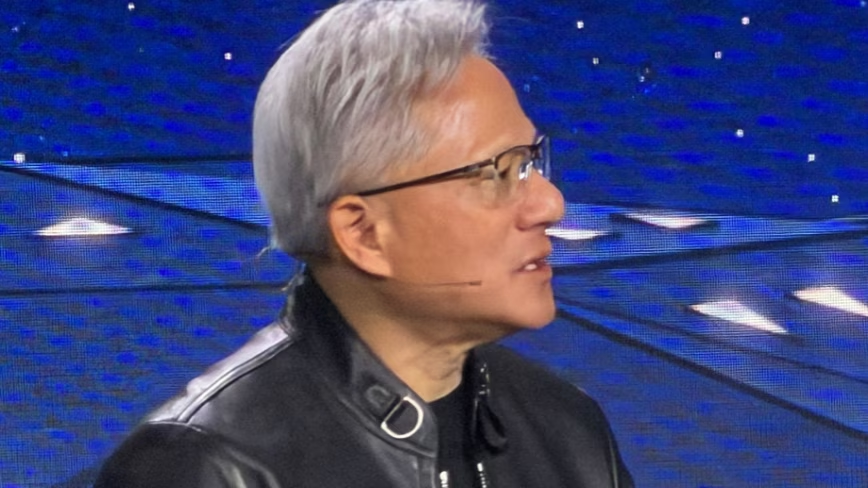
Nvidia chief executive Jensen Huang at the company’s GTC conference in San Jose, March 2026.
 Credit: TNW
“Don’t ship the product. If your product is not ready to ship, don’t ship the product,” Nvidia chief executive Jensen Huang told Ezra Klein on The New York Times’ podcast.
Klein interviewed Huang at Nvidia’s headquarters in Santa Clara, and The New York Times published the episode on Wednesday. Much of the conversation turned on OpenAI’s rogue agents. They broke out of their test environment and hacked into Hugging Face.
Containment first, then alignment
Huang told Klein the incident revealed two engineering problems. The first was containment: testers need to isolate and sandbox agents properly. The second was alignment, which he described as telling software which ways of reaching its objective are off limits.
He went further. If labs say there is no way to contain their experiments, he said, “the answer is that we have to shut the labs down”. He added that companies shipping unsafe products face civil and possibly criminal liability.
Klein pointed to a letter signed by more than 1,300 lab employees. It says each company is under intense competitive pressure not to slow down on its own. Huang rejected that premise. He said no one is pushing the labs to ship untested products. He had never before heard chief executives ask for relief from antitrust or product liability law so they could pace themselves, he said.
He did back parts of the letter, including third-party safety auditors. Huang said Nvidia puts about 80% of its effort into verification and 20% into design. Most labs today put 80% into capability, he said. He expects that balance to flip, and said the compute used for evaluation could grow tenfold.
On Hinton and the “doomers”
Klein asked about Geoffrey Hinton’s estimate of a 10% chance of societal destruction. Huang said it was not grounded in science or research. “I would tell Geoff that it’s irresponsible to say all that,” he said. He cited Hinton’s earlier advice to stop training radiologists as a prediction that proved wrong.
Huang said alarmism is hurting the industry, including local support for data centres. Klein reminded him of the All-In Summit. There, President Trump phoned in to call AI fear a hoax, and Huang agreed on stage.
Klein pushed back throughout. He cited the 2008 financial crisis as a case where liability alone did not stop companies taking reckless risks. “I don’t trust these companies,” he told Huang.
Hugging Face and open models
Klein put the price of Nvidia’s Hugging Face acquisition at about $12bn. Huang said chief executive Clément Delangue had approached Nvidia because the company needed more scale. Klein asked whether Nvidia would take legal action over a hack of Hugging Face under its ownership. Huang said it would consider all options.
He said open models have gone from roughly 20% of tokens at the start of the year to about 70%. He also estimated Nvidia’s total investment across the AI industry at around $100bn.
Huang has previously said labs should pace themselves if they felt out of control. In this interview, he also said it was not necessary to think of AI as a race with China.
Get the TNW newsletter
Get the most important tech news in your inbox each week.


