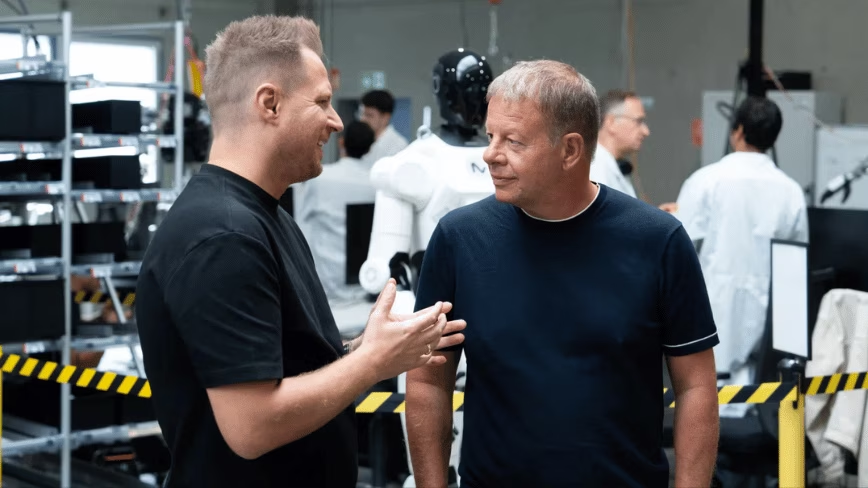
NEURA Robotics founder and CEO David Reger, left, with SECO CEO Max Mauri

A German company designs the robot. An Italian company builds the board that goes inside it. An American company designs the chip that goes on the board. That is the European Physical AI stack as it actually exists. On Monday, two thirds of it signed a partnership.
NEURA Robotics and SECO said in a joint announcement that SECO will design, engineer and manufacture the electronic compute modules for NEURA’s cognitive robots. That includes the 4NE1 humanoid. The release is datelined Metzingen and Arezzo. The modules will be developed and produced in Europe, and they carry Qualcomm Dragonwing processors.
NEURA is the German robotics company that raised up to $1.4bn in June, at roughly a $7bn valuation. It says it intends to build millions of cognitive robots by 2030. SECO is a rather different sort of company, and the gap between the two is the most interesting thing here.
Who SECO actually is
SECO is a listed embedded-computing firm in Arezzo, in Tuscany. It trades in Milan under the ticker IOT. It makes computer-on-module boards and single-board computers, and sells an edge AI software framework called Clea. Its customers sit in industrial automation, medical devices, transport, energy, defence and vending machines.
Its numbers are modest and improving. First-half revenue came in at €98.8m against €98.4m a year earlier, which is essentially flat. Arezzo24 reported the preliminary figures in July. Edge computing accounted for €91.4m of that, up 6%. Clea contributed €7.4m, of which €4.8m was recurring, up 12%.
The margin line is the encouraging one. Gross margin rose to 54% from 53.4%, and SECO managed that while absorbing higher memory prices. Anyone who followed the memory crunch this year will recognise what that took. Second-quarter revenue of €50m beat guidance. The company has guided to about €60m in the third quarter, which would be up 25% and its best quarter ever.
Where the sovereignty claim holds, and where it does not
The announcement talks about technological sovereignty and a resilient European supply chain. Both phrases are doing work. It is worth being precise about what Europe supplies here.
Europe supplies the integration. SECO engineers the module, qualifies it, and manufactures it at volume. That is genuinely hard and genuinely scarce. What Europe does not supply is the compute. The Dragonwing processors are Qualcomm’s, from San Diego. They arrive under a separate long-term collaboration the two firms announced in March, covering the Brain and Nervous System reference architectures.
NEURA does not hide this. Founder and chief executive David Reger said in the announcement that Physical AI “will not be built by one company alone”. He framed the goal as combining European industrial knowledge with the best technologies in the world. That is a coherent position rather than a dodge. It is just a narrower claim than sovereignty usually implies.
It also matches what this desk found in August. The argument then was that the hardest problem in the field may be the magnet, not the model. Europe’s real position keeps turning out to sit in the unglamorous industrial layers: magnets, actuators, embedded boards, qualification and volume manufacturing. This deal is another instance of the same pattern.
The arithmetic nobody has addressed
Here is the number that should shape how you read this. NEURA wants millions of robots by 2030. SECO turned over €98.8m in six months across every market it serves, from hospital equipment to vending machines.
That is not a criticism of SECO, which is a real manufacturer with real lines and a record order book. It is an observation about scale. A humanoid robot needs many boards, not one. NEURA’s Smart Limbs approach distributes sensing and compute through the machine rather than centralising it in a torso. Millions of robots therefore means tens of millions of modules. Neither company has said what capacity that requires, or who pays to build it.
Max Mauri, SECO’s chief executive, said in the announcement that the work has relevance beyond a single factory or application. That is the right ambition. The capacity question sits underneath it, unanswered, and it is the one to press at the next set of results.
The part that is not about robots
Read past the compute modules and there is a second agreement that may matter more. NEURA and SECO also plan to use data from real production lines to build Physical AI automation for semiconductor and electronics manufacturing.
The logic is a flywheel. European factories generate process data, robots learn from it, and the resulting capabilities get sold into chip plants anywhere. It fits NEURA’s Neuraverse pitch, where skills learned on one job become reusable parts rather than staying locked inside a single automation project. It also puts NEURA in the same bracket as onsemi, which made a $7bn bet on Synaptics in June.
The companies also plan a NEURA Gym in Italy, the first in southern Europe. The gyms are training halls where robots learn tasks by demonstration. TNW covered the model when NEURA opened one with RWTH Aachen in July. Putting the next one beside a manufacturing partner rather than a university is a change of emphasis worth noting.
What to watch
SECO reports third-quarter results having guided to a record. The first test is whether robotics shows up in those numbers, or stays a line in a press release. The second is whether anyone names a production volume for the 4NE1, which still has no public shipping figure.
Europe has spent two years hearing that it missed the AI platform layer. The bet in Metzingen and Arezzo is that the next layer is physical, and that industrial engineering is the part Europe never lost. The bet is reasonable. It is also, for now, only a bet.
Get the TNW newsletter
Get the most important tech news in your inbox each week.


