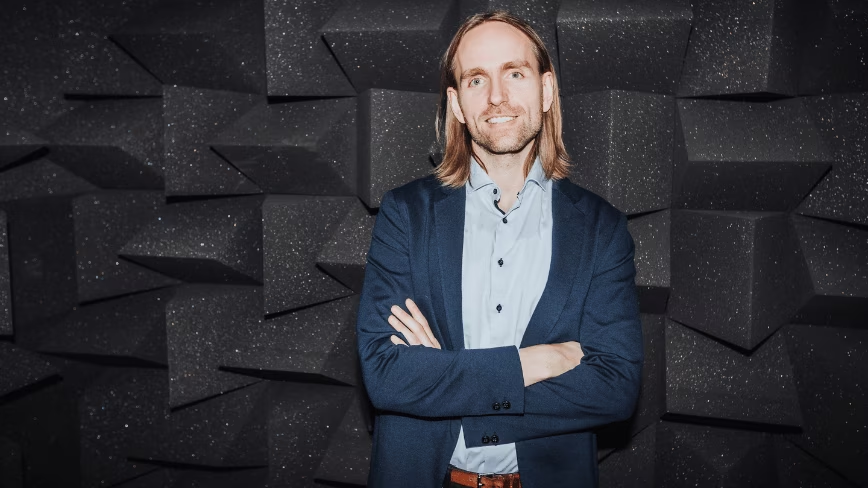
Finnur Pind, co-founder and chief executive of Treble Technologies.

“AI models and devices that perform well in a laboratory can struggle when they encounter reverberation, background noise, or an unfamiliar physical environment,” said Finnur Pind, co-founder and chief executive of Treble Technologies.
The Reykjavík company has raised $18m, about €15m, in a Series A-2 round, it announced on 17 September. Paladin Capital Group led the round. The existing investors KOMPAS VC, Frumtak Ventures and the European Innovation Council Fund took part.
The round brings Treble’s total funding to €36m. The money will support its growth in the US market, the company said.
Simulating rooms instead of recording them
Treble sells cloud software that models how sound moves through a space. Its platform combines acoustic simulation, digital twins and synthetic data generation, the company said.
The datasets it produces cover different rooms, materials, vehicles, devices, speakers and ambient sound conditions. Development teams can generate labelled datasets, test edge cases that are hard to reproduce, and compare product configurations under controlled conditions.
That replaces much of the work of collecting recordings in physical locations, which Treble called slow and costly. The approach can cut prototype testing and data collection “from months to days”, according to the company.
Acoustic engineers Finnur Pind and Jesper Pedersen founded Treble in Reykjavík. The company also sells to architects and engineers, alongside product manufacturers and AI developers.
Sound for physical AI
Treble said development of physical AI has focused mainly on vision and touch. Products must also hear and interpret sounds through background noise, across room layouts, and with microphones placed differently, it said.
A moving device adds another layer, the company said. It listed wearables, head-worn devices, humanoid robots and autonomous vehicles as examples. Meta is preparing camera-free smart glasses that rely on voice.
Other startups are also building environments for machines to learn in. NEURA Robotics is building gyms to gather robot training data. Patronus AI raised $50m to stress-test AI agents in simulation.
Amazon and Logitech
Treble said it has worked with Amazon and Logitech. Both companies supplied statements for the announcement.
“In many stages of developing Alexa as an AI assistant, we rely on virtual acoustic environments to accelerate product design and model development,” said Wontak Kim, senior audio research manager at Amazon. He said the platform lets Amazon assess audio quality virtually and test scenarios that physical testing alone cannot reproduce.
Andy Harper, head of audio AI and signal processing at Logitech, said the simulations cover acoustic environments that are hard to reproduce or test at scale. “The fidelity of the underlying physics gives us confidence in those simulations,” he said.
What the investor said
François Ruether, a vice president at Paladin Capital Group, said today’s robots are largely limited to visual perception. They may detect what is in front of them but cannot interpret sounds such as “someone falling in another room or a crash around a corner”, he said.
Treble’s platform is designed to help robots and physical AI models combine visual and auditory inputs, Ruether said. He called that multimodal capability essential to making robots useful and safe around people.
Money is flowing to voice and world models elsewhere too. Fish Audio raised $52m for open voice models in July. Emulate, founded by former DeepMind researchers, is in talks over a $700m round.
Get the TNW newsletter
Get the most important tech news in your inbox each week.


