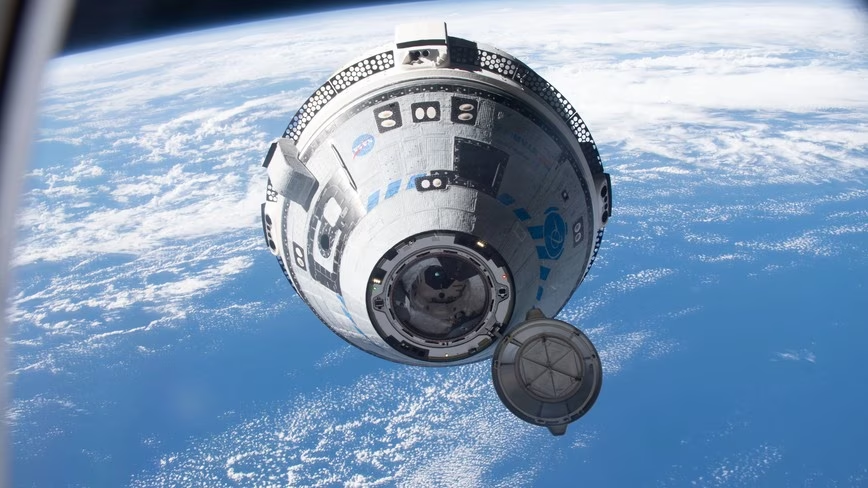
Boeing’s Starliner spacecraft in orbit above Earth
 Credit: NASA
NASA will pay Boeing $359m to help get its Starliner spacecraft flying again. It will also buy two more Starliner flights to the International Space Station. NASA and Boeing announced the plan at a news conference on Monday, and NASA set it out in a statement. It wants astronauts back on Starliner by 2028.
“I do not think it’s a secret that SpaceX intends to sunset older platforms like Falcon and Dragon as they concentrate on their next-generation capability, Starship,” said NASA Administrator Jared Isaacman.
SpaceX’s Dragon has flown NASA astronauts to the station since 2020. The announcement confirms what Eric Berger reported for Ars Technica earlier this month.
$359m for thrusters and a new rocket
The $359m covers a rebuild of the thrusters that overheated in flight, said Dana Weigel, who runs NASA’s low Earth orbit programme. It also pays to certify United Launch Alliance’s Vulcan rocket for crews. Vulcan will replace the Atlas V, which is nearing its final flight.
The two extra flights, the fifth and sixth, bring NASA’s Starliner missions to six. NASA has already paid Boeing $5.1bn under its fixed-price commercial crew contract. Starliner has cost Boeing more than $2bn in losses, Ars Technica reported. The agreed price for Starliner-2 to Starliner-6 is about $90m a seat, according to Ars.
An uncrewed test first
The next flight, Starliner-1, will carry cargo but no crew. It could fly in December or in January 2027, to test the spacecraft’s thermal fixes and find any risks left.
“Our current plan is to return astronauts on Starliner-2 by 2028,” Isaacman said.
NASA astronaut Woody Hoburg will command Starliner-2. After Starliner-1, NASA and Boeing will redesign the service module’s thruster valves to fix a seal problem. Boeing will also fit new crew module thrusters and batteries.
What went wrong in 2024
Starliner’s first crewed flight, in June 2024, carried NASA astronauts Butch Wilmore and Suni Williams to the station. Its service module thrusters ran outside their qualified limits, and the spacecraft lost control. Starliner came back empty, and the two returned on SpaceX’s Crew-9 in March 2025.
In February, NASA’s investigation report declared the flight a Type A mishap, its most serious category, and made 61 recommendations.
A ride for private stations
NASA is backing private space stations, which it calls commercial LEO destinations (CLDs), to follow the ISS. Isaacman said NASA will need two astronaut seats to low Earth orbit every six to nine months. Boeing has talked to all the private station companies about flying their crews, said John Mulholland. He runs Boeing’s commercial crew programme.
“We couldn’t provide detailed pricing to the CLD suppliers as the Vulcan rocket has not been certified, and the spacecraft has not been certified, and we don’t have detailed pricing on the Vulcan,” Mulholland said.
SpaceX’s Starship reached orbit for the first time on Monday. An engine failure on the same flight could slow NASA’s plan to return to the Moon. Greece has picked an astronaut for a private 2027 Vast mission to the station.
Get the TNW newsletter
Get the most important tech news in your inbox each week.
Also tagged with


