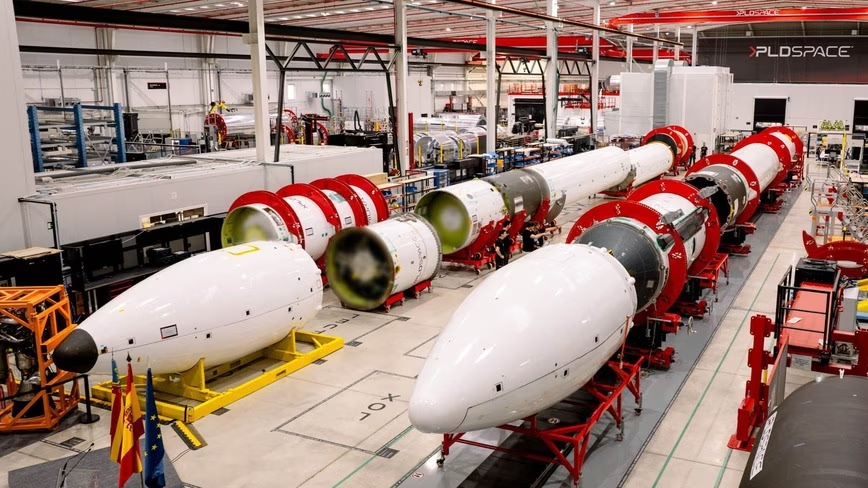
Miura 5 rocket hardware at PLD Space’s factory in Elche, Spain.
 Credit: PLD Space
Spanish launch company PLD Space announced that it has started system-level testing of its Miura 5 orbital rocket and has now built its first three vehicles.
Two of the three are qualification units, used for testing, and the third is the first rocket meant to fly; it is still being assembled, the Elche-based company said in a statement. Building them side by side lets engineers feed test results straight into the flight vehicle.
The main step is a fully assembled second stage, which combines the structure, electronics, fuel system, controls, and engine. It stands upright at PLD Space’s test site in Teruel, in eastern Spain.
There, it will go through a wet dress rehearsal, a practice countdown with real propellants. A static fire test will follow, in which the engine runs while the stage is held down.
The company said the tests will help reduce risk before Miura 5’s first demonstration flight, planned for the first half of 2027.
PLD Space has also finished tests of how the two stages separate in flight, and of two test versions of the nose cone that protects the payload.
In addition, it has built seven complete engines and 13 fuel tanks, including the liquid-oxygen tanks for both stages of the first-flight rocket. Flight electronics are now ready for four complete rockets, according to the company.
“Having manufactured three vehicles in parallel allows us to accelerate this learning process,” said Raúl Torres, PLD Space’s chief executive and co-founder.
The company is also expanding its sites. It has 17,000 square metres of factory space in Elche and ten test stands in Teruel, including a new 10.2-metre stand built to test complete second stages.
Meanwhile, at the Guiana Space Centre in Kourou, French Guiana, where Miura 5 will launch, PLD Space has received about 60 containers of ground equipment. It is working with the French space agency, CNES, on safety procedures for launches.
At the same time, the company is testing its launch pad equipment. This includes the strongback that raises the rocket upright, the clamps that hold it down until liftoff, and the lines that connect it to power and fuel.
PLD Space said it has spent €42.7M with 493 suppliers, and the work is backed by its selection for the European Space Agency’s European Launcher Challenge and a €288mn Series C funding round.
The company first flew a smaller suborbital test rocket, Miura 1, in October 2023.
Get the TNW newsletter
Get the most important tech news in your inbox each week.


