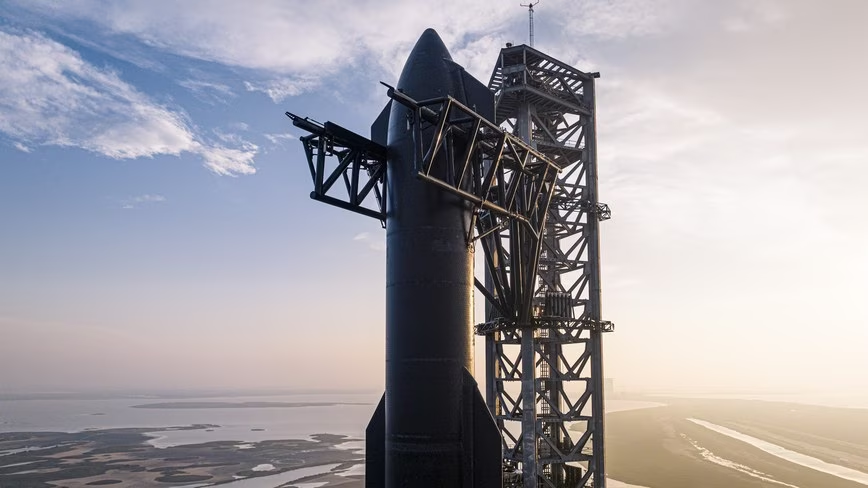
Starship on the launch tower at Starbase, Texas, April 2023

The engine failure on SpaceX’s latest Starship test could make it harder for NASA to land astronauts on the Moon on schedule, Reuters reported on Tuesday. The spacecraft reached orbit for the first time on Monday, but only after a Raptor engine shut down early.
During that 14th test flight, the ship released 26 Starlink satellites, its first commercial deployment. However, SpaceX ended the mission several hours earlier than planned.
The implications of the shutdown extend well beyond SpaceX, since NASA has chosen a version of Starship as one of two possible moon landers, with the lander depending on the same engines to take the astronauts down to the moon and then back up again.
Dean Sladen, an aerospace engineer with Accu Components, told Reuters that the extent of the damage will depend on whether only one component has failed or the entire design must be corrected on each vehicle.
“Any engine fix that holds up the next flights, including the planned attempt to catch the ship with the launch tower’s arms (after re-entry), eats into that schedule,” Sladen said.
Starship has suffered from Raptor problems in the past. On the 12th flight in May, one of the engines failed to ignite as intended. All the engines ignited during the climb on the 13th flight in July. SpaceX has also stated that it wishes to catch the upper stage with its tower, a move which it has not yet carried out.
At the same time, NASA has a tight schedule. The agency intends to return astronauts to the Moon by 2028, ahead of China’s 2030 target, which many experts consider overly ambitious.
A functioning lander also needs to be available earlier to support Artemis III, a test of docking in Earth orbit planned for as early as summer 2027.
SpaceX is no longer the only company to have the moon landing. Although it was the first to win the contract for the lander, NASA’s chief Jared Isaacman stated in April that the agency would use the first lander to be ready. This gave an opportunity to Blue Moon, which is a more conventional design by Jeff Bezos’s Blue Origin.
If both of them are ready, both landers could take part in Artemis III; however, neither NASA nor SpaceX had given any comment to Reuters by the time the article was published.
Get the TNW newsletter
Get the most important tech news in your inbox each week.
Also tagged with


