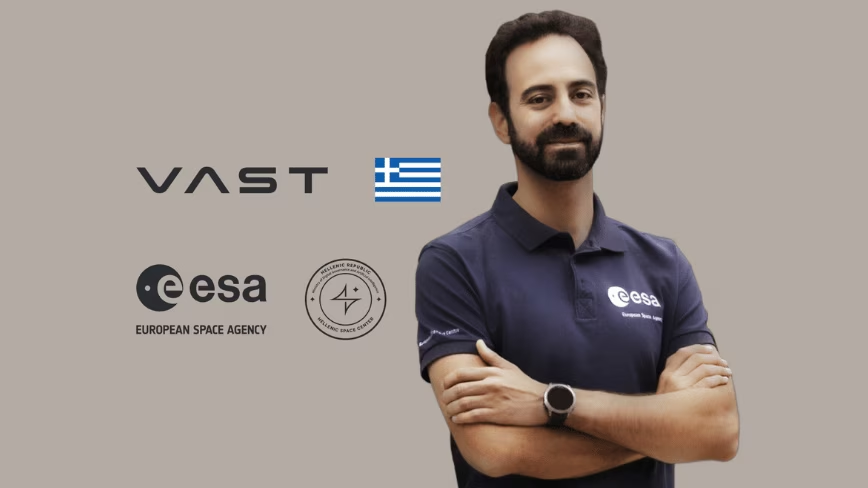
ESA project astronaut Adrianos Golemis of Greece.

Adrianos Golemis is set to become Greece’s first astronaut, subject to approval by the space station partners. The European Space Agency has signed an agreement on behalf of Greece with the US company Vast. Vast plans the mission to the International Space Station for 2027, the company announced on Wednesday.
Greek prime minister Kyriakos Mitsotakis announced the deal on stage with French president Emmanuel Macron. They spoke at the International Space Summit in Paris. The flight, called Vast-PAM-1, is part of the sixth private astronaut mission to the station. It runs in partnership with NASA. SpaceX will provide transport on a Dragon spacecraft launched on a Falcon 9 rocket.
The crew
Golemis, who has worked as a flight surgeon for ESA, is to serve as mission specialist. He is expected to join two ESA colleagues. Thomas Pesquet of France has been named commander. Aleš Svoboda of the Czech Republic, an ESA project astronaut, is slated to serve as pilot. According to the announcement, the name of the final crew member will follow soon.
His place depends on review and approval by the Multilateral Crew Operations Panel. The panel decides by consensus among the five station partners. They are NASA, ESA, Roscosmos, the Japan Aerospace Exploration Agency and the Canadian Space Agency.
Over the coming months, Golemis will take training modules in Europe and the US. One of the first steps takes him to the US in September. There he will work with teams from Vast, SpaceX and NASA.
He studied medicine at the Aristotle University of Thessaloniki. He then completed a Master of Space Sciences at the International Space University in Strasbourg. In 2014 he spent a year in Antarctica, running European experiments on human physiology and psychology in complete isolation. Since 2018 he has contributed to the medical support of ESA astronauts as a flight surgeon. He applied to ESA’s astronaut selection in 2022.
“This is a historic moment for Greece,” ESA director general Josef Aschbacher said in the announcement. Dimitris Papastergiou is Greece’s minister of digital governance and artificial intelligence. He said the mission would create opportunities for Greek experiments in medicine, human physiology, agri-food, materials and sensors, among other areas. The announcement did not say what the seat costs.
ESA wants a decision on its own crew launches
The announcement came at a summit where European space autonomy was on the agenda. Aschbacher gave an interview to Politico Europe before it opened. He said he wants European countries to decide by the end of the year whether to launch astronauts without US help. He described that as a European rocket, crew vehicle, launch system, recovery and control centres.
Politico reported that he will put the question to ministers in Rome in mid-December. They will decide whether to give ESA a mandate to explore it. “We will always work with the U.S. in space,” he told Laura Kayali. “What we certainly want to achieve now is a stronger Europe.”
Macron posted a message on X, the Associated Press reported: “Europe is taking its destiny into its own hands, including in space.” SpaceX and Blue Origin cancelled plans to attend the summit, the French government said. Politico reported that the White House had urged US space companies not to attend, as TNW covered last week.
Elsewhere in European space
ArianeGroup chief executive Christophe Bruneau told reporters that Ariane 6 is technically fully capable of carrying out crewed flights, Politico reported. Germany’s Isar Aerospace sent a rocket carrying five small satellites into orbit from Norway last weekend. Politico called it the first successful commercial orbital launch from continental European soil.
France’s The Exploration Company has raised a $450m Series C, Ars Technica reported. It is developing the Nyx cargo capsule, a crewed spacecraft and a reusable heavy-lift rocket. The EU’s IRIS2 satellite constellation is not expected to be fully operational until 2030, the AP noted.
Britain has set out a £7.8bn space strategy to 2030, TechRadar reported, including £149m for ESA’s Vigil mission. On the station, ESA astronaut Sophie Adenot wore a prop badge from Star Trek to mark the franchise’s 60th anniversary, Ars Technica reported.
Get the TNW newsletter
Get the most important tech news in your inbox each week.


