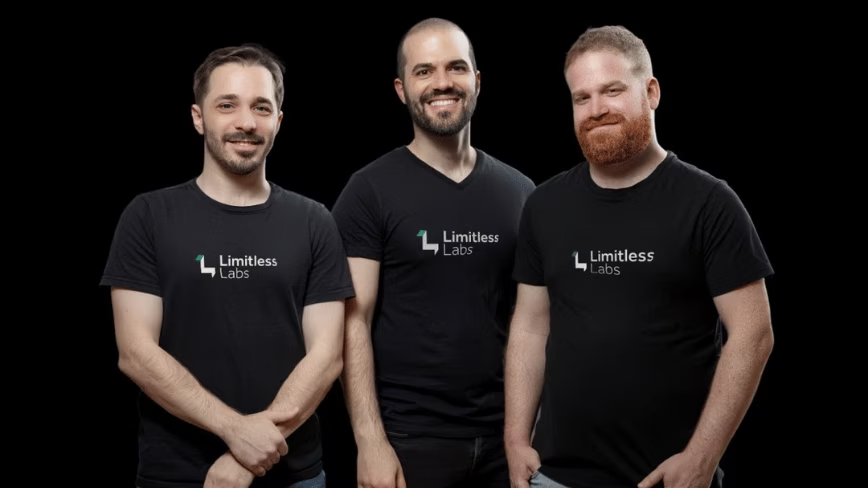
 Credit: Limitless Labs
The hottest pitch in AI right now is not another chatbot. It is software that can run the machines on a factory floor, and a two-year-old Israeli startup has just raised $20m on the strength of programming parts for Jeff Bezos’s rockets.
Limitless Labs, formerly LimitlessCNC, closed a $20m Series A co-led by Dell Technologies Capital and Square Peg, with Grove Ventures, Meron Capital and Kinetica. That takes total funding to $27.3m.
The Tel Aviv company builds an AI agent for CNC machining, the precision metal-cutting behind everything from rocket engines to medical implants. Feed it a 3D design file and it picks the cutting tools, sequences the operations and generates a ready-to-run machine program, cutting programming time by up to half.
Capturing knowledge before it retires
The problem it is chasing is demographic. Nearly a quarter of US manufacturing workers are 55 or older, some 409,000 factory jobs sit unfilled, and the gap is projected to hit 1.9 million by 2033.
Much of the skill lives in veteran machinists’ heads as what the trade calls ‘tribal knowledge’, and it walks out the door when they retire. ‘The manufacturing world needs a better way to capture and scale the expertise that lives inside the heads of a relatively small number of experienced machinists,’ said co-founder and chief executive David Priev.
Rather than a model trained on text, Limitless says its ‘Physical AI’ is trained on the physics of metal cutting, machine limits and CAD geometry, and it plugs into the software engineers already use, Siemens NX, Mastercam and PTC Creo.
Rockets and F1, at Series A
What is unusual is the customer list. Limitless is already in production with Blue Origin, Cadillac’s Formula One team, Sandvik and toolmaker ISCAR, environments where a programming error can be catastrophic and tolerances are measured in microns. It is ITAR-compliant and runs on AWS GovCloud for defence work.
Landing those names at Series A, while most rivals are still stuck in pilots, is the strongest signal the approach works. The founders, two of them veterans of the IDF’s elite 81 tech unit, closed the round in three weeks, with the US investor roadshow falling, as Priev told Geektime, in the opening days of the Iran war, his family sheltering at home as he pitched abroad.
A crowded, deep-pocketed field
The ‘Physical AI’ label is suddenly everywhere. Barcelona’s THEKER raised €73m for factory robots, NEURA Robotics pulled in up to $1.4bn, and incumbents from Fanuc and Google to Accenture are racing to wire AI into the factory. Against that, $20m is modest.
And the harder goal is still ahead. Limitless wants to push towards ‘closed-loop’ automation, but for now a human engineer signs off every program. Capturing a master machinist’s instincts in a model, reliably enough to trust on a rocket, is the real test, and the one the money is meant to crack.
Get the TNW newsletter
Get the most important tech news in your inbox each week.


