TL;DR
Fanuc, the world’s largest industrial robot manufacturer with 1.1 million robots installed globally, is integrating Google Cloud’s Gemini Enterprise and Google’s Intrinsic robotics platform into its systems, replicating Google’s Android strategy for factory robots and sending Fanuc shares to a record high.
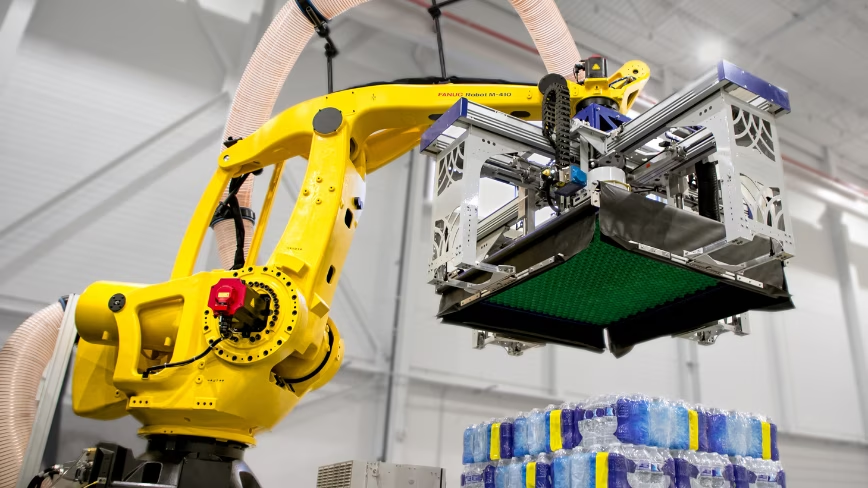
Fanuc makes more industrial robots than anyone on the planet. Google makes more software platforms than anyone on the planet. On Wednesday, the two companies announced a partnership that merges those positions: Fanuc will integrate Google Cloud’s Gemini Enterprise and Google’s Intrinsic robotics platform into its industrial robot systems, giving the 1.1 million Fanuc robots already installed in factories worldwide the ability to understand human instructions, recognise objects, and coordinate autonomously. Fanuc shares surged 16 per cent to an intraday record of 8,880 yen. The market understood what this means before the press release finished loading.
It means Google is doing to factory robots what Android did to phones.
The Android play
In February 2026, Google folded Intrinsic, its robotics software subsidiary, out of the experimental Other Bets division and into the core business. The move was not administrative. It was strategic. Intrinsic had spent years building Flowstate, a web-based platform that lets manufacturers build robotic applications without writing thousands of lines of code. The platform handles motion planning, machine learning integration, and task orchestration across different manufacturers’ hardware. A factory could swap robot arms from Fanuc, Universal Robots, and KUKA while keeping the same Intrinsic-powered software running operations.
The analogy is precise. Android does not build phones. It provides the operating system that runs across Samsung, Xiaomi, Motorola, and every other manufacturer’s hardware, giving Google access to billions of users without manufacturing a single handset. Intrinsic does not build robots. It provides the intelligence layer that runs across Fanuc, Universal Robots, and KUKA’s hardware, giving Google access to millions of industrial machines without bending a single piece of metal.
The Fanuc partnership is the Samsung moment. Samsung was not the first Android partner, but it was the one with the manufacturing scale and market share to prove that Android could dominate. Fanuc commands roughly 16 to 18 per cent of global robot shipments, holds an estimated 50 to 60 per cent of the global CNC market, and has surpassed 1.1 million robots installed in factories from automotive plants to pharmaceutical packaging lines. When the world’s largest robot manufacturer adopts your software platform, the rest of the industry recalculates.
The partnership
The technical details matter. Fanuc will use Google Cloud’s Gemini Enterprise, the same generative AI platform that powers eight million paid enterprise seats across 2,800 companies, to build industrial robot systems that can process natural language instructions, identify and classify objects in unstructured environments, and autonomously control multiple robots working together. Fanuc will also achieve full compatibility with Intrinsic’s Flowstate development environment, meaning developers can program Fanuc robots through a visual, web-based interface rather than proprietary Fanuc code.
Fanuc has already shipped more than 1,000 robots equipped with physical AI capabilities since demonstrating the technology at the International Robot Exhibition in Tokyo last December, and reported that demand was accelerating. The company plans to demonstrate an AI agent system for industrial robots later this month, in which collaborative and non-collaborative robots operate together using natural language instructions. The Google partnership provides the foundation model layer that Fanuc’s existing physical AI stack lacked.
Accenture has invested in General Robotics, whose GRID platform deploys AI skills across more than 40 robots from different manufacturers including Fanuc, illustrating that the consultancies are already building businesses around multi-vendor physical AI orchestration. Google’s entry changes the economics. Intrinsic is not a startup seeking Series B funding. It is backed by a company with 4.6 trillion dollars in market capitalisation, 70 billion dollars in annual cloud revenue, and the most widely deployed generative AI models in enterprise computing.
The company
Fanuc was born from a division of Fujitsu in 1956 and spun off as an independent company in 1972. It is headquartered in Oshino, a village at the base of Mount Fuji in Yamanashi Prefecture, where the corporate campus is surrounded by forest and painted entirely in the company’s signature yellow. By 1982, Fanuc had captured half of the world CNC market, a position it has never relinquished. The company makes three things: CNC systems that control machine tools, industrial robots that operate in factories, and robomachines that combine both capabilities. It makes them better and in greater volume than any competitor.
Fanuc posted record sales of 857 billion yen in fiscal 2025, roughly 5.7 billion dollars, with an operating margin of 21.4 per cent. Robot sales declined 16 per cent during the period due to weaker demand in China, Europe, and the Americas, particularly in automobile-related industries. But the physical AI announcement, and the Google partnership that followed, signal that Fanuc sees the next growth cycle coming not from selling more robot arms but from making the arms it has already sold significantly more capable.
Nvidia’s GTC 2026 opened with 30,000 attendees and announcements that could reshape the next two years of AI infrastructure, and physical AI was a dominant theme. Fanuc was already a Nvidia partner, having announced in March 2026 that it would integrate Nvidia’s Isaac simulation frameworks and Omniverse libraries into its physical AI pipeline. The Google partnership adds the foundation model layer on top of Nvidia’s simulation and training infrastructure, giving Fanuc a two-platform AI stack that no competitor can match.
The market
The physical AI market is projected to grow from 1.5 billion dollars in 2026 to 15.2 billion dollars by 2032, a compound annual growth rate of 47 per cent. The adjacent industrial robotics intelligence software market is forecast to add 49 billion dollars by 2031 as factories shift from programmed motion to adaptive automation. McKinsey projects the broader market for general purpose robots could reach 370 billion dollars by 2040. The numbers are large and speculative. What is not speculative is that every major robotics company in the world is partnering with at least one foundation model provider, and the companies that partner with the strongest providers will capture the most value.
Fanuc’s competitors are moving in the same direction. ABB has partnered with Nvidia for simulation-based physical AI. KUKA and Universal Robots are Intrinsic partners. Yaskawa, whose shares also rose on the Fanuc-Google news, has its own AI integrations. But none of them have Fanuc’s installed base. The 1.1 million robots in factories worldwide represent an upgrade opportunity that no amount of new robot sales can match. If even a fraction of those machines receive AI software upgrades through the Intrinsic platform, Google’s physical AI revenue could scale faster than any hardware competitor’s.
Alphabet closed in on Nvidia as the world’s most valuable company after Q1 2026 earnings beat estimates across every division, with Google Cloud growing 63 per cent year on year to cross 20 billion dollars in quarterly revenue. The robotics partnership extends Google Cloud’s value proposition beyond chatbots and enterprise agents into the physical operations that account for the majority of global economic output. Manufacturing, logistics, agriculture, and construction are collectively worth tens of trillions of dollars. The companies that provide the intelligence layer for those industries will capture a proportional share.
The geography
The partnership has a geopolitical dimension. Fanuc announced in March 2026 a 90 million dollar investment to build an 840,000 square foot robot manufacturing facility in Pontiac, Michigan, creating 225 jobs and expanding its US-based production capacity for physical AI-enabled robots. Since 2019, Fanuc America has invested nearly 300 million dollars in US facilities, expanded its footprint to three million square feet, and created more than 700 jobs. The company is opening the largest robotics and automation skills development centre in the United States at its Auburn Hills, Michigan campus later this year.
Japan accounts for roughly 38 per cent of global industrial robot production by value and houses five of the ten largest robot manufacturers. SoftBank, NEC, Sony, and Honda have formed a 2.3 billion dollar physical AI consortium with backing from Japan’s national research agency. The country that dominated industrial robotics for four decades is now positioning itself to dominate the AI layer that will make those robots intelligent. Fanuc’s Google partnership is the commercial expression of that national strategy.
Sundar Pichai opened Cloud Next 2026 with a 240 billion dollar backlog, 750 million Gemini users, and a plan to turn every Google product into an agent manager. The Fanuc deal shows that the agent strategy extends beyond screens. The same Gemini models that summarise emails and generate code are now being adapted to control robotic arms that weld car frames and assemble electronics. The intelligence is the same. The output modality is different. Instead of text, it produces physical motion.
The bet
Nvidia’s Jensen Huang said at GTC 2026 that every industrial company will become a robotics company. Google is betting that every robotics company will become a Google customer. The Fanuc partnership is the most significant evidence yet that the bet is working. A 54-year-old Japanese manufacturer that has spent half a century building the most reliable industrial robots in the world just decided that Google’s software is the intelligence layer its machines need.
Kia has confirmed plans to deploy Boston Dynamics Atlas robots in its Georgia factories starting in 2028, and every major automaker is evaluating similar programmes. The demand is real. The question was always which software platform would run the robots. Fanuc’s answer, delivered to a market that added 16 per cent to its share price in a single morning, is that the platform will be built by the same company that runs Android, Search, YouTube, and the fastest-growing cloud business in enterprise computing. The factory floor just became a Google product.


 Credit: Fanuc