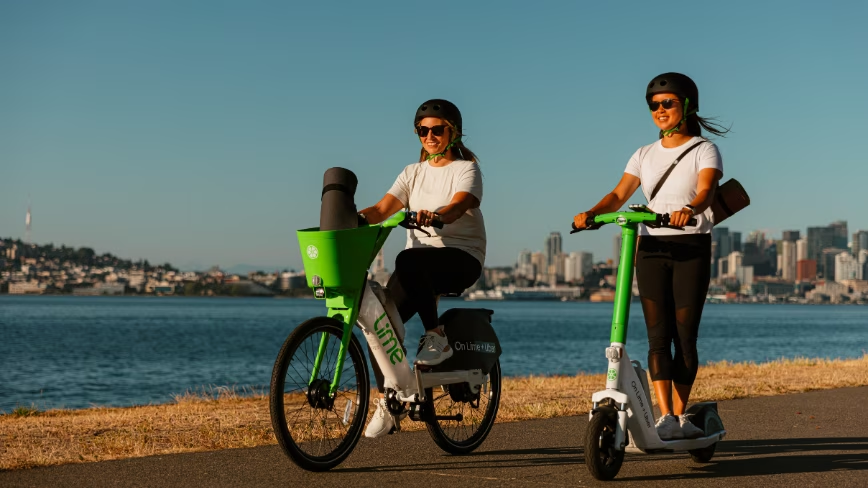
The San Francisco scooter-and-e-bike operator goes public as Neutron Holdings with Goldman Sachs and JPMorgan as joint book-runners. $686m in 2024 revenue and two consecutive years of free cash flow give it a financial profile that the rest of the category never reached.
Lime, the Uber-backed shared scooter and e-bike operator, filed for a US IPO on Friday under its corporate name Neutron Holdings. The San Francisco-based company plans to list on Nasdaq under the ticker LIME.
Goldman Sachs and JPMorgan are leading the syndicate. Pricing terms, share count, and target valuation were not disclosed in the initial filing.
The S-1 lands at the end of a quiet stretch. The IPO market reopened in March after the spring slowdown that followed Middle East tensions and equity-market volatility, and a queue of AI-infrastructure, defence, and biotech filers has worked through it.
Lime is the first significant urban-mobility name to test public-market appetite since 2018, when its peers Bird and Uber’s Jump unit attracted the last big micromobility valuations.
The category Lime is opening up has a graveyard. Bird filed for Chapter 11 in December 2023 after misstating ridership revenue and burning through its SPAC cash. Tier laid off 22% of its workforce in 2024 before merging with Dott. Spin shut down.
Voi reached EBITDA-positive in 2022 but has not gone public. The narrative attached to shared scooters in 2018 was hyper-growth, low margins, and a regulatory ceiling. By 2024, two of those three had been priced out of the model.
Lime’s filing is a different proposition. The company reported $686m in 2024 revenue, up 32% year-on-year, and posted positive free cash flow for the second consecutive year.
Lime says it now operates in 280 cities across roughly 30 countries, and that it served more than 24 million riders in 2024.
Profit growth, on the company’s own characterisation, outpaced revenue growth. None of those data points individually proves a public-market case, but together they do something the rest of micromobility never managed: deliver a financial profile that public investors can underwrite without having to invent a TAM story.
Wayne Ting has been chief executive since May 2020, when he took over from Brad Bao after Lime’s pandemic-era restructuring.
The current operating model concentrates on contracts with cities (which buy permits or limit fleet sizes), in-house fleet maintenance, and integration with the Uber app, which now lists Lime in over 55 cities globally.
Both pieces matter for the equity story: regulatory durability and a partner-driven distribution channel.
Uber as a sponsor
Uber’s stake dates to 2020, when it invested in Lime at a $510m post-money valuation as part of a $170m round, and divested its own Jump bike-and-scooter business into Lime in the same transaction.
The IPO marks the first opportunity for Uber to mark its position to a public price.
Lime executives have said the company is targeting a substantially higher valuation than its 2020 mark, and bankers familiar with the process have pointed to a target in the $4-5bn range, although that has not been disclosed in the S-1.
The relationship cuts both ways. Uber is both an investor and a competing platform. Uber’s own ride-hailing business has, at times, run promotional pricing that displaces low-end mobility journeys; on the other hand, Uber’s app is one of Lime’s largest top-of-funnel channels. The S-1’s risk factors section will be worth reading on this point.
Lime is filing into a market that has been more receptive to physical-asset and infrastructure stories than to consumer mobility.
Fervo Energy’s $1.33bn climate-tech listing and X-Energy’s record $1.02bn nuclear IPO were both well subscribed; SpaceX has begun a roadshow at a $1.75 trillion target valuation. The unifying feature is balance-sheet-heavy companies with long-duration revenue visibility.
Lime fits that profile less perfectly: its assets depreciate quickly, its city contracts come with re-tender risk, and the residual cohort of Bird, Tier and others reminds investors that the category model is still being written.
Recent precedents in adjacent consumer fintech and platform stories have not all aged well. The cautionary arc of Klarna’s post-IPO 76% decline has been a reminder that even profitable, recognisable consumer brands can struggle on public markets when their multiple is set in a generous private round.
Lime’s ability to come to the tape priced sensibly will matter more than the size of the deal.
Three things will determine the bookbuilding. First, the price talk. A target north of the 2020 mark is taken; the more sensitive question is whether bankers can frame the unit economics in a way that defends a multi-billion-dollar valuation against a sceptical comparable set.
Second, primary versus secondary share mix. Lime needs growth capital, but Uber and other early backers will also want to take chips off the table. The split tells investors how confident the inside list is in the long-term story. Third, the calendar.
Pricing in the second half of May would land alongside Fervo, ahead of SpaceX’s marketing window in early June; later than that risks competing with the SpaceX overhang.
If the deal works, micromobility re-enters the public-market conversation seven years after Bird’s stumble. If it does not, Lime will become a private market outlier whose financials look better than its peers’ but whose category still cannot find an investor base.
The S-1 will be amended in the coming weeks, with terms and price talks to follow.
Get the TNW newsletter
Get the most important tech news in your inbox each week.


