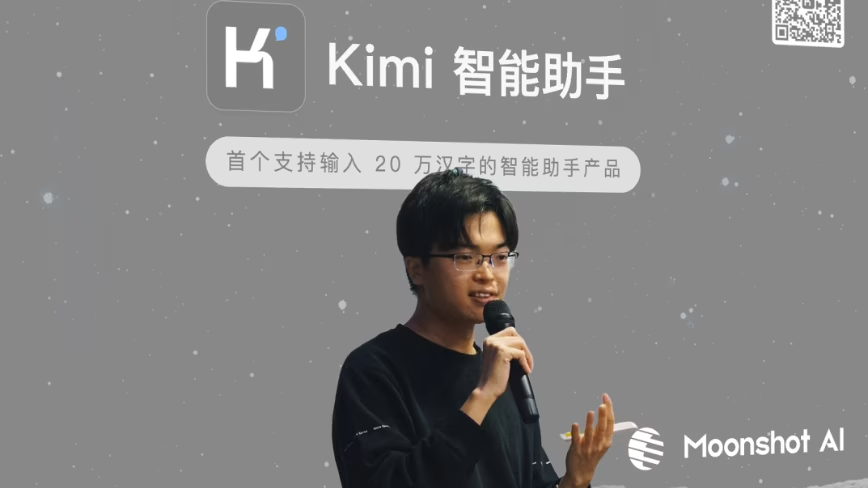
The $20bn Kimi developer has informed shareholders it will dismantle its variable-interest-entity structure, after Beijing made it clear an exemption was unlikely. The IPO would be one of the biggest Chinese AI listings on record.
Moonshot AI, the Beijing-based developer of the Kimi chatbot, has told shareholders it intends to dismantle its variable-interest-entity (VIE) structure to clear the path for a Hong Kong listing, South China Morning Post reported on Monday, citing people familiar with the matter.
The company is valued at $20bn after its most recent funding round, and the IPO would be among the largest Chinese AI listings since the category opened up to public-market capital.
The structural decision is the substantive news. Moonshot’s offshore vehicle is registered in the Cayman Islands, with its operating assets in mainland China held through a VIE arrangement.
Under the China Securities Regulatory Commission’s revised IPO rules, listing candidates with offshore VIE structures must now justify their continued existence in a procedural review, with the regulator’s preference being for mainland-anchored entities. Moonshot initially sought a waiver.
The company’s pivot to unwinding the structure entirely signals that the waiver pathway looked, on internal counsel’s read, unlikely to succeed.
The funding context is the part that gives the IPO its scale. Moonshot closed a $2bn round earlier this month at the $20bn post-money valuation, bringing total funding since November 2025 to roughly $3.9bn, on AI Insider’s accounting.
The company has scaled its annualised recurring revenue to about $200m as of April. Investors in the recent rounds include Alibaba, with rumours of Tencent and Hillhouse participation that the company has not formally confirmed. Bloomberg first reported the Hong Kong IPO consideration in March, when Moonshot’s valuation was at a lower level, and the regulatory question still appeared resolvable through an exemption.
The wider competitive frame is the Chinese-AI race. Moonshot’s Kimi chatbot has been one of the consistently top-performing Chinese AI products by user-engagement metrics, alongside DeepSeek’s open-weights models and ByteDance’s Doubao.
TNW’s previous coverage of DeepSeek’s open-weights cadence is the most accessible English-language framing of where Chinese AI now sits. The companies that emerge as listed entities through the 2026-27 window will become the publicly comparable benchmarks against which US-listed OpenAI (whenever it lists), Anthropic, and others are valued.
The geopolitical overlay is the part the regulators have made unavoidable. Moonshot’s listing would land inside the same window as the Trump-Xi Beijing summit’s loosely-defined AI guardrails conversation, the H200 export-licensing arrangement that has so far produced more paper clearance than actual chip delivery, and the ongoing CSRC tightening of Chinese companies’ offshore structures.
A Hong Kong listing rather than a New York one is, in that context, an explicit choice to anchor the company’s capital base in a jurisdiction the Chinese government can directly regulate. The fact that Moonshot was prepared to sacrifice the VIE structure to make the listing happen is the most visible operational consequence of that choice.
What the unwinding looks like in practice is a technical structural-finance question. Moonshot’s offshore entities and the mainland operating company will be merged or restructured under a single Hong Kong-listing vehicle, with the regulatory approvals required across multiple Chinese supervisory bodies.
The timeline is, on standard Chinese-AI-IPO cadence, several quarters rather than several months. A formal listing application after the restructure completes, plus the standard Hong Kong Exchange approval window, would place the actual listing date in the late 2026 or early 2027 window.
What remains unresolved is the indicative price range Moonshot will target, the share of new versus existing equity in the offering, and whether the unwinding process will require Moonshot to re-paper its US dollar funding rounds into renminbi-denominated equivalents.
The latter is the kind of detail that materially affects existing Western investors’ rights in the eventual listed entity. The company has not, on the available primary text, addressed any of those three questions publicly.
Get the TNW newsletter
Get the most important tech news in your inbox each week.


