TL;DR
Geothermal developer Fervo Energy is offering ~55m Class A shares at $21–24 each in a Nasdaq IPO positioned as climate-tech’s most direct play on the AI infrastructure trade.
 Credit: Fervo Energy
Geothermal developer Fervo Energy is offering ~55m Class A shares at $21–24 each in a Nasdaq IPO positioned as climate-tech’s most direct play on the AI infrastructure trade.
On Monday, Fervo Energy formally launched its IPO roadshow, offering 55,555,555 shares of Class A common stock at an indicated range of $21 to $24 each. At the high end of the range, the geothermal-energy developer would raise as much as $1.33bn and become the largest climate-tech IPO of 2026 to date. The company has applied to list on Nasdaq under the ticker FRVO, with pricing expected the week of 11 May.
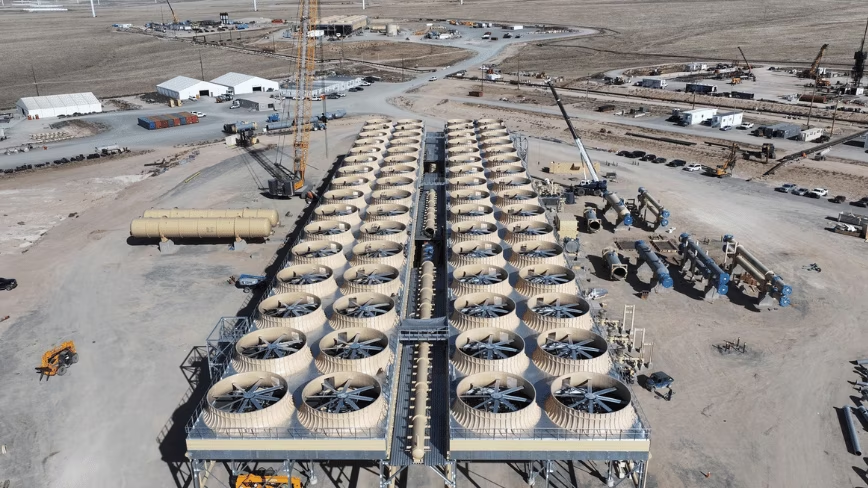
Fervo’s commercial proposition is the deployment of enhanced geothermal systems at scale. The company combines horizontal-drilling techniques borrowed from oil and gas with fibre-optic sensing and advanced reservoir engineering to extract geothermal heat from hot dry rock formations that, until recently, were not economically viable as energy sources. Canary Media’s coverage of Fervo’s S-1 emphasised the company’s progress on its first commercial-scale Cape Station project in Utah, which is being developed in phases and has signed power-purchase agreements with hyperscaler customers including Google.
That hyperscaler-customer dimension is the part of the Fervo story that made the IPO viable. Geothermal has been a marginal energy category for decades, with deployment limited to geographies where naturally hot rock met permeable reservoirs near the surface. Fervo’s enhanced geothermal approach extends the addressable geography substantially, and the AI build-out has produced a customer base, hyperscalers, willing to sign long-term power-purchase agreements at premiums for 24/7 carbon-free baseload.
The structural argument behind Fervo’s pitch is that AI infrastructure has, in 2026, become one of the largest new sources of demand for clean baseload power. TNW has tracked the energy dimension of the AI build-out, and the relevant context is straightforward: hyperscaler capex is on track to exceed $725bn this year, and a meaningful share of the constraint on data-centre deployment is no longer money or chips but power, specifically reliable, low-carbon power available 24/7. Fervo is, on its own framing, a direct answer to that constraint. TNW’s earlier coverage of Oracle’s $16.3bn Stargate-related financing and the broader pattern of AI infrastructure being financed against contracted lease and power agreements is the funding context Fervo is now plugging into.
TechCrunch noted in its IPO preview that Fervo has been one of the most-watched climate-tech companies for several years, with backers including Breakthrough Energy Ventures, Sumitomo Corporation, and a long roster of climate-orientated funds. The IPO is the company’s transition from private climate-tech bet to public infrastructure operator. Renaissance Capital’s IPO desk set the deal terms at $1.2bn before the upsizing to $1.33bn at the offered range, signalling reasonable book demand at the higher figure.
Geothermal at commercial scale remains a hard engineering problem. Fervo’s Cape Station has demonstrated commercial viability in pilot phases, but the trajectory from a single producing site to a fleet of multi-gigawatt geothermal facilities is not yet proven. Bloomberg’s IPO coverage flagged execution risk specifically around drilling-cost inflation and the regulatory environment for the long-duration land and water permits that geothermal at scale requires.
The financing context is also volatile. Climate-tech IPOs have, in recent years, performed unevenly in public markets, and Fervo’s listing comes into a market that has been more enthusiastic about AI infrastructure plays than about climate-tech assets even when the latter directly serve the former. The company’s pitch, that geothermal is the cheapest 24/7 carbon-free baseload available to hyperscalers, will be tested by both how the order book closes and how the share price holds in the weeks after listing.
There is also a softer comparison worth noting. TNW recently reported that SpaceX’s pre-IPO disclosures warn orbital AI data centres rely on unproven technologies and may never be commercially viable. Fervo’s commercial proposition, by contrast, is grounded: terrestrial drilling, conventional fibre-optic sensing, established power-grid interconnection, and signed power-purchase agreements with named hyperscaler customers. The IPO will, if it prices at range, give public investors a way to participate in the AI-infrastructure trade through a climate-tech vehicle that is, by current standards, unusually mature.
Pricing the week of 11 May. Bookrunners include J.P. Morgan, BofA Securities, RBC Capital Markets, and Barclays as joint leads, with Baird, BBVA, Guggenheim, MUFG, Société Générale, William Blair, Piper Sandler, and Wolfe-Nomura on the wider syndicate. The deal is, on paper, well-supported. The final indicator of climate-tech IPO appetite in the AI infrastructure cycle is now the order book.
Get the most important tech news in your inbox each week.


