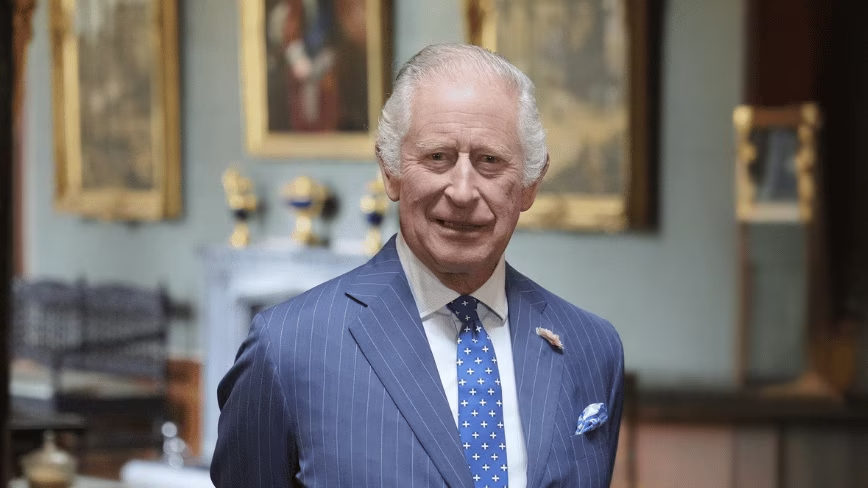
King Charles III at Windsor Castle in July 2023. Cropped from a White House photograph.

King Charles is convening about 30 senior figures from the AI industry at a Scottish country house this month. He does not intend to tell them what he thinks.
Joseph Bambridge reported the plans for Politico. Two people familiar with them spoke on condition of anonymity, because nobody has announced the event. One of them named three guests. Nvidia chief executive Jensen Huang, Google DeepMind founder Demis Hassabis, and Paolo Benanti, who advises the Vatican on AI.
A Royal official confirmed the convening role on the record. The king’s unique ability as sovereign, the official told Politico, is “his ability to convene top level stakeholders”. The King will not offer his own views, the official said. He wants to “convene, engage, listen and encourage debate”.
Where and who
The venue is Dumfries House in Ayrshire, the headquarters of The King’s Foundation, the charity Charles founded in 1990. The Ditchley Foundation, which runs discussion forums on international questions, is organising. Ministers are invited too.
Politico approached the named guests. Benanti declined to comment and Nvidia did not respond. A DeepMind representative said the company could not comment on Hassabis’s movements. So the guest list rests on one source, and nobody attending has confirmed it.
The Benanti invitation is the one worth pausing on. Seating a Vatican ethics adviser beside the man who sells most of the world’s AI chips is a deliberate pairing. The Holy See has been unusually active here. Pope Leo XIV made AI a defining theme of his papacy. An Australian firm eventually certified his writings as human-authored, after claims a machine had helped.
A monarch cannot make policy
This is the constitutional fact that shapes everything about the event. The British sovereign does not set policy, does not take positions on contested questions, and does not lobby. The Royal official’s wording was careful for that reason.
What the office can do is get people in a room. Executives who ignore most invitations accept this one, and the guest list reflects that. Convening power is real power, and it is the only kind the position carries.
Charles has used it on this subject before. He met Huang and executives from Apple, Amazon and Google during a state visit to Washington in April. He hosted a Windsor Castle banquet during Donald Trump’s state visit last September. Huang and Sam Altman were among the guests. In November he presented awards to Huang and other AI figures. He also gave Huang a copy of his own address to the AI Safety Summit.
That address said: “If we are to realize the untold benefits of AI, then we must work together in combatting its significant risks.” Almost nobody in the industry would dispute that. Which is rather the point of it.
The timing is doing the work
An unannounced gathering is not usually news. This one matters because of what has been happening to Britain’s formal AI machinery around it.
Two channels that were supposed to carry this work have faltered inside a year.
The Trump state visit last September coincided with a US-UK Tech Prosperity Deal and a wave of American investment announcements. Trade disagreements later suspended that deal. The formal transatlantic channel, in other words, is not currently working.
Meanwhile the domestic apparatus has been losing people. Matt Clifford, who wrote the government’s AI Opportunities Action Plan, stepped down as ARIA chair on Monday after taking a job at Anthropic. Kanishka Narayan, who became the first cabinet-level AI minister in July, now has a governance question to answer about how that arrangement was cleared.
Set against that, a monarch who cannot make policy convening the people who do starts to look less like a curiosity and more like the channel that still functions.
What Hassabis wants from a room like this
One guest has a specific agenda. Hassabis, now DeepMind’s chair, called in July for a US-based global standards organisation for AI.
That proposal needs exactly this kind of forum, because there is nowhere obvious to put it. The US has been asking the G20 not to build AI governance machinery at all. The EU has the AI Act and limited appetite for another layer. An informal gathering with no communiqué and no votes is where an idea like that gets tested before anyone commits to it.
Huang arrives from a different position. Nvidia sells the hardware underneath all of it, and he spent last week declaring that AGI has arrived while calling for 400,000 more GPUs to come online. He is not short of platforms. He is unlikely to decline this one.
Ditchley is the other detail worth knowing. It is not a royal body but an independent foundation that has run off-the-record transatlantic discussions for decades, which tells you the format before anyone describes it. Small room, senior people, no communiqué.
What we will not find out
The honest caveat is that private convening is private. No published agenda exists, no attendee list, no promised readout. Nothing obliges anyone to say afterwards what was discussed.
Politico reports the guest list at around 30 people. That number is small enough to be a conversation and large enough to be an industry, which is presumably the intention.
That is the format working as designed. Ditchley events run on the understanding that people speak more freely without an audience, and the argument for them is that candour produces better thinking than performance does.
It also means the only public record of a British head of state gathering 30 AI leaders and several ministers may be that it happened. Whether that is convening or lobbying depends entirely on what gets said, and nobody outside the room will be able to tell the difference.
Get the TNW newsletter
Get the most important tech news in your inbox each week.


