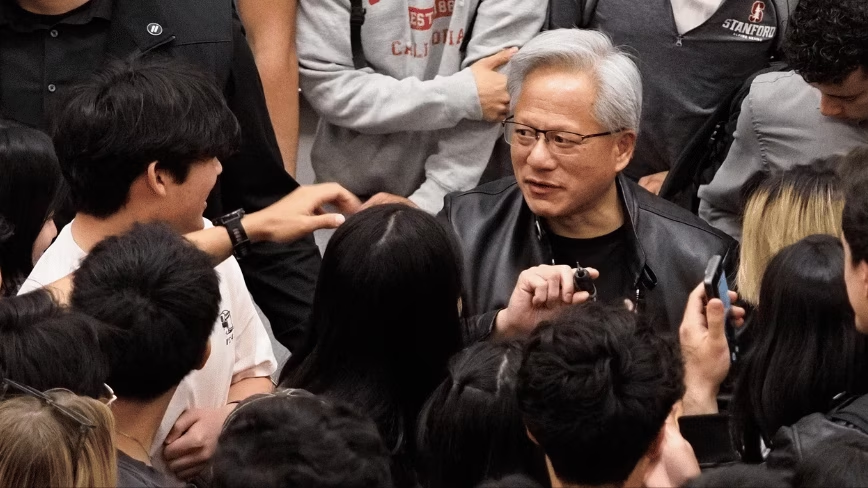
Nvidia chief executive Jensen Huang with students after a talk at Stanford University, 30 April 2026.

Jensen Huang said it in four words. “AGI has arrived,” the Nvidia chief executive wrote on X late on Sunday, congratulating OpenAI on GPT-6 Astra. By Monday morning the post had passed 10 million views.
The rest of the post is the part worth reading. Huang wrote that OpenAI trained Astra on more than 100,000 Nvidia Grace Blackwell chips in NVLink72 racks, with “400K GPUs coming online next”. He was replying to Chase Lochmiller, chief executive of the data centre builder Crusoe, who had posted a day earlier that the milestone made Abilene, Texas, “the birthplace of AGI”. Crusoe built OpenAI’s campus there.
So the declaration came from the man who sold the chips, in reply to the man who built the building. OpenAI itself was less sure by the end of the weekend than it had been at the start.
Who has claimed it, and who has not
The word entered the launch on 3 September, when OpenAI president Greg Brockman told reporters he thought the company was there, while leaving it to readers to decide for themselves. OpenAI’s official account did not use the term. Its launch posts listed benchmarks: state of the art on FrontierMath Tier 4, ARC-AGI 3, and Terminal-Bench 4.0.
The timeline in his post is accurate. ChatGPT launched in November 2022. The o1 reasoning model followed in September 2024. Astra arrived on 3 September 2026, so four years is right almost to the week. What the timeline leaves out is that o1 and Astra were both announced with benchmark tables, and only one of them arrived with the word AGI attached.
Huang’s post removed the hedge. It is the flattest statement yet from a chief executive of that size that a specific model qualifies, and he made it about a product he did not build.
The people who run the benchmark that carried the claim have already qualified it. ARC Prize published two scores for Astra on launch day: 99.9% inside OpenAI’s own harness, and 62.7% inside the foundation’s standard one. The gap comes from the scaffolding, not the weights. ARC Prize said it was not claiming AGI, and co-founder Mike Knoop wrote that the evidence was not there yet.
OpenAI’s own scientist wants a slowdown
Earlier the same day, OpenAI published an essay by its chief scientist, Jakub Pachocki. It argues that no lab has solved alignment and monitoring well enough to keep scaling at maximum speed for much longer. Pachocki called it a time for extreme caution and said he expected voluntary slowdowns to become commonplace.
Read together, the two posts describe the same model from opposite ends. The supplier says the industry has reached the destination and 400,000 more GPUs are on the way. The scientist says nobody is ready for what is already here and the pace should drop.
Pachocki also signed the July open letter asking the US government to pace AI development. He is not an outside critic. He runs the research that produced the model Huang is celebrating.
Neither statement is a technical finding. AGI has no agreed definition, no independent test, and no regulator that certifies it. OpenAI’s own charter version, systems generally smarter than humans, is the one Brockman used. Huang gave none.
Why Nvidia’s CEO is the one saying it
Nvidia’s position on Astra is not that of a bystander. The company put $30bn into OpenAI in February, its largest single commitment, and now holds $99bn in shares of its own customers. Astra’s training run is a reference sale for Grace Blackwell. The 400,000 GPUs Huang says are coming next are revenue Nvidia has not yet booked.
Crusoe is in the same trade. It has been raising about $3bn at a valuation near $30bn and signed a $13bn five-year contract with Jane Street last week. A data centre operator whose flagship site is the birthplace of AGI has a better story to tell lenders than one whose flagship site hosts a large language model.
None of that makes the claim false. It does explain why the strongest version of it came from outside OpenAI. Brockman had a company to protect and hedged. Huang had a market to address and did not.
The number that is not in the post
Huang wrote “100K+” and “NVLink72” in the same breath, and the two can be read two ways. An NVL72 rack holds 72 Blackwell GPUs. If he meant 100,000 racks, that is 7.2 million GPUs, far beyond any training cluster ever described. If he meant 100,000 GPUs arranged in NVL72 racks, that is about 1,400 racks, a large cluster but a plausible one. The second reading is almost certainly the intended one. Nvidia had not clarified it by publication.
The ambiguity matters because the post now circulates as the training scale of the first AGI. A figure that can be off by a factor of 72 needs the caveat every time it travels.
What to watch
Three things. The first is whether OpenAI adopts Huang’s wording. Sam Altman reposted Pachocki’s essay and called it important. If OpenAI wanted to declare AGI, it had its own launch to do it in, and chose benchmarks instead.
The second is what “coming online next” means on a calendar. Nvidia and OpenAI have a 10GW supply agreement, and 400,000 GPUs is a fraction of it. When they land, where, and who pays are the questions that decide whether this is a training cluster or a press cycle.
The third is the harness. ARC Prize now publishes both scores side by side. The next model that claims AGI on the strength of 99.9% will have to say which 99.9%.
Get the TNW newsletter
Get the most important tech news in your inbox each week.


