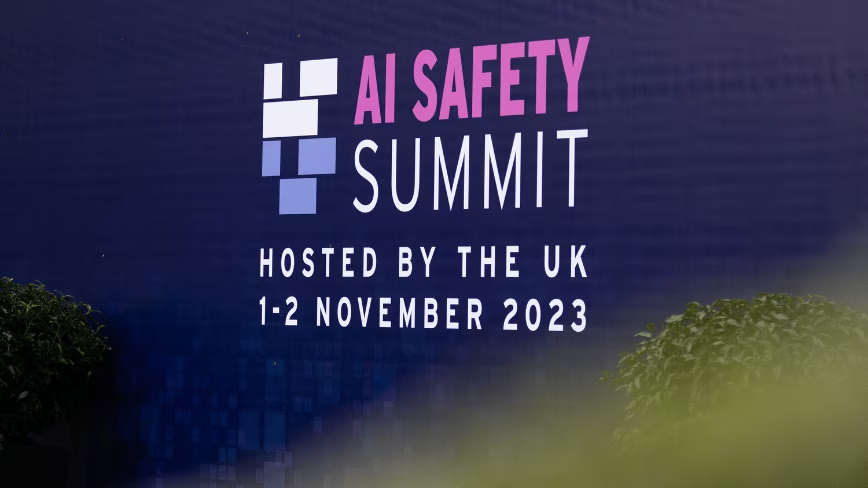
Signage at the UK’s AI Safety Summit, Bletchley Park, 1 November 2023

The man who wrote the UK’s AI Opportunities Action Plan is leaving the government research agency he chaired. He announced it five days after taking a job at Anthropic. The resignation itself is not the interesting part. The arrangement it undoes had already been reviewed and cleared by a government department.
Matt Clifford will step down as chair of the Advanced Research and Invention Agency, the UK’s taxpayer-funded body for high-risk science. ARIA, as it is known, funds frontier work in areas from neurotechnology to climate science. He set out the decision on Monday in a post on LinkedIn.
The Guardian reported that he had been forced to stand down, under pressure from senior MPs. Clifford presented it as his own call. Both versions can be read from the same facts, and the gap between them is worth noting.
“Having completed my first full term last month, I have decided to step down to ensure my new role at Anthropic doesn’t become a distraction from ARIA’s incredible work,” he wrote.
The safeguards lasted five days
Clifford joined Anthropic last week as managing director of international affairs. The role covers the company’s engagement with governments outside North America. He said then that he would keep the ARIA chair alongside it. That plan did not survive the week.
It was never an informal plan. Freya Pratty, writing for Sifted, reported the detail that matters. An ARIA spokesperson said the Department for Business, Innovation, Science and Trade had formally reviewed the arrangement. Robust mitigations had been agreed with the department, the spokesperson said, including Clifford stepping back from any ARIA business where a conflict could arise.
Anthropic gave Sifted its own account. Clifford had no involvement in or visibility of ARIA’s commercial discussions with the company. Those sat with ARIA’s executive, behind an ethical wall, with external counsel.
Sifted also reported the fact that makes this commercial rather than cosmetic. ARIA holds a commercial licence with Anthropic, alongside other AI providers. So the agency is a customer, and its chair now works for the supplier.
Put plainly: a department assessed the conflict, designed controls, and signed them off. The structure then collapsed within five days of meeting Parliament.
The committee is not finished
Dame Chi Onwurah chairs the Commons Science, Innovation and Technology Committee. The Labour MP had called the overlap a clear conflict of interest. She had also written to the AI minister, Kanishka Narayan, about it. In her committee statement she welcomed the resignation, then kept the file open.
“However, important questions remain,” she said. She wants to know how the situation arose. She wants the conflict of interest assessments that were carried out. And she wants to know what safeguards protect confidence in ARIA’s governance. She expects a detailed answer within weeks.
That is the live thread. The resignation removes one man’s conflict. It leaves the process question exactly where it was. Narayan, who became the first cabinet-level AI minister in July, now owns the reply.
Two more months in post
Clifford is not going immediately. He said the Secretary of State asked him to stay until 6 November, while a search for a new chair runs. He agreed, with appropriate safeguards against potential conflicts in place.
Those are close to the words that defended the original arrangement. For the next two months, the chair of a public agency that licenses Anthropic technology is also the Anthropic executive who deals with governments. The one thing that has changed is that an end date exists.
A pattern with names attached
The Guardian set the move against a run of similar ones. Rishi Sunak has taken roles at Anthropic and Microsoft. George Osborne works for OpenAI. Nick Clegg held a senior job at Meta until 2025. Beeban Kidron, the crossbench peer and a persistent critic of government AI policy, welcomed the resignation. Rebuilding trust needs a clear line between tech interests and those of citizens, she told the paper.
The objection is not only about appearances. Tom Brake, who runs the campaign group Unlock Democracy, had put the practical case to the Guardian. Carrying detailed knowledge of a policy as sensitive as AI into a private company soon after leaving government can weaken the state’s hand later, when it wants to argue for caution.
The pull is easy to explain. Anthropic has been building a British footprint at speed. It signed a $45bn compute deal with the UK firm Nscale in August. It has also been working European capitals directly, joining OpenAI, Google and Microsoft on an open letter on cyber defence aimed at EU policymakers. A company doing all that wants someone who knows how Whitehall decides things.
Whitehall, meanwhile, keeps buying. In June the government agreed a deal with ElevenLabs to put voice AI into public services. Anthropic knows the other side of that relationship too, having won a court ruling against the Pentagon in August. Customer, supplier and policymaker keep turning out to be the same small group of people.
What is actually at stake
Nobody has alleged that Clifford did anything improper. No evidence suggests he did. ARIA says the ethical wall held, and Anthropic says the same. He also built much of the machinery he is now leaving. That includes the Frontier AI Taskforce, which became the AI Security Institute, and the 2023 AI safety summit. He chaired ARIA for four years, from its founding. Carly Page, writing in The Register, noted that the decision reverses the position set out only days earlier.
The question Onwurah is pressing is narrower, and harder to answer. A department looked at one man chairing a public funder while representing one of its suppliers to governments. It concluded that recusal was enough. Parliament disagreed within days. Whatever lands by November will say more about how Britain polices the traffic between its AI policy and its AI industry than this resignation does.
Get the TNW newsletter
Get the most important tech news in your inbox each week.


