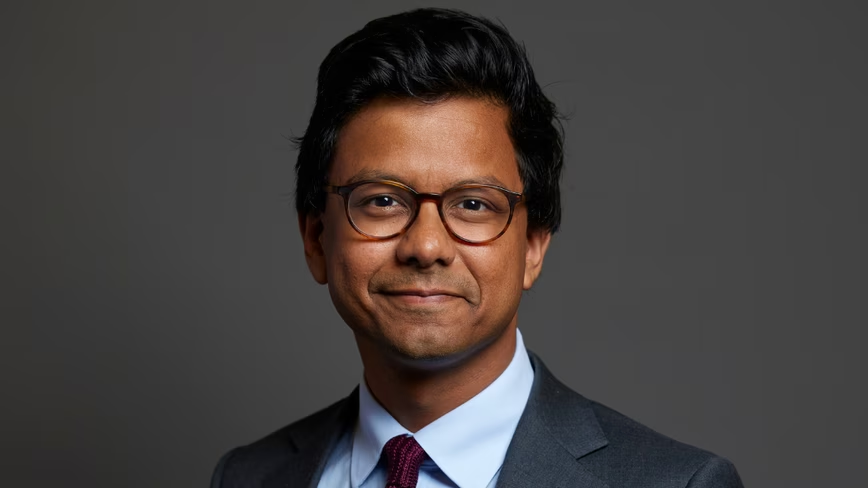

Kanishka Narayan has become the first UK minister for artificial intelligence to sit at the cabinet table, a promotion that arrives as new prime minister Andy Burnham reshapes Whitehall around the technology.
Narayan, the MP for the Vale of Glamorgan and until this week a junior minister for AI and online safety, said Burnham had asked him to attend cabinet “as minister for AI, a sign of his deep commitment to AI’s importance.”
The elevation coincides with the scrapping of the Department for Science, Innovation and Technology (DSIT), the body that had steered Britain’s pro-innovation AI rules and its push for homegrown compute.
Its remit has been folded into a new Department for Business, Innovation, Science and Trade under Jonathan Reynolds, with online safety and digital duties moving to other departments.
Burnham took office on 21 July, and the reshuffle claimed several senior figures. Liz Kendall, Narayan’s former boss as technology secretary, left her post, while Lord Patrick Vallance stepped down as science minister after nearly a decade in government, citing personal reasons.
The reorganisation folds a standalone science department, created less than two years ago, back into a broader economic ministry, a decision likely to be read as a bet that AI policy now belongs closer to the centre of government rather than in a specialist silo.
For Narayan, the job is less a change of subject than a change of altitude. He reached Parliament only in July 2024, winning the Vale of Glamorgan and becoming the first ethnic minority MP elected in Wales, before taking the AI and online safety brief that September in place of Feryal Clark.
His route there was unusually well suited to the file. After a spell in the civil service during the coalition government, he worked at the investment bank Lazard, studied for an MBA at Stanford, and spent time with the venture firm Atomico and the fintech investor Clocktower before running Labour’s tech policy.
That background has earned him a rare reputation among people who watch the sector closely.
Leo Ringer of Form Ventures described him as “a minister whose understanding of his brief has been there from day one,” while Matt Clifford, a former government AI adviser, welcomed the move and said Narayan “understands the scale and opportunity” of the technology.
The in-tray is heavy. Britain has promised long-delayed legislation on the most powerful AI models, and ministers are still weighing how far to regulate without deterring the investment flowing into UK AI.
Questions over compute capacity, the safety of frontier systems, and the future of the AI growth zones meant to spread jobs beyond London now report, in effect, to a cabinet minister.
Narayan has also inherited an online safety agenda mid-implementation, though responsibility for that brief has moved elsewhere in the restructure, leaving the exact boundaries of his role to be drawn.
Narayan has framed the stakes in expansive terms. “AI is likely the most significant technology in human history,” he wrote after the appointment, arguing that “nations have a narrow window to decide whether they shape AI or get shaped by it. Britain is in that window right now.”
He has also signalled a wish to push the gains beyond the usual clusters, backing regional innovation hubs and investment in places such as his own Welsh seat, part of a wider argument for domestic capability and a sovereign UK AI model.
Whether a cabinet seat carries the budget and authority to match that rhetoric is the question the coming months will settle.
The change puts Britain alongside France and Canada, which have already given AI its own senior political berth, Silicon Republic reported.
For now, officials have offered little detail on how the reshaped department will operate day to day, or when the promised AI bill will finally reach Parliament, leaving Narayan to define a job that did not exist a week ago.
Get the TNW newsletter
Get the most important tech news in your inbox each week.


