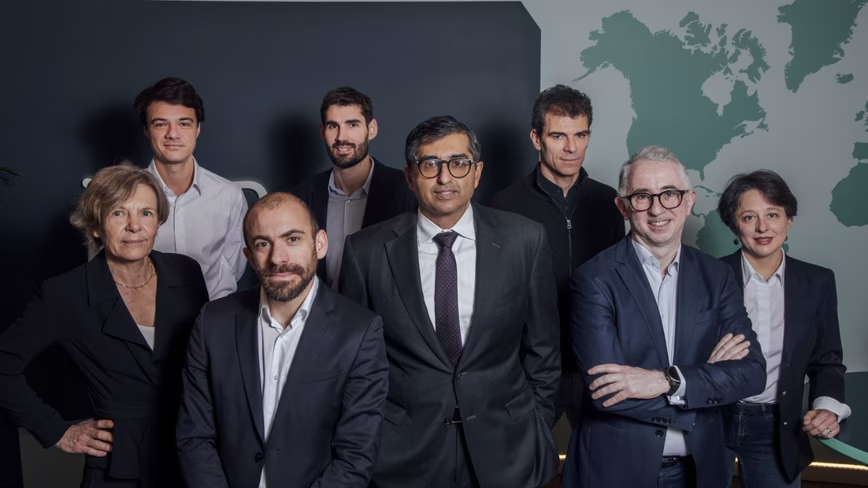

The neutral-atom quantum computing company, co-founded by Nobel laureate Alain Aspect, has announced a business combination with Bleichroeder Acquisition Corp. II, with the deal expected to close in the second half of 2026.
When Alain Aspect shared the Nobel Prize in Physics in 2022, the citation concerned experiments performed decades earlier, precise measurements of quantum entanglement that definitively showed that the universe operates according to principles that defy classical intuition.
The science was old. The commercial applications were just beginning.
Aspect co-founded Pasqal in 2019, and the French quantum computing company he helped build has now agreed to a transaction that, if completed, will make it one of the few quantum startups to reach a public market.
On March 4, 2026, Pasqal announced a definitive business combination agreement with Bleichroeder Acquisition Corp. II, a blank-check vehicle, valuing the combined company at $2 billion pre-money and targeting a listing on the Nasdaq.
The deal structure
The transaction is expected to close in the second half of 2026, pending regulatory and shareholder approval. According to the announcement, the deal includes approximately $200 million in committed convertible financing and could provide more than $600 million in total proceeds.
In anticipation of the listing, Pasqal also separately announced a $395 million funding round, with participation from Parkway, Quanta Computer, LG Electronics, and CMA CGM, a shipping conglomerate with a growing interest in advanced computing infrastructure.
Financial terms beyond the pre-money valuation figure were not disclosed in full, including the final equity structure, fee arrangements, or the specific conditions under which the convertible financing would convert.
What Pasqal actually builds
Founded in 2019 and headquartered in Massy, France, Pasqal develops neutral-atom quantum computers. The approach differs from the superconducting qubit systems used by IBM and Google: rather than engineering qubits from physical circuits cooled to near absolute zero, Pasqal traps individual atoms using laser arrays and manipulates their quantum states.
The company has argued that neutral-atom architectures offer advantages in qubit connectivity and scalability.
As of the announcement, Pasqal operates seven quantum systems and works with more than 25 commercial customers and partners. The company has not disclosed revenue figures.
A crowded queue for the public markets
Pasqal is not the only quantum computing company eyeing the public markets. IonQ was listed via a SPAC in 2021, and several others have followed or are preparing to do so.
The sector has attracted sustained investor enthusiasm even though most quantum computers remain in the early stages of practical commercial utility, capable of running demonstrations and specific optimisation tasks, but not yet the general-purpose fault-tolerant systems that proponents have long described as transformative.
For European deep tech, the listing would represent a meaningful milestone. EU quantum computing investment has lagged behind US and Chinese spending, and a Nasdaq debut by a French company backed by a Nobel laureate would provide visibility and, if the stock performs, confidence that European quantum research can compete commercially.
The transaction is not yet complete, and SPAC deals carry a well-documented history of valuation resets post-listing. Investors who followed IonQ, Rigetti, and others through their SPAC processes will approach the Pasqal deal with that record in mind.
The question is not whether the science is real, Aspect’s Nobel confirms that much, but whether the commercial timeline is.
Get the TNW newsletter
Get the most important tech news in your inbox each week.


