TL;DR
Trapped-ion quantum-computing scale-up eleQtron has raised €57m led by Schwarz Digits, the tech arm of Europe’s largest retail group. The financing structure tells you something about how European quantum is being funded.
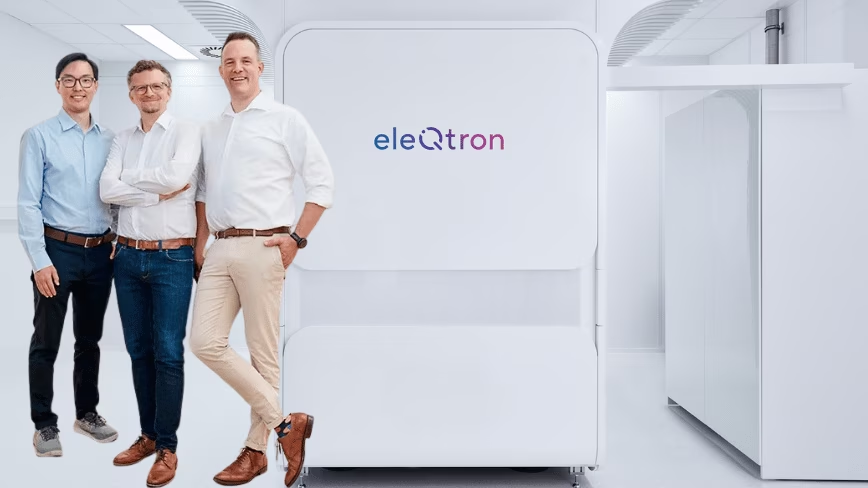
Jan Leise, Michael Johanning, and Kaoru Naganuma
 Credit: eleQtron
Trapped-ion quantum-computing scale-up eleQtron has raised €57m led by Schwarz Digits, the tech arm of Europe’s largest retail group. The financing structure tells you something about how European quantum is being funded.
Quantum computing has, for most of its commercial existence, been a category in which European labs do exceptional research and US and Asian companies do most of the venture funding. On Tuesday, the German trapped-ion quantum-computing scale-up eleQtron announced that it has closed a €57m Series A round, one of the largest of its kind in the European quantum sector. The round was led by Schwarz Digits, the technology arm of Schwarz Group, Europe’s largest retail conglomerate and the parent of Lidl and Kaufland.
It is a meaningful funding event for two related reasons. The first is the cap table itself: €57m at this stage is a serious commitment to a hardware-led quantum-computing thesis at a moment when much of the global venture market has tilted aggressively toward software-only AI. The second is who put the money in. Schwarz Digits is not a venture investor in the traditional sense; it is the technology arm of a strategic European industrial group, and its participation signals a different kind of customer-driven funding logic.
Founded in 2020 in Siegen by Michael Johanning, Christof Wunderlich, and Jan Leisse, eleQtron operates one of Europe’s most credible trapped-ion quantum-computing programmes. The company’s distinguishing technology is MAGIC, Magnetic Gradient Induced Coupling, a control architecture that uses radio-frequency rather than laser fields to manipulate trapped-ion qubits. TechFundingNews’s coverage of the round notes that the architecture is intended to scale more easily into a chip-fabrication-style manufacturing process than competing trapped-ion approaches that rely on bespoke optics.
eleQtron raised an earlier €50m round in November 2022, reported at the time by The Quantum Insider, with Earlybird Venture Capital and the regional Siegerlandfonds among the participants. The Schwarz-Digits-led €57m extends that base and, on the company’s own framing, provides the runway needed to take the architecture from research-prototype scale toward commercial deployment.
The strategic context matters. Schwarz Digits is the technology arm of a retailer that runs one of Europe’s largest data-processing operations, a sovereign-cloud platform under the brand StackIT, and increasing interest in technologies that reduce dependency on US hyperscalers. Backing eleQtron is, in that frame, less a financial bet and more a procurement-and-strategic-positioning bet. If trapped-ion quantum computing develops along the trajectory eleQtron’s architecture allows, Schwarz Digits will have early access to a European-built, European-controlled quantum-computing capability. TNW has tracked the broader European tech-sovereignty arc for some time, and eleQtron’s Series A fits squarely inside it.
The wider quantum policy framing is also moving. TNW has reported on the UK’s quantum-computing security work, and Europe’s broader push to build sovereign capability in quantum infrastructure is now being matched, on the funding side, by capital sources like Schwarz that operate outside the conventional venture-capital model. That changes the funding ecosystem for European quantum companies in a useful way.
Trapped-ion quantum computing is one of several approaches still competing for primacy in the field. Superconducting-qubit architectures, championed by IBM and Google, have larger qubit counts but face their own scaling challenges. Photonic, neutral-atom, and topological approaches are all being pursued. Whether MAGIC’s particular advantage translates into commercial scale will be visible only as eleQtron moves from current systems to higher-qubit-count machines, and as customers begin running production workloads.
There is also the talent question. European quantum hiring competes globally with US labs that pay in dollars and offer larger compute budgets. The Schwarz Digits round increases eleQtron’s ability to compete on that ladder, but does not eliminate the underlying labour-market pressure.
None of these risks is fatal. They are the costs of being a hardware-led quantum company at this stage of the field, and eleQtron is, on the available evidence, executing as well as any of its European peers. Tuesday’s round confirms that European capital, when it can be marshalled, can fund a quantum scale-up at competitive scale. Whether the resulting commercial trajectory matches what the financing implies is the harder question, and one that the next 24 months of MAGIC system deployments will start to answer.
Get the most important tech news in your inbox each week.


