TL;DR
Honeywell-backed Quantinuum filed for a US IPO targeting a valuation above 20 billion dollars. The quantum computing company reported 30.9 million dollars in annual revenue and 192.6 million in losses, pricing itself on a fault-tolerant machine planned for 2029.
Quantinuum filed for a US initial public offering on Thursday that could value the company at more than 20 billion dollars. In the year ended 31 December 2025, Quantinuum reported revenue of 30.9 million dollars and a net loss of 192.6 million dollars. The company is asking public market investors to pay a premium of more than 600 times revenue for a quantum computer that does not yet exist in its final form. The computer it is building, a universal fault-tolerant machine called Apollo, is scheduled for 2029.
The filing is significant not because of Quantinuum’s current financials, which are modest by any standard, but because of what the IPO market’s appetite for it will reveal about how investors price a technology that has been five to ten years away from commercial utility for the past twenty years. Quantinuum is backed by Honeywell, which owns 54 per cent of the company. JPMorgan and Morgan Stanley are leading the offering. The ticker will be QNT on the Nasdaq Global Select Market.
The company
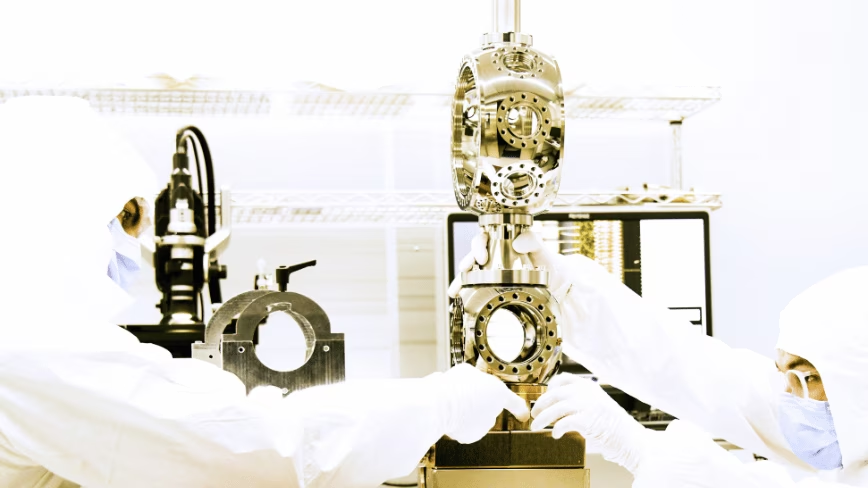
Quantinuum was formed in 2021 from the merger of Honeywell Quantum Solutions and Cambridge Quantum Computing. It builds quantum computers based on trapped-ion architecture, a technology in which individual atoms are suspended in electromagnetic fields and manipulated with lasers to perform calculations. The company claims the highest average two-qubit gate fidelity in the industry as of December 2025, a measure of how accurately the machine performs the basic operations of quantum computation.
Its customers include BMW, Airbus, JPMorgan Chase, HSBC, Mitsui, and Thales. BMW expanded its multi-year partnership with Quantinuum in May 2026 to apply quantum computing to catalyst chemistry research for fuel cells. Airbus is exploring quantum simulation for hydrogen-powered aircraft. JPMorgan has been working with Quantinuum since 2020 and is one of the most active corporate users of its software development kit.
These are research partnerships, not production deployments. No company is running quantum computing in production at a scale that affects its bottom line. The partnerships exist because the companies believe quantum computing will eventually transform their industries and want to be ready when it does. The word “eventually” carries all the risk.
The numbers
Quantinuum’s 2025 revenue of 30.9 million dollars represented 34 per cent growth over the prior year’s 23 million dollars. The net loss of 192.6 million dollars represented 34 per cent growth over the prior year’s 144.1 million dollars. Revenue and losses grew at exactly the same rate.
The first quarter of 2026 was worse. Revenue fell to 5.2 million dollars from 19.1 million dollars in the same quarter a year earlier. The net loss expanded to 136.6 million dollars from 30.5 million dollars. The quarterly numbers suggest that revenue is lumpy and dependent on the timing of contract milestones, a pattern common in pre-commercial deep technology companies.
The target valuation of more than 20 billion dollars would represent a doubling from the 10 billion dollar pre-money valuation at which Quantinuum raised 600 million dollars in September 2025. Before that, it raised 300 million dollars in January 2024 at a 5 billion dollar valuation. The valuation has quadrupled in two years while the company’s revenue has grown from 23 million to 31 million dollars.
The roadmap
Quantinuum’s hardware roadmap has four generations. The current system, Helios, is commercially available. Sol is planned for 2027. Apollo, the system that the company describes as universal and fully fault-tolerant, is planned for 2029. A fault-tolerant quantum computer is one that can perform complex calculations with enough error correction to produce reliable results, the threshold at which quantum computing transitions from a research tool to a commercial platform.
Riverlane raised 75 million dollars to build chips that solve quantum error correction, targeting one million error-free operations by 2026. Error correction is the central engineering challenge of the field. Without it, quantum computers produce results that are too noisy to be useful for the complex simulations that justify the technology’s theoretical advantages. Quantinuum’s Apollo is designed to solve this problem at the system level. Whether it will, and whether 2029 is achievable, are the questions on which the IPO valuation rests.
Europe is spending billions on quantum computers, with governments in Germany, the Netherlands, France, and the United Kingdom launching or expanding national programmes. France has committed 500 million euros to five startups building fault-tolerant quantum machines. The public investment reflects a consensus among policymakers that quantum computing is a strategic capability, even as the private market struggles to determine what the capability is worth before it works.
The market
Quantinuum would join a small cohort of publicly traded quantum computing companies. IonQ, which uses the same trapped-ion technology, went public via SPAC in 2021 and is the only pure-play quantum stock with positive returns in 2026, up 16 per cent year to date after posting more than 100 million dollars in annual revenue. Rigetti Computing, which uses superconducting qubits, is down 10 per cent. D-Wave Quantum is down 9 per cent.
IQM has built 30 full-stack quantum computers from its facility in Finland and announced a 1.8 billion dollar SPAC merger to list on the NYSE. The quantum computing sector is pre-profit and largely sentiment-driven, with stock prices moving on milestone announcements, government contracts, and capital raises rather than fundamentals. Quantinuum’s IPO would be the largest quantum computing listing to date and would set a valuation benchmark for the entire sector.
The risk is that the benchmark reflects the market’s enthusiasm for a technology whose commercial timeline remains uncertain. Industry experts surveyed in 2025 said quantum utility is at most ten years away, a timeline that has not changed meaningfully in a decade. Google’s chief executive said five to ten years. NVIDIA’s chief executive said at least fifteen.
The bet
Honeywell’s decision to take Quantinuum public is part of a broader restructuring that includes the spin-off of its aerospace division and the separation of its advanced materials business. The IPO gives Quantinuum access to public capital markets and gives Honeywell a path to gradually reduce its 54 per cent stake. The 600 million dollar raise in September 2025 was led by investors including JPMorgan, which is now also leading the IPO underwriting, a dual role that reflects the degree to which the investment banking community’s interests are aligned with the offering’s success.
Quantinuum’s filing is a bet that public market investors will value a quantum computing company the way private markets have: on the promise of a technology that does not yet work at scale, priced against a future in which it does. The 30.9 million dollars in revenue is not the product. The product is Apollo, a machine that is three years and several fundamental engineering breakthroughs away. The IPO is a wager that the market will pay 20 billion dollars for the right to wait.


 Credit: Quantinuum