The Dutch startup, the only company offering a dedicated commercial solution for quantum chip testing, raised a €3M extension to its June 2025 seed round from the European Innovation Council Fund.
The accompanying MAX Partnership Programme gives quantum chip makers a structured way to shape the next generation of OrangeQS’s high-throughput test equipment.
OrangeQS, the Delft-based quantum chip testing startup spun out of QuTech and TNO, has closed a second tranche of its seed round, extending total funding to €15 million. The additional €3 million comes from the European Innovation Council Fund, the investment arm of the EU’s EIC that backs European deep-tech ventures.
EIC Fund investor Zeina Chebli joins the OrangeQS board as part of the investment. The company closed a €12 million first tranche in June 2025, led by Icecat Capital with participation from Cottonwood Technology Fund, QBeat Ventures, QDNL Participations, and InnovationQuarter Capital, in the largest seed round to date in the Dutch quantum sector.
Alongside the funding, OrangeQS is launching the OrangeQS MAX Partnership Programme, a structured arrangement through which quantum chip manufacturers can influence specific parts of the MAX product and technology roadmap in exchange for a commitment to the platform.
The three founding members are Rigetti Computing, the US-listed superconducting quantum company; QuantWare, a Dutch startup making superconducting quantum processor chips; and Peak Quantum, which recently completed €5 million in total funding.
Each partner works independently with OrangeQS, keeping its intellectual property separate, while collectively steering the development of a test platform that needs to remain compatible with multiple hardware architectures simultaneously.
The problem OrangeQS is solving is unglamorous but structurally critical. Quantum chips, whether superconducting or semiconductor-based, do not operate at room temperature. They require millikelvin cryogenic environments, ultra-low electromagnetic noise, and precise microwave signal control.
Testing a single chip currently takes weeks and ties up both expensive equipment and PhD-level operators. As quantum chip development moves from academic laboratories into foundry-style manufacturing, that testing bottleneck will become increasingly severe: you cannot scale chip production if characterising each chip takes longer than making it.
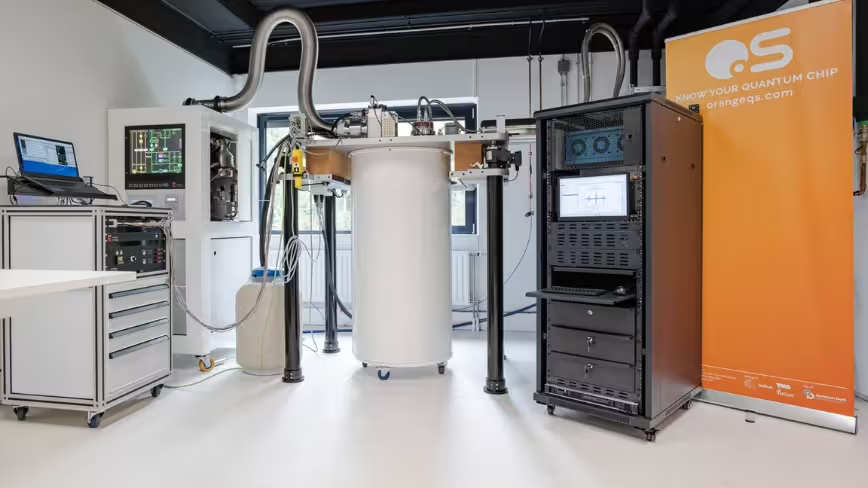
OrangeQS’s flagship product, the MAX, is designed as high-throughput industrial test equipment capable of evaluating chips in days rather than weeks. It is already deployed at IQM’s site in Espoo, Finland.
The FLEX, the company’s second product, is a more customisable R&D-oriented system in use at the Karlsruhe Institute of Technology, the University of Napoli, Chalmers Next Labs, Berkeley Lab’s Advanced Quantum Testbed, and QuTech in Delft. The open-source operating system, OrangeQS Juice, runs across both.
The initial focus of the partnership programme is parallel and non-destructive testing technologies, two capabilities that would allow multiple quantum chips to be characterised simultaneously without damaging them, addressing both throughput and yield concerns.
OrangeQS has published a white paper alongside the announcement outlining the technical roadmap. The company’s positioning echoes a pattern familiar from other deep-tech infrastructure plays: rather than competing to build the quantum computer itself, it is building the equipment that every quantum computer maker will need, regardless of which hardware architecture ultimately prevails.
The company has around 30 employees, drawn from experimental physics, systems engineering, and aerospace engineering. With the new capital, it plans to expand production capacity, grow the team, and advance the MAX to handle increasingly complex multi-qubit chips.
Get the TNW newsletter
Get the most important tech news in your inbox each week.


