TL;DR
Germany-based Focused Energy raised an oversubscribed $240M Series A led by utility RWE to commercialise laser-powered inertial confinement fusion based on the NIF’s historic net energy gain experiment. The company plans a demonstration reactor at a decommissioned German fission plant.
Focused Energy, a Germany-based fusion startup, has raised an oversubscribed $240 million Series A round to develop a commercial reactor based on the same approach that produced the world’s first controlled fusion reaction with net energy gain. The round, led by German utility RWE, brings the company’s total private capital to $300 million. Focused Energy has also received $200 million in grants, making it one of the most heavily funded fusion startups in the world at approximately $500 million in total funding.
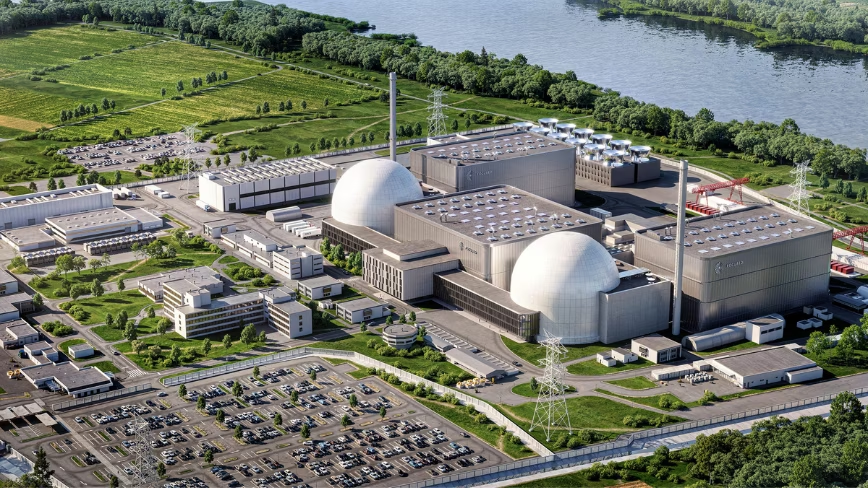
The round also included participation from SPRIND, the German Federal Agency for Breakthrough Innovation, Prime Movers Lab, and the European Innovation Council Fund. Focused Energy plans to build its first demonstration system, called Lighthouse, at the site of a decommissioned nuclear fission power plant in Germany operated by RWE, a practical decision that leverages existing grid connections, cooling infrastructure, and regulatory frameworks designed for nuclear facilities.
From NIF experiment to commercial reactor
Focused Energy’s approach is inertial confinement fusion, in which lasers compress a fuel target to create conditions extreme enough for atoms to fuse and release energy. The technique was validated in December 2022 at the National Ignition Facility at Lawrence Livermore National Laboratory in California, a breakthrough that arrived as global energy demand from AI data centres was beginning to surge. That experiment remains the first and only controlled fusion reaction to release more energy than was required to ignite it.
The NIF connection is not just conceptual. Debbie Callahan, who helped design the fuel target used in the historic NIF experiment, joined Focused Energy in December as chief strategy officer. Her task is to simplify the target for commercial production. The NIF’s fuel target is complex and difficult to manufacture, and the facility fires approximately 400 shots per year. A commercial reactor will need to fire 10 shots per second, or roughly 864,000 per day.
One critical simplification is eliminating the hohlraum, a precision-manufactured gold cylinder that the NIF uses to convert laser energy into X-rays, which then compress the fuel pellet. Focused Energy’s “direct drive” system skips this intermediate step, with lasers compressing the fuel pellet directly. This should improve the reactor’s energy efficiency and simplify the fuel target manufacturing process, both of which are essential for a system that needs to operate continuously at industrial scale.
A crowded field with real money
Focused Energy is entering an increasingly competitive fusion landscape. European deep tech startups are attracting significant government and private investment, and fusion is among the most capital-intensive categories. Inertia Enterprises raised a $450 million Series A in February for its own inertial confinement reactor, making it a direct competitor. Thea Energy raised $100 million last week for a pixel-inspired fusion approach. Type One Energy, backed by Bill Gates, raised nearly $90 million toward a $250 million Series B in January. Commonwealth Fusion Systems, which is in Gigascale Capital’s portfolio, raised $863 million for its magnetic confinement approach.
The investment wave reflects a convergence of factors: the NIF’s proof that net energy gain is physically possible, AI-driven electricity demand that is straining existing grids, and government programmes in the US, EU, and UK that are providing grants and regulatory frameworks for fusion development. Energy storage and generation technologies that can provide baseload power without carbon emissions are attracting capital that would have been unimaginable five years ago.
The engineering gap
The distance between the NIF experiment and a commercial power plant is enormous. The NIF achieved net energy gain measured against the energy delivered to the fuel, not against the total energy consumed by the laser system, which is orders of magnitude larger. A commercial reactor must achieve gain measured against total system input, which requires both more efficient lasers and higher-yield fuel targets.
Focused Energy’s direct-drive approach addresses part of this gap by removing the hohlraum’s energy losses, but the company still needs to demonstrate that its laser system can achieve the precision, repetition rate, and efficiency required for continuous operation. The urgency of the energy problem is real, with AI infrastructure alone expected to consume 9% of US electricity by 2030, but urgency does not change the physics.
RWE’s involvement as lead investor is the most commercially meaningful signal in the round. A major European utility putting capital into a fusion startup and offering a decommissioned plant site for the demonstration system suggests that at least one entity with deep experience operating power plants believes Focused Energy’s approach has a credible path to grid-connected electricity. Whether Lighthouse can bridge the gap between laboratory physics and commercial power generation is the $500 million question.