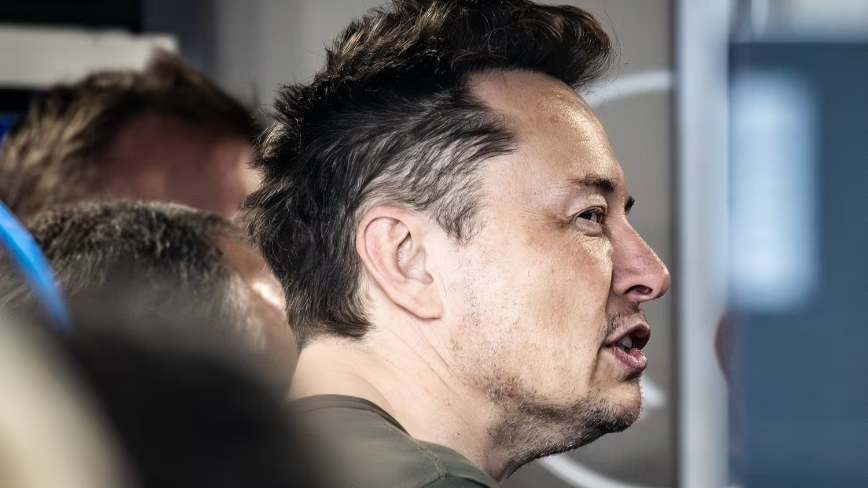
Elon Musk, CEO Tesla in Miami, Florida, May 2023 at the F1 World Championship.
 Credit: Cristiano Barni/Shutterstock
“I know this sounds totally nuts,” Elon Musk told investors midway through SpaceX’s first earnings call as a public company, Fortune reported. He then laid out a plan to put a robot workforce on the Moon and scale up SpaceX’s manufacturing there. “We are going to land a lot of tonnage on the moon,” he said. “We’re going to build the factories on the moon.”
The idea is not a stray remark. It runs through the regulatory filings SpaceX lodged before its record-breaking IPO in June, in language far drier than Musk’s.
What the filing actually says
SpaceX says it intends to establish “lunar-based manufacturing capabilities, including factories to produce large-scale AI compute satellites.” The method is to mine the Moon’s regolith, its dusty surface layer, for raw minerals such as aluminium, titanium, and silicon. Chips and other light parts would ship from Earth. The bulk of each satellite would be built on the Moon itself.
Getting the finished satellites to space is the other half. SpaceX describes a “lunar mass driver,” an electromagnetic launcher that flings payloads off the surface without rockets. It ties into a bigger goal the filing calls a petawatt-scale constellation of orbital AI compute, which the company wants to start deploying as early as 2028.
The Moon, in this telling, becomes the factory floor for AI in space.
‘Pure insanity’
The reaction from the space industry was a mix of awe and disbelief. “It’s pure insanity,” said Jim Cantrell, an Arizona space commissioner who worked with Musk on rockets back in 2001. “But he’s going to do it, because that’s what Elon does.” He argued the raw materials are genuinely there, and that lunar factories are feasible.
Investors may prefer the Moon to the alternative. “Getting to Mars is a 26-month launch, six-months in transit, versus a two-day trip to the moon,” said Greg Martin of Rainmaker Securities. “As an investor, the moon feels much more palatable.”
Everything is trying to kill you
The Moon fights back at every step. Lunar dust is abrasive and electrostatically charged, clinging to solar arrays and sapping their output. Temperatures swing from below minus 300 degrees to above boiling. “Everything is trying to kill you on the moon,” said Jaret Matthews, a former SpaceX engineer who now runs the rover firm Astrolab. The factories, he said, would be fully robotic, launched in pieces and assembled on site.
Cantrell expects the workforce to be Tesla’s humanoid Optimus robots, which need only power and a little lubrication. Powering them is its own puzzle, because the Moon gets 14 days of sunlight followed by 14 days of dark. Nuclear power, he said, would be the answer.
The commercial case rests on those AI satellites and on helium-3, a possible fusion fuel. It is also unproven and years away. SpaceX booked $7.8bn in second-quarter revenue, up 92%, but its space segment ran an adjusted loss on Starship spending. Ryan Westerdahl, another former SpaceX engineer, put the timeline plainly.
“He’s usually off by a few years and a little on the optimistic side,” he said. For shareholders, the question is whether they trust the trajectory enough to wait.
Get the TNW newsletter
Get the most important tech news in your inbox each week.


