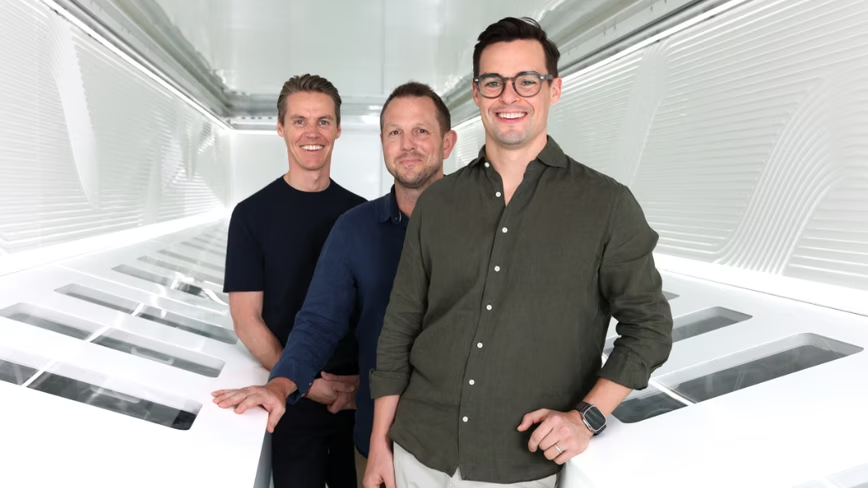
Jonathan Levee (from left), Oliver Curtis and Tim Rosenfield, the three co-founders of AI data centre developer Firmus.
 Credit: Firmus
Firmus is seeking up to $5bn in its listing on the Australian Securities Exchange, according to Bloomberg, which would make it one of the largest floats the exchange has handled.
The figure the company was working with in April was $2bn, at a valuation of $5.5bn. By August the valuation had passed $10.5bn.
Investor meetings began in the middle of this month, with Australian roadshows to follow. No pricing, listing date or free float has been announced.
The five months between those two numbers were unusually productive. OpenAI signed a multi-year compute contract across two Malaysian sites last week, becoming the anchor customer and pushing Firmus past 900MW of contracted capacity.
Neither side disclosed what the contract is worth, which has not stopped it from doing the work of a prospectus.
In June, the company committed to a 360MW site in Batam, Indonesia, with access to as many as 170,000 Nvidia accelerators through 2028 and an expectation of $25bn to $30bn in committed offtake over its first six years.
That one goes live in the first quarter of 2027. Firmus is building into a region that is planning four times the data centre capacity it currently runs, with Malaysia carrying most of a 6GW pipeline.
At home, Project Southgate is the flagship: 1.6 gigawatts across five Australian locations by 2028, starting in Launceston, Tasmania, on an initial build of $4.5bn against a full programme the company has costed at $73.3bn. The $10bn debt facility Blackstone led in February is what pays for the early part of that.
Two of the seven AI factories are actually running. Everything else above is contracted, committed or announced, and the distance between a signed offtake agreement and a delivered megawatt is where data centre developers usually get into trouble. Firmus is asking public markets to fund the crossing.
Australia has also made the crossing harder in a way that might, on balance, suit a company built around efficiency claims.
Since July, AI data centres there have been expected to put back more power than they draw, funding new renewable generation rather than simply buying from the grid.
Firmus markets its liquid-cooled design as using a third less energy and almost no water, which is a better position to argue that rule from than most.
The company was founded in 2019 and headquartered in Singapore, and it started out mining Bitcoin. Its backers now include Nvidia and Blackstone, and the question the roadshow will settle is whether a $10.5bn valuation is a judgement on 900MW of contracts or on the two sites currently drawing power.
Get the TNW newsletter
Get the most important tech news in your inbox each week.


