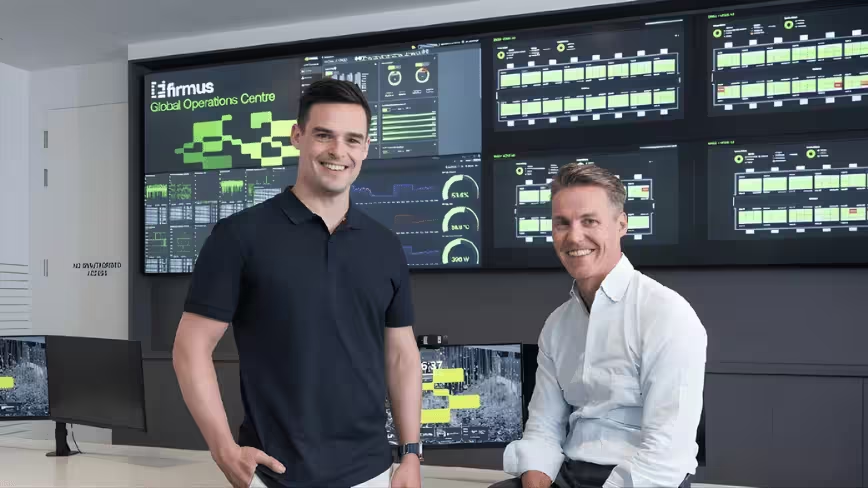
Tim Rosenfield and Oliver Curtis, co-founders and co-chief executives of AI data centre developer Firmus.

In short: Australian AI data centre company Firmus has raised $505m at a $5.5bn valuation in what it says is its final pre-IPO round, and is now targeting a $2bn listing on the ASX in June or July, backed by a $10bn Blackstone-led debt facility secured in February and a plan to deploy 1.6 gigawatts of liquid-cooled AI compute across Australia by 2028.
Firmus Technologies, the Nvidia-backed Australian company building what it calls AI Factories powered by renewable energy, has raised $505m in new equity at a $5.5bn valuation ahead of an anticipated initial public offering on the Australian Securities Exchange later this year. The raise, announced on 6 April 2026 and led by Coatue Management with continued participation from Nvidia, is the third equity round Firmus has completed in six months, bringing total equity raised in that period to approximately $1.35bn.
The IPO, expected in June or July, would seek to raise an additional $2bn and, if completed at that scale, would rank among the largest technology listings in Australian history. Bank of America, JPMorgan, Morgans Financial, and Morgan Stanley are conducting a non-deal roadshow with potential investors this week in preparation.
From Tasmania to a national grid
Firmus’s flagship asset is Project Southgate, a $4.5bn initial construction programme centred on a purpose-built campus in Launceston, in northern Tasmania. The site has been designed as a campus of modular, fully liquid-cooled AI Factories built to run Nvidia’s GPU clusters at high density, and will eventually house 36,000 Nvidia GB300 Grace Blackwell chips. Its first stage, delivering 90 megawatts of AI infrastructure, is targeted for completion in 2026.
The Tasmanian location is not incidental. The island state runs on a grid that is overwhelmingly powered by hydroelectric generation, giving Firmus a credible claim to a low-carbon compute footprint that most data centre operators cannot match. The company says its liquid-cooling technology reduces energy consumption by up to 60% compared with conventional air-cooled facilities and cuts construction costs by roughly half. Those metrics, if they hold at scale, make a material difference to the economics of large AI training runs, which are among the most power-intensive industrial processes currently operating.
Project Southgate is planned to expand beyond Tasmania into a national network, with sites in Melbourne, Sydney, Canberra, and Perth bringing total capacity to 1.6 gigawatts across five Australian locations by 2028. The full programme, developed alongside Nvidia and listed data centre operator CDC Data Centres, carries a projected build cost of $73.3bn, a figure that reflects both the capital intensity of AI infrastructure and the ambition of the national rollout.
The $10bn Blackstone debt facility
Equity is only part of the financial architecture supporting Firmus’s buildout. In February 2026, the company closed a $10bn debt financing facility led by funds managed by Blackstone Tactical Opportunities and Blackstone Credit & Insurance, with additional support from Coatue. The deal is one of the largest private credit transactions in Australian history and was structured as long-dated infrastructure debt, a format that reflects both the bankability of contracted AI data centre assets and private credit’s appetite for exposure to the AI infrastructure cycle.
The proceeds are being deployed to fund the national expansion of Project Southgate. Kirkland & Ellis advised Blackstone on the transaction. The $10bn facility, combined with the equity raised across six months, gives Firmus a funded position that is unusually robust for a company of its age and public profile, and positions it to break ground on multiple sites simultaneously ahead of the IPO.
The scale of private credit committed to AI infrastructure has become one of the defining features of the current investment cycle, reflecting the same underlying logic that drove SoftBank’s $40bn bridge loan to fund its OpenAI commitment: the demand for compute is growing faster than any company can fund it from equity alone, and institutional lenders are willing to provide long-dated capital against contracted revenue streams from hyperscalers and AI labs.
Nvidia as investor and supplier
Nvidia’s role in Firmus is unusual: it is both a strategic investor and the primary chip supplier for every facility the company builds. Nvidia joined as an investor at Firmus’s $330m raise in late 2025, at which point the company’s valuation stood at $1.9bn. The $505m raise values the company at $5.5bn, a near-threefold increase in roughly six months. Nvidia’s investment represents an alignment of incentives: the faster Firmus builds, the more GB300 systems Nvidia ships.
Project Southgate runs on Nvidia’s DSX reference architecture, a deployment standard that Nvidia developed specifically for high-density AI compute environments. Nvidia’s expanding position as the infrastructure layer beneath most frontier AI compute, whether through its own hardware or through the partners it strategically backs, is a theme that runs through the entire AI infrastructure buildout. Nvidia’s enterprise AI platform continues to deepen that integration at the software and enterprise layer, making the GPU maker progressively harder to displace even as custom silicon from Google and Broadcom gains market share at the largest AI labs.
The founders and the backstory
Firmus was co-founded in 2019 by Oliver Curtis, Tim Rosenfield, and Jonathan Levee. Curtis and Rosenfield serve as co-CEOs. The company is incorporated in Singapore, where Curtis relocated in 2023 with his family.
Curtis is a notable figure in the Australian business press for reasons beyond the data centre sector. He was convicted of insider trading in 2016 and served a custodial sentence, before re-emerging as an investor and eventually co-founding Firmus. Curtis initially invested $250,000 in the company; at Firmus’s latest valuation that stake is worth considerably more. His profile adds an unusual dimension to what would otherwise be a straightforward infrastructure company IPO narrative, Australian financial media coverage of the listing is likely to reflect both the scale of the business and the personal story of one of its founders.
Firmus’s origins are also worth noting: the company began as a cooling technology provider serving bitcoin mining operations before pivoting to AI data centres. That pivot, from crypto infrastructure to AI compute, is a trajectory shared by a number of capital-intensive technology businesses that found a far larger market in AI than they had in cryptocurrency.
Australia as an AI infrastructure destination
Firmus is the most capitalised example of a broader trend: the emergence of Australia as a serious destination for AI infrastructure investment. The country’s combination of renewable energy resources, political stability, an English-speaking workforce, and proximity to the Asia-Pacific market has attracted significant capital. NEXTDC, the listed Australian data centre operator, secured A$6.4bn in debt facilities in 2025 and is developing a hyperscale AI campus in Sydney in partnership with OpenAI. The Australian government released national expectations for data centre and AI infrastructure developers in March 2026 as part of its broader AI policy framework.
The concentration of AI compute in specific geographies, a dynamic driven by energy availability and regulatory environment as much as by commercial preference, is one of the structural shifts that a 2025 recap for tech and AI would have identified as nascent but has now become a capital-allocation reality. Australia, alongside Northern Europe and parts of Southeast Asia, is positioning as a beneficiary of the geographic diversification pressure on AI infrastructure investment, particularly relevant given the disruption to Gulf data centre plans caused by the 2026 Iran conflict.
The broader compute arms race is also reflected in deals like Meta’s $27bn infrastructure deal with Nebius and the scale of capital commitments flowing into AI infrastructure globally. For Firmus, the question that the IPO will answer is whether public market investors are willing to value a pre-revenue infrastructure developer with contracted assets, an Nvidia partnership, and an ambitious national buildout on the same terms that private credit and equity investors have been applying.
At $5.5bn pre-listing with a $2bn raise targeted, the implied post-IPO valuation would position Firmus as one of the most valuable technology companies ever to list in Australia. Whether the ASX can absorb it, and whether public investors share private equity’s confidence in the AI infrastructure thesis, will be determined by the time the roadshow concludes.
What is already settled is that the capital is committed, the sites are breaking ground, and Tasmania’s hydroelectric grid is about to start powering some of the most energy-intensive AI training runs in the southern hemisphere. The question of how governed and sovereign AI infrastructure gets built, who owns it, who controls access to it, and what regulatory frameworks apply, is one that Firmus’s listing will force Australian policymakers and investors to confront in real terms for the first time.
Get the TNW newsletter
Get the most important tech news in your inbox each week.


