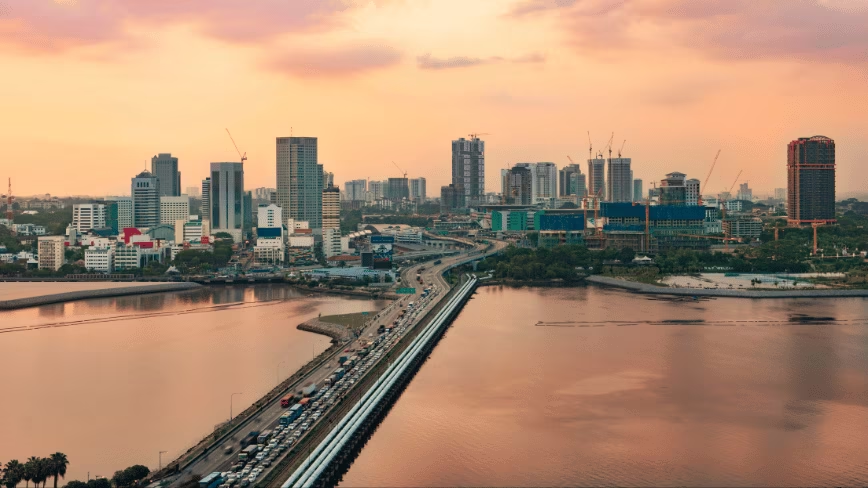
Johor Bahru is one of the biggest cities in southern Malaysia, located near Singapore.
 Credit: Kinsei-TGS via Canva / Getty Images Pro
Southeast Asia has 306 data centres running and 173 more in the pipeline, according to figures published on Tuesday. The capacity being planned is nearly four times what is already operating.
Southeast Asia data centre investment will rise from $15.72bn in 2025 to $35.08bn by 2031, according to Arizton. The Chicago research firm puts that at a compound annual growth rate of 14.32%.
What the region is forecast to hold
Arizton puts regional capacity at 1,435 MW by 2031, across 5.83 million square feet of white floor space.
Building it is expensive. Construction runs between $7m and $11m per megawatt depending on the country. Limited land, labour rates and access to power hold the figure up.
Malaysia is where the pipeline sits
Malaysia leads the region on announced capacity, with more than 6 GW of IT load planned.
Most of it is in Johor, across the strait from Singapore. As of November last year the state had around 4.0 GW of upcoming capacity.
Roughly 700 MW of that was under construction. The other 3.3 GW sat at the planned or announced stage, which means land and power are secured but nothing has been dug.
The national market is forecast to grow from $6.15bn to $11.40bn by 2031, reaching 679 MW.
The cost gap that moved the industry north
Industrial electricity in Malaysia ran between $0.06 and $0.09 per kWh in 2025. In Singapore it was $0.21 to $0.24.
Construction costs $8m to $10m per megawatt in Malaysia. The Philippines is cheaper still at $6m to $7m, the lowest in the region, with land at $120 to $200 per square metre last year.
Malaysia also offers a 100% investment tax allowance on qualifying capital spending for five to ten years. Developers can take a corporate tax rate between zero and 10% instead, through a scheme run by the country’s investment development authority.
Then Malaysia raised the price of power
New data centre tariffs took effect in July last year. They could lift energy costs by 10% to 14%, Arizton says.
Facilities drawing more than 100 MW now sit in an ultra-high voltage band and pay the highest rates. That works out at an extra $15m to $20m a year each.
Operators have been reassessing their energy options since.
The rules are aimed at greening, not closing
Malaysia is targeting 70% renewables in its power mix by 2050, through solar, hydropower and green hydrogen.
Its Corporate Green Power Programme has set aside a quota of 800 MW of solar generation. Companies buy from it through virtual power purchase agreements, data centre operators included.
Large developments require environmental impact assessments. The government also publishes green data centre guidelines.
Those rules aim to green the sector rather than shut it out, Nicholas Spiro of Lauressa Advisory argued in the South China Morning Post.
Singapore stopped growing outward
Singapore ran a moratorium on new data centres from 2019 to 2022. It has 45 operational facilities and only six upcoming.
Its forecast additions are the smallest in the region, 356,000 square feet and 89 MW by 2031. Future development will focus on efficiency and density rather than more buildings.
It is still spending. The country approved a 700 MW low-carbon data centre park on Jurong Island in October last year. That site draws on hydrogen-ready plants, battery storage, ammonia power and solar.
Thailand is the fastest riser
Thailand’s market is forecast to grow from $1.44bn to $6.28bn by 2031, a rate of 27.78%. That is the steepest in Southeast Asia.
Its pipeline passed 2.87 GW last September, which Arizton calculates at 3.7 times Indonesia’s. On planned capacity, Thailand is expected to overtake Indonesia between 2026 and 2031.
Its investment board approved four projects last November totalling around 376 MW. Building there costs $7m to $8m per megawatt.
Foreign money surged 80% in investment bids last year.
Indonesia has the Singapore overspill
Indonesia is forecast to go from $2.82bn to $6.09bn by 2031. It has 88 existing facilities and 25 upcoming, with 38 of the live ones in Jakarta.
Batam sits 20km from Singapore, which makes it a low-latency extension of the city state’s infrastructure. Oracle opened its first Indonesian cloud region there last July, leasing from an operator rather than building.
Microsoft opened its first Indonesian data centre in May last year. It said the site would add about $2.5bn to the economy and create 60,000 jobs by 2028.
Nvidia-backed Firmus is building a 360MW facility on Batam. Ooredoo put $800m into an AI cloud in the country this month.
What is pulling the demand
AI computing requirements across the region are projected to rise nearly tenfold by 2030, Arizton says. Regional data centre capacity is expected to almost triple to meet it.
Connectivity is the other driver. Singapore has 32 active submarine cables with 12 in development, Indonesia has 60 with a dozen more coming, and Malaysia has around 24 with six more due within three years.
Microsoft joined a consortium last July to build another subsea cable between India and Southeast Asia.
Water and people are the named constraints
Data centres run continuously and need large volumes of water to cool high-performance computing, according to Poh Seng Lee, a mechanical engineering professor cited in the research.
Malaysia has enough water now. Charles Santiago, who chairs the Malaysian Water Services Commission, warned that the pace of development could push demand to the point where shortages appear.
The country also lacks enough skilled staff for data centre operations, cloud and cybersecurity work.
The contrast with the United States
Jefferies has described the American backlash as a structural constraint on AI infrastructure that has widened into broader anti-AI sentiment, Spiro noted.
Nothing comparable has stopped construction in Southeast Asia. Big Tech is running a charm offensive in the United States to get sites built, while Malaysian and Thai agencies compete to approve them.
What the forecasts do not settle
The two headline capacity numbers measure different things. Arizton forecasts 1,435 MW across the region by 2031, while Malaysia alone reports more than 6 GW of announced pipeline. One is delivery, the other is intention.
Arizton does not say how much of the announced pipeline it expects to be built, or what happens to the Johor projects if power costs keep rising.
Nor does it forecast how much water the buildout will need.
Get the TNW newsletter
Get the most important tech news in your inbox each week.


