Thomas Rettenwander was writing his doctoral thesis at Austria’s Montanuniversität Leoben when he first studied dragonfly wings in detail. Not for their beauty, but for their engineering.
Dragonfly wings are a masterclass in structural minimalism: heavy fibres only where forces concentrate, a gossamer membrane everywhere else. Rettenwander spent years turning that biological blueprint into a manufacturing process.
The result is Fibionic, a Tyrolean deeptech company that has now raised €3 million to prove the idea works at an industrial scale.
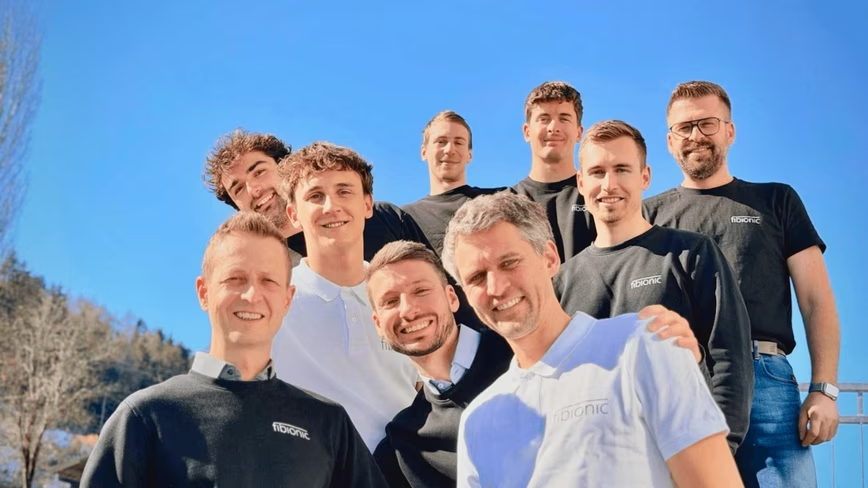
The company, based in Götzens, a village of a few thousand people perched above Innsbruck, officially launched in June 2021. Rettenwander co-founded it with Johannes Mandler, a mechatronics engineer, and the two were joined in 2024 by Elias Hirschbichler, who brought in strategic and digital expertise as a third co-founder. The team now numbers eight.
The seed round was led by Berlin-based Redstone, which has partnered with Euregio+, the cross-border Alpine venture fund, as co-lead alongside Caesar and Leap435.
A group of technology-focused business angels rounded out the consortium. Ben Scheidt, a partner at Redstone, described the ambition plainly: Fibionic should become a European player capable of making lightweight construction competitive across every major industry.
The technology at the heart of Fibionic is its patented Fibionic fibre placement process, or FFP. Rather than layering continuous sheets of carbon fibre, the conventional approach, which is wasteful and slow, the FFP system calculates exactly where reinforcement is needed along real structural load paths, and deposits fibres only there.
The process is fully automated and runs on a thermoplastic composite yarn that, when heated, fuses carbon into its final shape. Critically, the cycle time is under one minute per component.
The company says its first fully automated production machine, now operational in Götzens, can produce up to 500,000 parts a year.
The numbers matter because lightweighting has long been trapped in a cost trap. Carbon fibre parts can be extraordinarily strong, light, precise, but producing them at consumer volumes has historically required either enormous waste or enormous time.
Fibonic claims that the FFP approach reduces reinforcement material by up to 50 per cent compared with standard methods, while running 30 to 50 times faster than conventional alternatives. If those figures hold at scale, the economics of high-performance composites change substantially.
A concrete demonstration of the technology exists in the cycling world. For the 2026 season, Italian saddle-maker Selle Italia launched its SLR Racing Replica, at 109 grams, one of the lightest race saddles currently available, built around a carbon fibre skeleton developed in collaboration with fibionic.
The skeleton allows a shell just 1.5 mm thick while maintaining the stiffness demanded by professional riders. The saddle is now used across multiple WorldTour and Pro cycling teams. It is a small product; it is also proof that bionic fibre placement can meet the standards of an elite market.
The €3 million will be used to industrialise the technology further and push into new sectors. The target markets, according to Fibionic, include automotive, aerospace, robotics, and wearables, wherever strong and light components are needed in high volumes.
An external production line is planned to be operational by 2027, with licensing of the FFP technology to international partners intended to follow.
There is a quiet but notable ambition embedded in the company’s longer-term framing. The founders have said they want fibionic components to appear in everyday household products within the coming decade.
Whether that means running shoes, consumer electronics, or something not yet imagined, the point is that they are not positioning this as a luxury deeptech niche. The dragonfly, after all, does not design for the elite. It just designs efficiently.
Get the TNW newsletter
Get the most important tech news in your inbox each week.


