TL;DR
Andrej Karpathy, one of OpenAI’s original 11 co-founders, has joined Anthropic’s pre-training team. He will build a new group that uses Claude itself to accelerate the most expensive phase of frontier model development.
Karpathy will build a new team that uses Claude itself to accelerate the most expensive phase of frontier model development
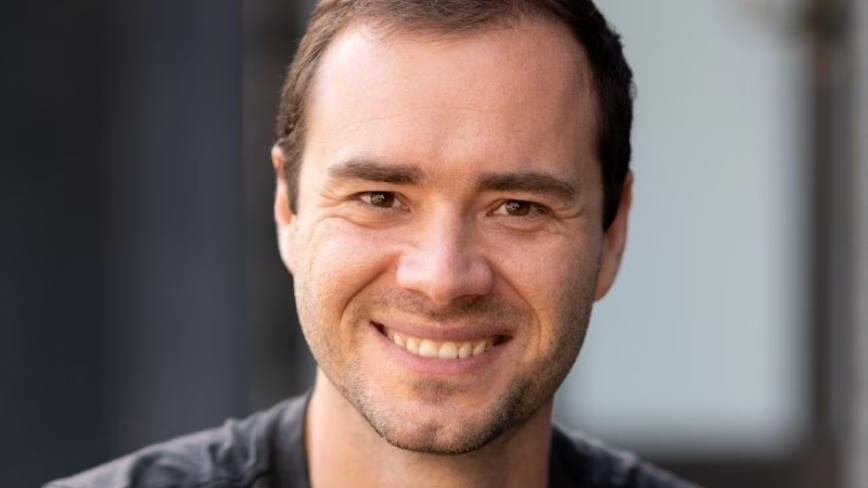
 Credit: LinkedIn
Andrej Karpathy, one of OpenAI’s original 11 co-founders, has joined Anthropic’s pre-training team. He will build a new group that uses Claude itself to accelerate the most expensive phase of frontier model development.TL;DR
Andrej Karpathy, one of the original co-founders of OpenAI and among the most recognised AI researchers in the world, announced on Monday that he has joined Anthropic. The move is a significant talent coup for the Claude maker as it races to stay at the frontier of large language model development.
Karpathy is joining Anthropic’s pre-training team, led by Nick Joseph, where he will build a brand-new group focused on a strikingly recursive goal: using Claude itself to accelerate pre-training research. Pre-training, the massive compute-intensive phase that gives a frontier model its core knowledge and capabilities, is the single most expensive part of building systems like Claude. Finding ways to make that process faster and more efficient could reshape the economics of the entire AI industry.
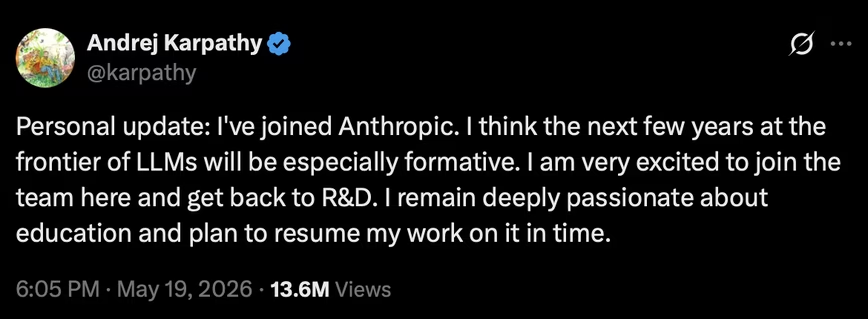
In an X post that racked up 13.6 million views, Karpathy wrote that he believes “the next few years at the frontier of LLMs will be especially formative.” He added that he remains “deeply passionate about education” and plans to resume that work in time.
The hire caps a career arc that has touched nearly every major inflection point in modern AI. Karpathy earned his PhD at Stanford under Fei-Fei Li, the computer scientist behind ImageNet, focusing on deep learning and computer vision. He was among the 11 people who co-founded OpenAI in 2015, where he worked on deep learning research before departing in 2017 to join Tesla as its director of AI.
At Tesla, Karpathy led the computer vision teams behind Full Self-Driving and Autopilot, the programmes that underpin the electric carmaker’s ambitions for autonomous vehicles. He left in July 2022, returned to OpenAI for roughly a year, then departed again in 2024 to found Eureka Labs, a startup applying AI assistants to education. Eureka Labs’ work is now paused while Karpathy throws his weight behind Anthropic.
The timing is notable. Anthropic has emerged as a magnet for top-tier technical talent at a moment when its chief rival, OpenAI, has experienced a string of high-profile departures. Over the past two years, OpenAI has lost more than a dozen senior executives and researchers, including CTO Mira Murati, reinforcement learning pioneer John Schulman, and, most recently, three executives who left on a single day in April 2026.
For Anthropic, landing Karpathy signals that the company can attract talent of the highest calibre as it scales both its research and its commercial operations. The firm, led by CEO Dario Amodei, has drawn investor interest at a valuation of roughly $800 billion and is reportedly exploring an IPO that could come as early as late 2026.
Karpathy’s new role also underscores a broader trend in frontier AI: the use of existing models to improve the next generation. If Claude can meaningfully speed up its own pre-training pipeline, it would mark a practical demonstration of recursive self-improvement, one of the capabilities the AI safety community has long watched closely. Whether that prospect excites or unnerves observers may depend on how much trust they place in the safety-minded culture Anthropic has cultivated since its founding.
For now, Karpathy appears to be exactly where he wants to be: back in the lab, building models at the frontier.
Get the most important tech news in your inbox each week.


