OpenAI adopts C2PA standard and Google’s SynthID to make AI-generated images easier to identify
The dual-layer approach pairs visible metadata with invisible watermarks, but it only covers OpenAI’s own products.
TL;DR
OpenAI is joining the C2PA open standard and partnering with Google to embed invisible SynthID watermarks in its AI-generated images. The company is also previewing a public verification tool, though the measures only apply to OpenAI’s own products and will not affect imagery from other AI tools.
OpenAI has announced two new measures designed to help the public determine whether an image was created by its AI models. The company is formally joining the Coalition for Content Provenance and Authenticity (C2PA) open standard while simultaneously partnering with Google to embed its invisible SynthID watermark across OpenAI’s image outputs.
The moves represent a meaningful step toward transparency in AI-generated imagery, though their scope remains limited to content produced by OpenAI’s own tools.
Two systems, one goal
The C2PA standard, founded in 2021 by Adobe, Arm, the BBC, Intel, Microsoft, and Truepic, attaches metadata to a file that records its origin and any edits made along the way. It has since been ratified as an ISO standard and adopted by a range of Google products, though adoption remains inconsistent across the wider industry. Because the C2PA signal sits in a file’s metadata, it is clearly accessible, which also means it can be stripped or manipulated. The standard is most reliable among trusted users and platforms that choose to preserve it.
SynthID, developed by Google DeepMind, takes a different approach. Rather than attaching readable metadata, it embeds an invisible watermark directly into the image. That watermark is designed to persist even through screenshots, resizing, compression, and other forms of digital manipulation, making it far harder for bad actors to remove.
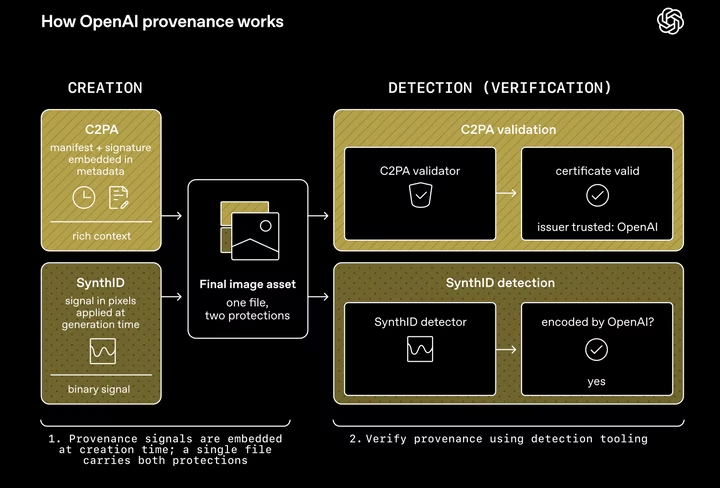
How OpenAI provenance work, source: OpenAI — Credit: OpenAI
The two systems are intended to complement each other. As OpenAI explained, watermarking offers durability through transformations such as screenshots, while metadata provides richer contextual information than a watermark alone. Together, the company argues, they create a provenance system more resilient than either layer would be independently.
A public verification tool, with caveats
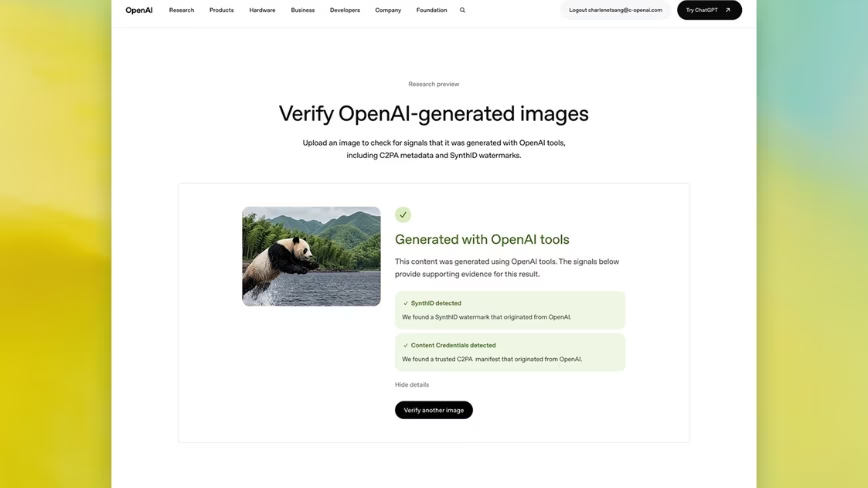
Alongside the announcement, OpenAI is previewing a public verification tool that checks for both C2PA credentials and the SynthID watermark. The tool will allow anyone to upload an image and determine whether it was generated by one of OpenAI’s models.
For now, the tool only covers images produced by OpenAI’s products, though the company has said it hopes to expand its scope over time. That is a significant limitation. The flood of AI-generated imagery circulating online comes from a vast ecosystem of tools, many of which have little incentive to adopt provenance standards. OpenAI’s new measures can help ensure the company is not contributing to the problem, but they will do nothing to address images from less scrupulous sources.
Part of a broader push
The announcement arrives amid growing concern from governments and civil society about the role of AI-generated content in misinformation and public discourse. C2PA has attracted more than 6,000 members and affiliates as of early 2026, and its specification reached version 2.1 last year. OpenAI has now joined the coalition’s steering committee, positioning it alongside Adobe, Microsoft, and other founding members in shaping the standard’s future direction.
Google, for its part, has been expanding SynthID adoption across its own products. The partnership with OpenAI marks the first time the technology will be embedded in a major rival’s outputs, a notable instance of cross-industry collaboration on AI safety and transparency.
Still, the practical impact of these measures depends on how widely they are adopted beyond the companies already at the table. Detecting AI-generated content remains a cat-and-mouse challenge, and provenance signals are only as useful as the platforms willing to check for them. OpenAI’s dual-layer approach is a sensible technical foundation, but the harder problem, getting the rest of the industry to follow suit, is one no single company can solve alone.
Get the TNW newsletter
Get the most important tech news in your inbox each week.