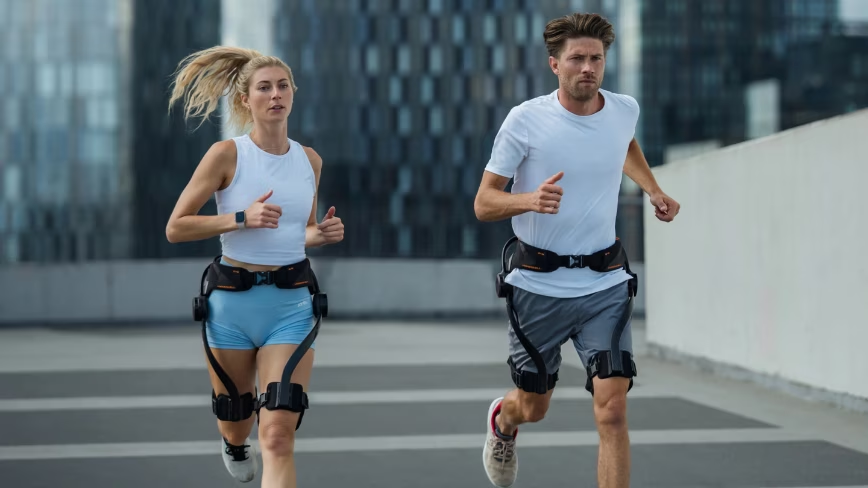
Ant Group and Meituan Dragonball co-led the $50m Series B+; Sofina and Granite Asia joined. Total Series B funding now stands at $120m at a near-$400m post-money valuation, ahead of Wednesday’s global X-Series launch.
Hypershell, the Shanghai-based consumer-exoskeleton company, has raised a $50m Series B+ co-led by Ant Group and Meituan Dragonball (referred to in the announcement as DragonBall Capital), with Sofina and Granite Asia participating. Cygnus Equity served as the exclusive financial advisor.
The round is the second tranche of a Series B series that takes the company’s total raised to $120m at a near-$400m post-money valuation, Yicai Global has separately confirmed.
What gives the round its category-defining quality is the timing. The wider B series, on Hypershell’s own disclosures, was raised inside a twelve-month window: $70m in pre-B and B rounds in November 2024, led by Luminous Ventures and 5Y Capital, then today’s $50m Series B+.
That cadence, on the cleanest read of the cap table, signals that Ant Group and Meituan Dragonball entered at the moment Hypershell’s unit economics moved from product-market-fit demonstration to volume-scaling proof point.
The company’s Hypershell X series is, on the company’s own framing, the first consumer exoskeleton ranked first on Amazon by both sales volume and market share in the US and Europe.
The product story behind the financing is the part that has been visible since 2023, when Hypershell ran the first consumer-grade exoskeleton Kickstarter and crossed $1.23m in pledges from 2,638 backers.
The first-generation device translated medical-and-industrial exoskeleton engineering into a sub-2kg consumer wearable aimed at hikers, travellers, athletes, and aged-mobility users.
Independent reviewers, including Fast Company’s gear desk, have since put the product through routine consumer scenarios with results that fit the company’s claimed 30% reduction in physical exertion and ~40% increase in effective leg strength.
The new product, the New Hypershell X Series, launches globally at 13:00 BST on Wednesday, 20 May. The headline technical claim is HyperIntuition, the company’s proprietary AI motion-control algorithm, which Hypershell describes as moving past preset gait patterns into a closed-loop perception-recognition-prediction-planning system that interprets user intent in real time.
The series is also the first end-to-end consumer exoskeleton verified by TÜV Rheinland, on Hypershell’s own framing, which the company is positioning as a regulatory-quality signal as the category moves into mass-market sales channels.
Hypershell was founded in 2021 by Kelvin Sun, the engineer behind hardware venture Lattepanda. The team is split across Beijing and Shenzhen with about 100 staff. ‘Hypershell started with a simple idea: help people go farther,’ Sun said in the announcement, citing reach into more than 70 countries since launch.
The strategic-investor mix defines what comes next. Ant Group is the consumer-data-and-payment-platform arm of Alibaba’s ecosystem; Meituan Dragonball is the early-stage venture arm of consumer-services superapp Meituan. Both bring distribution capacity, with Ant’s Alipay reach and Meituan’s logistics-and-services footprint giving Hypershell two non-obvious paths into the Chinese consumer market that hardware-led brands have historically found hardest to penetrate. Sofina and Granite Asia bring continuity from the Western retail traction the company has already built.
The competitive context is the wider Chinese robotics push that has accelerated through 2026. Barclays this week priced the macro version of the same trade, estimating that humanoid robots could offset as much as 60% of China’s projected 37-million-worker labour-force decline by 2035.
Hypershell sits a category over from the humanoid race: Unitree’s GD01 and $7bn IPO filing is the formally comparable bet on the bipedal-humanoid side, while consumer exoskeletons inhabit the augment-the-human rather than replace-the-human end of the same arc. The two product categories are competing for separate budget lines but for overlapping investor narratives.
The thing the press release does not address is the customer-satisfaction-versus-supply-curve question that has dogged the wider Chinese consumer-robotics category.
Independent surveys on the humanoid side currently put buyer satisfaction at 23% across 150-plus active manufacturers. Hypershell’s Amazon leadership claim is a meaningful data point against that pattern, but the New X Series launch on Wednesday will be the first product release the company has run with both the new capital and the new strategic-distribution partners in place. Whether Hypershell can land that launch at scale is the test the next two quarters will set up.
Get the TNW newsletter
Get the most important tech news in your inbox each week.


