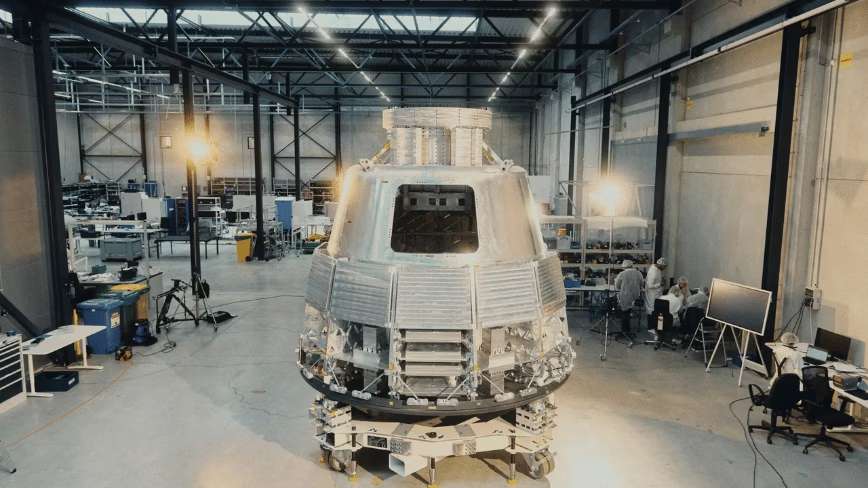

The Exploration Company has raised $450m. Most of it goes into something the company is not yet famous for.
Not Nyx, the reusable capsule that has drawn the contracts and the SpaceX comparisons. An engine.
Kate Duffy reported the round for Bloomberg. Founder and chief executive Hélène Huby told her why the balance falls that way.
“My strategy right now is to stay very focused on the rocket engine because there is no rocket without the engine,” she said. “That’s the most difficult and longest part to build.”
What Storm is
Storm burns oxygen and methane in a full-flow staged combustion cycle. That is the architecture SpaceX uses in Raptor, and one of the harder things in propulsion to make work.
The company calls it Europe’s first reusable high-thrust engine of its kind. It is meant for a future reusable heavy launcher carrying up to 40 tonnes to low Earth orbit.
Huby told Bloomberg the engine has been in development for three years. The money funds testing from the end of this year through 2028.
The near-term steps are modest, and the company says so. Pre-burner tests with a subscale thrust chamber come first, in the next few months. Then an oxygen-rich power pack. Then a full workhorse engine, some years after that.
Nothing has fired yet.
The launcher it is for has not been ordered
This is the part worth sitting with.
Europe has exactly one heavy-lift vehicle. Ariane 6, built by the Airbus and Safran joint venture ArianeGroup.
Huby told Bloomberg she expects the European Space Agency to open a competition for next-generation designs by the end of the decade.
Expects. ESA has announced no such competition.
The programme that does exist targets small and medium launchers. It is the European Launcher Challenge, and ESA started signing those contracts in August. Isar Aerospace took the largest at close to €200m, shortly before it reached orbit on its second flight. The programme names heavy-lift only as a future ambition.
So TEC is funding an engine for a vehicle Europe has not committed to. The bet rests on a procurement nobody has opened. Given how long engines take, that is defensible. It is still a bet.
Its closest competitor is European
The SpaceX framing travels well, and it obscures something.
ArianeGroup has been building Prometheus, an ESA-backed reusable engine that also burns oxygen and methane. It has been hot-firing on a test stand since 2022. ArianeGroup wants it equipping European launchers by 2030.
Storm would put TEC in the same territory. Several years behind on hardware, and considerably ahead on capital.
Two European teams are building the same class of engine for the same undefined vehicle. That is either healthy competition or duplicated effort. Which one depends entirely on whether ESA ever runs the contest Huby is anticipating.
It closed well above what it was seeking
We covered the negotiation. In July we reported the company in talks to raise $300m, a figure the Financial Times had reported first. We said plainly that nothing was locked in and the deal could still collapse.
It closed at $450m. Bessemer Venture Partners, Atomico and the Scaleup Europe Fund co-led, with Balderton, Plural, Cherry and Red River West returning. Bessemer’s Alex Ferrara joins the board. Total raised since 2021 is around $680m.
Three numbers we cannot check
Nobody disclosed a valuation. Not the company, and not any outlet covering the close.
When the Financial Times reported the talks in July, the round was said to be shaping up above $2bn. That is a talks-stage figure, not a post-money number, and it should not travel as one.
The company says it holds more than $2bn in contracts and commitments. In July we reported a backlog of about $770m. The word commitments is doing unmeasured work in that gap. Nobody has published the split between binding contracts and expressions of intent.
TEC also claims two records. Largest Series C ever raised by a European space company, and largest round ever by an EU-headquartered company led by a female founder and chief executive. Both come from the announcement. Neither is independently verifiable, and the second turns on definitions, since EU-headquartered excludes the United Kingdom and Switzerland.
The politics are not hidden, and that is the interesting part
The Scaleup Europe Fund is a €5bn EU vehicle. The European Commission handed EQT the job of managing it in May.
It has now backed Mistral, TEC, and Lovable at $13.3bn, where we noted at the time that the EU had effectively become a shareholder.
Emmanuel Macron and Ursula von der Leyen both commented on the record. Macron called the company an inspiration for European space firms. Von der Leyen cited the fund by name, and the significance of women’s leadership in technology.
The timing is tight. The International Space Summit opens in Paris tomorrow. The French government lists Huby, alongside the astronaut Thomas Pesquet, as one of the president’s two special envoys to it.
So an official envoy of the summit announced a round part-funded by an EU vehicle the day before it opened. The heads of the French state and the European Commission then praised her by name.
Nothing in that is improper, and we are not suggesting otherwise. It is what European industrial policy looks like when it runs in the open. It is worth naming rather than reading as a straightforward venture round. The same summit is the one four American firms skipped under White House pressure last week.
The number in context
Europe’s largest space round landed on the same day Stoke Space, in Washington state, raised $1bn for a rocket that has never flown.
That is the gap in one line. TEC now holds more money than any European space company has raised at this stage. It is also less than half what one American competitor raised on a Tuesday.
What to watch
Whether ESA opens a heavy-lift competition, and when. The engine is worth whatever the vehicle programme turns out to be.
Whether Storm fires. Pre-burner and subscale chamber tests fall due in the coming months, which is soon enough to check.
And whether Nyx reaches the International Space Station and comes back. No European company has done it. TEC expects the demonstration flight in 2028. That is the thing that would turn a well-funded ambition into a capability.
Get the TNW newsletter
Get the most important tech news in your inbox each week.


