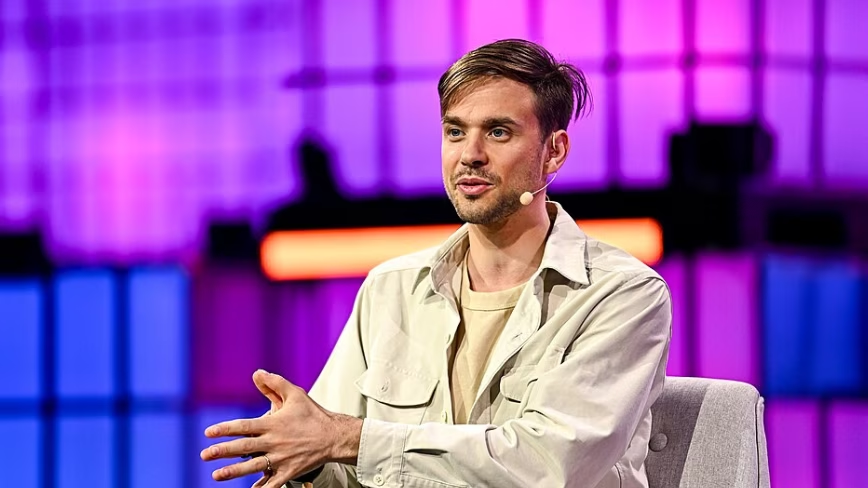
Anton Osika, Lovable’s chief executive and co-founder
 Credit: Web Summit
Lovable has raised $400m at a $13.3bn valuation. The Stockholm company lets people build software by describing it in ordinary language, and it is now one of Europe’s most valuable startups.
Eight months ago it raised $300m at $6.6bn. The valuation has more than doubled since December, and the round was first reported by the Wall Street Journal on Wednesday.
The final figure beat the rumour. Reports last week had Lovable in talks for $300m at $13.2bn, and it closed $100m above that.
Menlo Ventures co-led the round, with Balderton Capital among the backers joining, and Lovable published the details itself. The other co-lead is the Scaleup Europe Fund, and that is the part worth slowing down for.
The European Commission is now a shareholder
The Scaleup Europe Fund is an EU investment vehicle, managed by the Swedish asset manager EQT. Bloomberg reports Lovable is one of its first disclosed investments, out of a pot worth €5bn.
Brussels is not doing this for the returns alone. The fund exists because European startups keep growing up and then leaving.
EQT partner Victor Englesson put the fear plainly. If companies like Lovable end up backed mostly by American investors, he said, the shift towards “relocating headquarters or listing” in America becomes powerful.
That is not hypothetical. Nscale, built in Britain, is preparing a US listing rather than a European one.
Anton Osika, Lovable’s chief executive, has said before that Europe has a confidence problem rather than a talent problem. The Commission has now put money behind that argument.
Balderton Capital, another backer in the round, puts the affirmative case. Its general partner Daniel Waterhouse has known Osika since the early days of GPT Engineer, the project Lovable grew out of.
“Lovable is evidence that the most important AI companies can be built right here in Europe,” he said.
The numbers behind the price
Revenue is the reason anyone is paying $13.3bn. The company is on track for a run rate close to $600m by the end of this month. That is nearly triple what it disclosed in December.
Lovable was profitable before this. It is now spending instead, on product and growth.
The reach figures are larger than the company itself. Co-founder Fabian Hedin says more than 60 million projects have been built on the platform, with 1.2 million new ones every week.
“Over 900 million monthly visits to what people build,” Hedin wrote. “That’s an order of magnitude more than the reach of lovable itself.”
Three years, two failed launches
Hedin wrote the first line of Lovable’s code three years ago, on his birthday. The company then failed to launch its product twice.
“The third time, something clicked,” he wrote. Within a year it had reached employees at half of the Fortune 500.
Osika frames the ambition as infrastructure rather than software. Lovable is building “the business that helps build businesses”, he wrote. Both founders signed off with the same line: it is still day zero.
Waterhouse reads the opportunity the same way. The first chapter was letting people who cannot code build software, and the bigger prize is “what happens when those millions of users need to run the businesses they’ve built”.
The money goes on headcount and reliability. Lovable plans to grow its workforce by 50% to 450 people this year, expand in Latin America, and add security features.
The customers are the argument
The client list does the persuading. Nvidia uses Lovable to build internal tools that help team leaders track projects, and Adidas, Hearst and Deutsche Telekom are also customers.
Zendesk uses it too, which is where this gets awkward. Zendesk sells the kind of business software that tools like Lovable are supposed to make redundant.
Investors have a word for that risk, and Atlassian spent a quarter batting it away. The SaaSpocalypse thesis says in-house AI apps eventually eat the software industry that sells them.
Zendesk is relaxed. Its senior product director Jorge Luthe said Lovable “can’t provide the level of reliability at scale” needed to handle customer requests across channels.
The part the round does not fix
Lovable’s weak spot is not growth. It is what the generated code actually does once it is live, and the company has been caught out on this before.
Its answer so far has been to buy certification and an insurance policy from Lloyd’s. Osika now promises “secured code by default” on the platform itself.
He also committed to staying model-independent, routing between whichever models suit a task. That keeps Lovable from being hostage to one lab, which matters when the labs are also competitors.
Everyone is coming for this
Coding is the one generative AI product businesses reliably pay for, so everyone is building one. Anthropic’s Claude Code pulled OpenAI and Google in behind it.
The valuations show the pressure. Replit hit $9bn in March, triple its level six months earlier, and Musk’s SpaceX bought Lovable’s rival Cursor for $60bn in June.
Menlo partner Matt Murphy signalled conviction with size. Lovable will be the firm’s largest single investment after Anthropic, which he called “a testament to how bullish we are on Lovable’s outlook”.
Tencent is on the cap table as well, alongside Balderton Capital and World Innovation Lab. So a Chinese internet giant and the European Commission are now funding the same Swedish startup. That tells you how badly everyone wants a position here.
The real test is not the valuation. It is whether Brussels writing cheques actually keeps a company like this in Europe, or simply makes it more attractive to buy.
Get the TNW newsletter
Get the most important tech news in your inbox each week.


