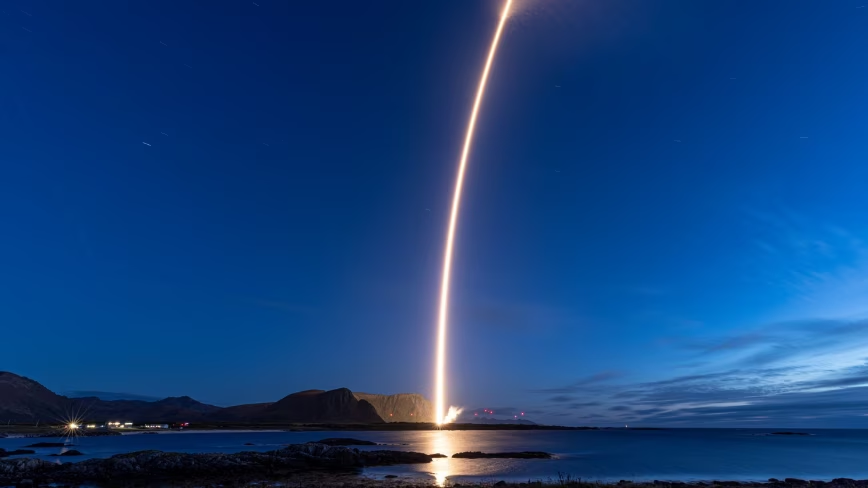
Isar Aerospace’s Spectrum rocket takes off from the Andøya Spaceport
 Credit: Isar Aerospace
Isar Aerospace’s Spectrum rocket reached orbit and deployed satellites from Andoya in northern Norway on Saturday night, the first commercial European company to do so and on only its second flight. It lands four days before Macron’s Paris space summit, which SpaceX and Blue Origin withdrew from last week.
Isar Aerospace’s Spectrum rocket reached orbit and deployed satellites after lifting from Andoya in northern Norway on Saturday night. The German company says it is the first commercial space firm in Europe to put satellites into orbit, and it did so on its second flight.
The rocket left the pad at 22:12 CEST, on a mission the company called Onward and Upward.
It reached orbit about four minutes later, in what Bloomberg reported as the first private space mission to reach orbit from continental Europe.
The first attempt, in March last year, lasted roughly 30 seconds before crashing. This year’s tries were held up by weather, technical faults and a boat straying into the range.
The payloads came from educational institutions and start-ups picked through the German Space Agency’s Microlauncher Competition, funded by an ESA programme. They were competition winners rather than paying customers.
“Today, Isar Aerospace opened space from Continental Europe,” chief executive Daniel Metzler said. He added that launch remains the largest bottleneck for the global space industry.
The timing is the part nobody planned, and it is the part Brussels will notice.
Macron’s international space summit opens in Paris on Wednesday, four days later, and four American companies withdrew last week under White House pressure. SpaceX and Blue Origin were two of them.
The summit’s theme is European sovereignty in space. Andoya, meanwhile, opened last year as continental Europe’s first spaceport for orbital launches.
Spectrum is 28 metres tall and lifts 1,000 kilograms to low Earth orbit, a fraction of a Falcon 9. Metzler argues the smaller size helps place satellites in specific orbits rather than competing on bulk.
The money has followed. Isar closed a EUR 270M round this year and signed a roughly EUR 200M contract with the European Space Agency in August under the European Launcher Challenge.
Defence customers now account for about 60% of orders at a company that began with civilian launches. A factory near Munich is meant to build up to 40 rockets a year, and the manifest is full to 2028.
Europe already had sovereign access to space, through Ariane 6 from French Guiana. What it did not have until Saturday was a commercial rocket reaching orbit from European soil, and five companies are competing to do it repeatedly.
Get the TNW newsletter
Get the most important tech news in your inbox each week.


