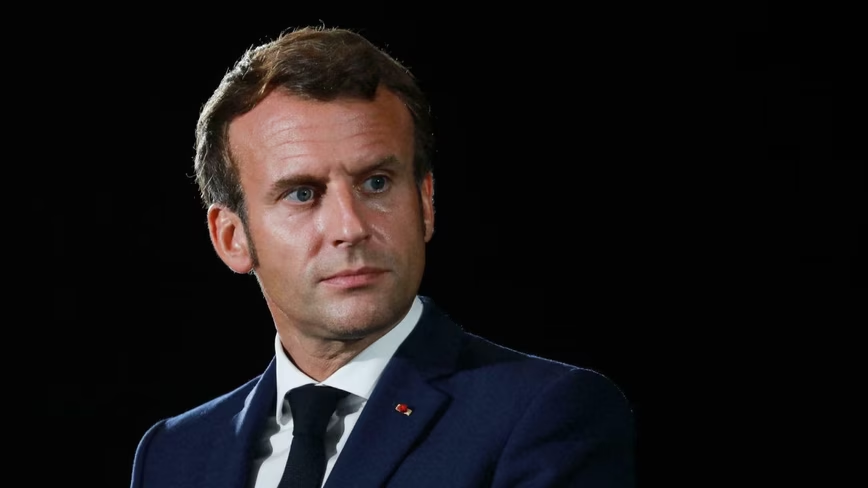
Portrait of French president Emmanuel Macron.

SpaceX, Blue Origin, Stoke Space and Starcloud pulled out of Macron’s Paris space summit after White House pressure, though several are expected back in the city days later for World Space Business Week. Organisers describe the event as behind schedule and unclear in purpose, while Washington lobbies against the EU Space Act.
Four American space companies pulled out of Emmanuel Macron’s Paris space summit after pressure from the White House. SpaceX, Blue Origin, Stoke Space and Starcloud told French authorities on Thursday, Politico reported.
The summit runs on 9 and 10 September. About 120 international delegations have been invited, and Chinese officials are expected to attend.
The boycott is not the summit’s biggest problem. Six people with first-hand knowledge of the organisation told Politico it is behind schedule, poorly coordinated with Europe’s main space players and unclear in purpose.
One called it the worst Macron-organised summit they had seen. Invitations went out over the summer and some were still being sent on Friday, while negotiations on the final declarations had already started.
The adviser running the summit for Macron left her job a month before it. A briefing at the Elysee in late August left many questions unanswered, space officials said.
The Elysee is unbothered in public. “If certain countries or actors don’t want to participate, in a way, that’s their loss,” an official told reporters.
One detail undercuts the drama. The same companies are expected back in Paris a week later for World Space Business Week, where Starlink and Blue Origin are still on the list.
So the boycott is aimed at a summit rather than at the French market, and the companies skipping Wednesday will be selling on the following Tuesday.
The substance sits elsewhere. Washington has lobbied against the EU Space Act, proposed by the Commission in June 2025 and still working through Parliament and Council.
It would apply to any operator serving users in the EU regardless of where it is established, require prior authorisation and an EU legal representative, and impose debris mitigation and cybersecurity duties.
The second fight is spectrum. A Franco-German push to allocate more satellite frequencies to European companies, including Europe’s own network IRIS2, cuts directly against Starlink.
Both concern access to limited resources rather than who attends a conference. The summit should produce declarations on data sharing, frequency allocation and space debris, and nobody has said who will sign them.
A satellite chief executive told Politico that orbit and spectrum are the resources at stake, and that SpaceX has a policy of complete dominance over both. Europe’s answer has been to legislate, to launch, and to remind Washington it cannot reach the moon without European hardware.
Get the TNW newsletter
Get the most important tech news in your inbox each week.


