

Apple’s March announcements arrived the way Apple increasingly prefers to move now: not as a single theatrical keynote, but as a controlled release of pressure across the product line. The headline items, a $599 MacBook Neo, a $599 iPhone 17e, and a refreshed iPad Air with an M4 chip, and a new MacBook Air with M5 chip, read at first like tidy maintenance.
The more interesting story is what that pricing symmetry is doing. Apple is building a wider front door into its ecosystem while doubling down on the vertical integration that makes leaving harder.
MacBook Neo (from $599)
But the MacBook Neo is the clearest signal, and also the cleanest piece of Apple theatre this week. At $599, Apple is “entering the budget market” in the same way a luxury hotel enters backpacking, by opening a smaller side door and charging you for the towel. Most of us looked at this as Apple entering Chromebook territory on price while refusing to play by Chromebook expectations: cheap, repairable, expandable, disposable.
- Chip: A18 Pro
- Display: 13-inch, 2408×1506 (Liquid Retina per Apple, resolution per The Verge)
- Memory: 8GB RAM (non-upgradable)
- Storage: 256GB or 512GB
- Ports: 2× USB-C + 3.5mm headphone jack (no Thunderbolt, no MagSafe)
- Camera: 1080p
- Notable caveat: Touch ID reportedly omitted on the 256GB base model
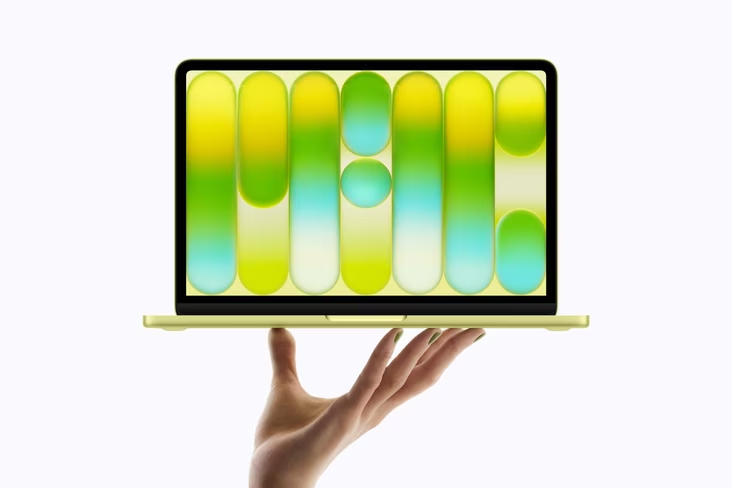
Apple, meanwhile, is selling the vibe: aluminum, battery life, “Apple Intelligence,” and a palette that suggests the machine is less a computer than a lifestyle object that happens to boot. Look closely, and the Neo is not so much “affordable” as carefully rationed; 8GB of RAM, limited ports (two USB-C), and other cost controls that Apple will describe as “minimalist” until you try to plug in literally anything.
The point is not to make a cheap Mac. It is to make a Mac that is cheap enough to get you in, and constrained enough to make you leave the entry tier as soon as you start doing anything remotely serious. Then there’s the strategic tell inside: the Neo runs on an A18 Pro, a chip class that lives in iPhones, not Macs. On paper, this is elegant: one architecture, one supply chain logic, one developer story.

MacBook Neo delivers up to 16 hours of battery life on a single charge. Source: Apple.
In practice, it also reads like Apple’s quiet attempt to redefine what “a Mac” means at the bottom end: less the open-ended personal computer and more a tightly managed appliance that happens to have a desktop. The efficiency story is real, but so is the subtext.
If the entry Mac inherits the iPhone’s silicon lineage, it can also inherit the iPhone’s idea of limits, what you can do, for how long, and under what conditions. Public information remains limited on independent benchmarks and sustained workloads, making the intent easier to see than the performance.
Honestly, the question isn’t whether the $599 MacBook is “good.” It’s why Apple suddenly wants a $599 MacBook at all. The answer looks like a funnel problem dressed as generosity. Apple’s premium positioning has held, but consumer electronics has been price-sensitive for years, and Apple’s real growth engine is not the first sale; it’s the long tail: services, accessories, upgrades, and the gentle psychological engineering of an ecosystem that’s always one purchase away from feeling “complete.”
The Neo fits that architecture perfectly. Limited ports push you toward dongles and hubs, the small but reliable Apple toll booth.
A low sticker price, paired with compromises that many users will outgrow quickly, nudges buyers up the ladder, ideally before they’ve had time to notice. It’s not a broadening of capability. It’s a re-pricing of the perimeter, with just enough friction to make the next, more expensive machine feel like relief.
iPhone 17e (from $599)
The iPhone 17e fits neatly into that pattern. Apple describes it as “a more affordable addition” to the iPhone 17 lineup, starting at $599 with 256GB base storage, and featuring the A19 chip and an Apple-designed C1X modem. It also brings MagSafe back into the budget tier, a small detail with large economic consequences because MagSafe is an accessories ecosystem as much as it is a charging method.
- Chip: A19
- Modem: Apple C1X cellular modem
- Camera: 48MP main camera (Apple + third-party roundups align on 48MP)
- Display size: 6.1-inch (reported by MacRumors roundup)
- Charging/accessories: MagSafe support; USB-C connector listed in Apple specs
- Base storage: 256GB starting storage
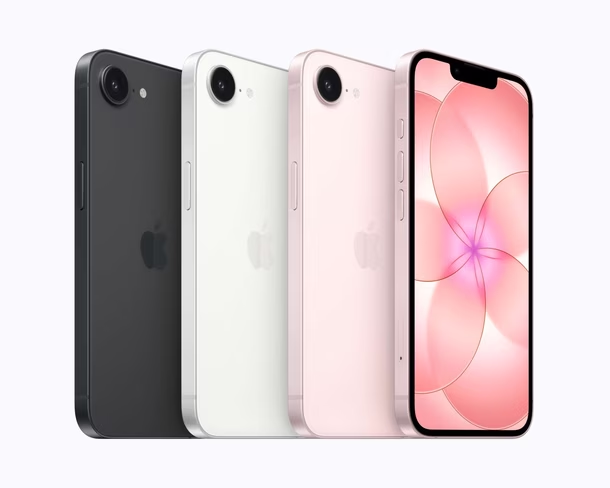
iPhone 17e delivers powerful features at an incredible value, including Apple’s latest-generation A19,
a 48MP 2-in-1 camera system, storage starting at 256GB, and the magic of MagSafe. Source: Apple.
Put the Neo next to the 17e, and you can see Apple building a matched set for the mass market: phone and laptop at the same psychological price point, arriving the same week, shipping the same day. That is not an accident. It is a bet that the next wave of Apple customers will come less from convincing someone to pay more, and more from making it easier to start paying at all.
Then comes the second layer: once you are in, Apple wants the stack to feel seamless, and increasingly, AI-shaped.
Across the week, Apple repeatedly frames new hardware as “better for AI” or “on-device AI,” whether that is the iPad Air with M4 and more memory, or the MacBook Air and MacBook Pro moving to M5-class chips with “expanded AI capabilities.” Apple is not alone in leaning on AI language, but Apple’s version matters because it is tied to silicon choices that competitors cannot easily replicate.
In the iPad Air press release, Apple highlights higher memory bandwidth, 50 percent more unified system memory than the previous model, and new connectivity chips, naming N1 and C1X, alongside Wi-Fi 7 support.
iPad Air (M4)
- Chip: M4
- Wireless (all models): N1 chip with Wi-Fi 7, Bluetooth 6, and Thread
- Cellular (Wi-Fi + Cellular models): Apple C1X modem; 5G (sub-6) support
In the MacBook Air release, Apple makes a similar point: M5 includes a Neural Accelerator in each core and the N1 wireless chip for Wi-Fi 7 and Bluetooth 6. On the Pro side, Apple’s messaging is even more explicit: M5 Pro and M5 Max are “engineered from the ground up for AI,” with Apple claiming large AI performance gains versus prior generations.
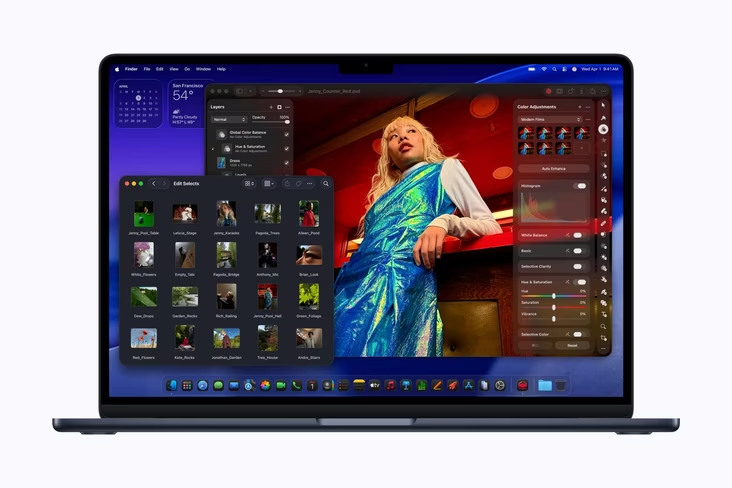
Source: Apple
MacBook Air (M5) (from $1,099)
- Chip: M5
- Wireless: Wi-Fi 7 + Bluetooth 6 (via Apple’s N1 wireless chip)
- Camera: 12MP Center Stage
- Ports: Two Thunderbolt 4 ports (per Macworld summary; Apple’s newsroom highlights Wi-Fi 7/Bluetooth 6 and storage)
- Storage (base): 512GB starting storage; configurable higher
There is a cautious way to read this, and then there is a more structural way.
The cautious read is that “AI” is the new “Retina,” a term that must appear, regardless of whether buyers asked for it. Apple’s performance claims are largely comparative and come from Apple; public information is limited on independent, real-world benchmarks immediately at launch.
The structural read is that Apple is turning AI into a justification for a familiar play: tighter coupling between custom silicon, operating systems, and first-party features. If AI is going to run locally, you need memory bandwidth, power efficiency, and system-level integration. Apple has spent a decade positioning itself as the company best placed to deliver that integration at consumer scale. This week’s hardware is an argument that the integration is now also a cost strategy.
For developers, the implications are less philosophical. A cheaper Mac expands the addressable market for macOS development, especially among students and first-time builders. But it also raises practical questions about performance tiers and expectations.
If Apple succeeds in pushing Macs into education and entry-level consumer segments, developers may have to care more about the lower bound of the Mac experience again, something the M-series era had, for a moment, allowed many teams to forget.
There is also a platform message in the timing. Apple did not announce “one AI product.” It refreshed the devices that define its installed base. That suggests Apple’s AI strategy is less about winning the model race headline by headline, and more about making AI a default layer across iOS 26, iPadOS 26, and macOS Tahoe, tied to hardware Apple can sell profitably at multiple price points.
In other words, Apple appears to be treating AI as infrastructure, not a feature.
This is where Apple’s position in the global landscape sharpens. In the US, the AI conversation is dominated by cloud-scale labs and the companies financing them. In China, it is inseparable from industrial policy.
In Europe, it is increasingly entangled with regulation, data governance, and enterprise adoption constraints. Apple’s route runs through a different chokepoint: devices, distribution, and the operating system layer that decides what is possible and what is permissible.
A $599 MacBook and a $599 iPhone are not “cheap.” They are strategically priced admissions tickets to a controlled environment. For Apple, that environment is now being renovated to look like the future of consumer AI: more local, more private by design in its marketing, and more dependent on Apple’s silicon roadmap.
Whether Apple can maintain that balance, widening the funnel without diluting the brand, will be tested in the unglamorous places that matter: schools deciding what to deploy, small businesses choosing standard hardware, developers deciding which edge devices to prioritise, and regulators scrutinising how AI features intersect with competition and platform control.
But the week’s message is already clear. Apple is not just selling new devices. It is trying to re-price the perimeter of its ecosystem, and, at the same time, make the centre of it even harder to copy.
Get the TNW newsletter
Get the most important tech news in your inbox each week.
Also tagged with


