

Apple Inc. has introduced a new MacBook Air powered by its latest in-house processor, the M5 chip, continuing the company’s steady annual cadence of silicon upgrades.
The refresh brings Apple’s newest system-on-chip architecture to its mainstream laptop line in 13-inch and 15-inch configurations. Base storage now starts at 512 GB, configurable up to 4 TB for the first time on the Air.
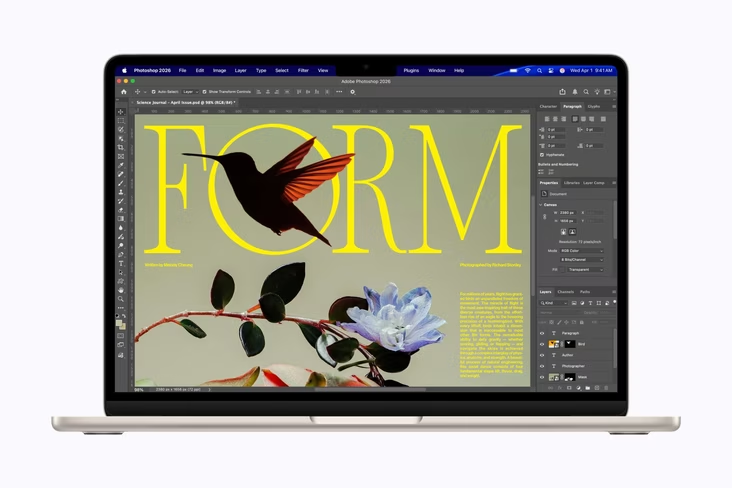
M5 brings exceptional performance and expanded AI capabilities to MacBook Air, the world’s most popular laptop. Source: Apple
A more capable M-series architecture
The M5 integrates a 10-core CPU and up to a 10-core GPU. Apple says the chip includes its fastest performance core to date and places a Neural Accelerator in each core, expanding parallel AI execution across the system.
The GPU introduces improved shader cores and a third-generation hardware ray-tracing engine, targeting 3D rendering and graphics workloads previously associated more with Pro-class devices.
Memory bandwidth reaches 153 GB/s, a reported 28% increase over M4. As with previous Apple Silicon designs, M5 uses a unified memory architecture, allowing CPU, GPU, and neural components to access the same memory pool.
This reduces latency compared to discrete GPU systems and can improve efficiency in mixed workloads such as image processing or machine learning inference.
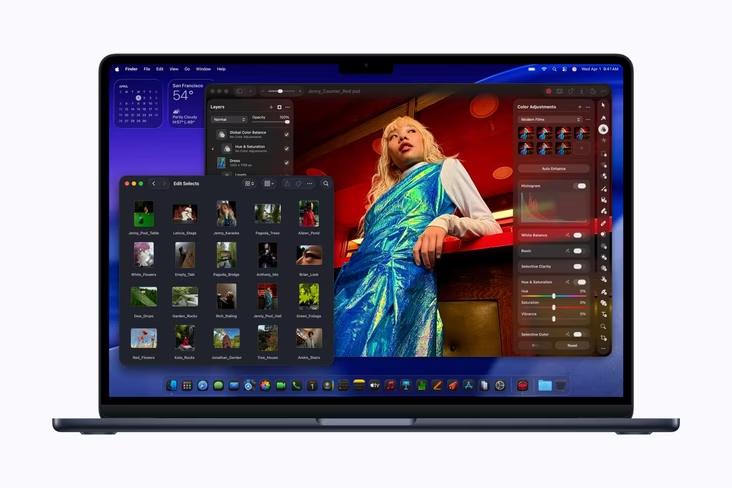
MacBook Air now comes standard with 512GB of storage and a new SSD that delivers 2x faster read/write performance, significantly accelerating file access and speeding up workflows. Source: Apple
Apple cites the following internal performance comparisons:
- Up to 4x faster AI tasks versus M4-based MacBook Air
- Up to 9.5x faster AI tasks compared with M1-based Air
- Up to 6.5x faster 3D ray-tracing performance in Blender versus M1
- Up to 6.9x faster AI video enhancement in Topaz Video versus M1
These figures are derived from Apple’s own testing. Independent benchmarks validating these claims are not yet broadly available.
Storage, connectivity, and I/O
The new Air includes a redesigned SSD delivering up to 2x faster read/write speeds compared with the prior generation, according to Apple. Faster storage can have a measurable effect on large file transfers, creative asset imports, and local AI model execution.
Connectivity upgrades include Apple’s new N1 wireless chip, adding Wi-Fi 7 and Bluetooth 6 support. The device retains two Thunderbolt 4 ports and supports up to two external displays.
The Liquid Retina display remains at 13.6 inches or 15.3 inches, with 500 nits of brightness and support for one billion colours. Battery life is rated at up to 18 hours. The design remains fanless and unchanged from the previous generation.
Pre-orders opened March 4, with availability beginning March 11.
US pricing starts at $1,099 for the 13-inch model and $1,299 for the 15-inch.
The design language and core feature set largely carry over from the previous MacBook Air generation; there is no indication of a major industrial redesign. Industry reporting ahead of the launch projected that the new Air would remain similar in form factor and focus on internal upgrades.
For European founders and investors, the updated Air underscores Apple’s ongoing strategy to push proprietary silicon across its product lineup while maintaining a clear segmentation between consumer and professional tiers.
The Air remains positioned as a mainstream laptop with broad appeal rather than a tool for high-end compute workloads.
The inclusion of more storage and modern wireless standards reflects incremental adaptation to shifting use cases such as hybrid work and on-device AI tasks.
The way Apple rolled out these announcements is also notable. Rather than a single event anchored in Cupertino, the company staged a series of product reveals over several days, including an updated iPad Air and other hardware news unrelated to the Mac line.
This suggests a more distributed communications strategy, perhaps intended to sustain media and consumer engagement over a longer period.
From a competitive standpoint, the MacBook Air with M5 does not on its own shift the dynamics between Apple and the wider PC market. Windows-based laptops have been emphasising discrete accelerators and specialised AI hardware in recent quarters, particularly at higher price points.
Apple’s unified architecture, combining CPU, GPU and Neural Engine, delivers energy efficiency and integration benefits, yet independent comparisons on metrics that matter to developers and power users remain sparse.
Those comparisons will matter for buyers who weigh Air upgrades against rival Ultrabooks and AI-capable notebooks in similar price bands. Public data on these comparative performance vectors is limited at the time of writing.
Get the TNW newsletter
Get the most important tech news in your inbox each week.
Also tagged with


