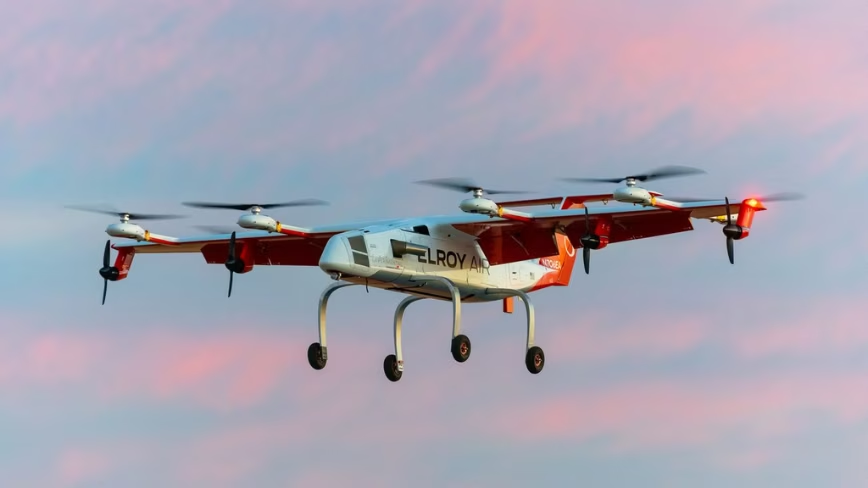
The maker of the autonomous Chaparral is in advanced talks to go public through a blank-cheque merger valuing the combined company at about $1bn.
The SPAC, declared dead more than once over the past few years, keeps finding new uses, and the latest is a cargo drone.
Elroy Air, a California startup that wants to replace some delivery trucks with autonomous aircraft, is in advanced talks to go public through a merger with a blank-cheque vehicle.
The deal would create a company with an enterprise value of about $1bn, and could be announced as soon as that day.
The counterparty is Columbus Circle Capital Corp. II, a special-purpose acquisition company led and backed by the management team of Inflection Point Asset Management.
The raise associated with the transaction is around $800m though the precise structure had not been disclosed at the time the talks were described.
Elroy Air’s product is the part that explains the interest. Founded in 2017 by David Merrill and Clint Cope, the company builds the Chaparral, a hybrid-electric drone with vertical take-off and landing designed for what logistics firms call middle-mile delivery.
The aircraft is built to carry 300 pounds of cargo autonomously over 300 miles, the gap between a distribution hub and a local depot that is too far for a van to serve cheaply and too short for a conventional aircraft.
It is a heavier-payload cousin of the grocery and parcel drones now flying commercially in Europe.
The order book gives the valuation something to lean on. Elroy Air says it holds a backlog of roughly 1,500 preorders from customers including FedEx and Bristow Group, alongside active contracts and interest from US and allied military forces.
In January 2026 it signed a $200m joint venture with Abu Dhabi’s Barq Group to manufacture the Chaparral, with commercial deployment targeted for this year.
The defence angle has grown more prominent. Elroy Air was selected earlier this year to provide autonomous aerial cargo delivery as part of a new White House programme, and active interest from US and allied militaries sits alongside the commercial backlog.
Autonomous logistics in contested or hard-to-reach environments is a use case militaries have been keen to develop, much as Europe’s first licensed cargo drone has edged toward operation, and a drone built to carry 300 pounds without a pilot fits that brief as readily as it fits middle-mile parcel delivery.
Taking a pre-revenue or early-revenue hardware company public through a merger with a blank-cheque vehicle lets it raise capital and gain a listing without the scrutiny of a traditional IPO roadshow, which is precisely why such deals proliferated, and then fell out of favour, among capital-hungry aerospace and mobility startups.
The wider drone-delivery industry has spent a decade promising deployment that mostly stayed just over the horizon.
Elroy Air’s manufacturing ambitions are expensive, and a public listing is one way to fund the build-out toward the deployment it has been promising.
Preorders are not revenue, and a target of commercial deployment in 2026 is a target rather than a delivery. The deal, as described, was still in talks and not yet signed, and the terms could shift before any announcement.
What is on the table is a roughly $1bn valuation for a company whose aircraft is moving toward deployment but not yet there, taken public by a vehicle whose own backers are making the bet. The next signal is whether the deal is announced on schedule, or slips.
Get the TNW newsletter
Get the most important tech news in your inbox each week.


